by Professor Gene Wengert
Editor's note: The following article is an excerpt from the book "The Wood Doctor's Rx," by Gene Wengert, Professor and Extension Specialist in Wood Processing, Department of Forestry, University of Wisconsin-Madison.
Interest in the abrasive planing of wood has been increasing the past few years, especially with an abrasive planer winning the Challenger Award in 1982 at the Louisville Fair. The abrasive planer is an extremely robust belt sander that uses an abrasive to remove the excess thickness of lumber. Many advantages are possible with the abrasive planer when compared to the knife planer (but not all are important in furniture manufacturing):
- Most machining defects around knots are eliminated (important mostly for knotty styles, as most knots are cut out in traditional styles).
- Belt is changed in minutes rather than knife sharpening in hours.
- Close thickness tolerance is possible (but also true for new knife planers).
- High feed speeds are possible (particularly important for softwood construction lumber).
- Less noise is produced (although newer planers are quieter, too).
- Little change is required for different species.
- Less stock need to be removed to obtain an acceptable surface.
There are a few disadvantages to abrasive planing:
- Belts must be handled and stored with care, usually in controlled RH conditions.
- Power consumption is quite high. (For example, a 24 in. wide abrasive planer may require 250 hp.)
We will examine two points concerning abrasive planing that would be of concern to the furniture industry: gluing of abrasive planed lumber, and potential yield benefits of an abrasive planer.
Gluing of Abrasive Planed Lumber
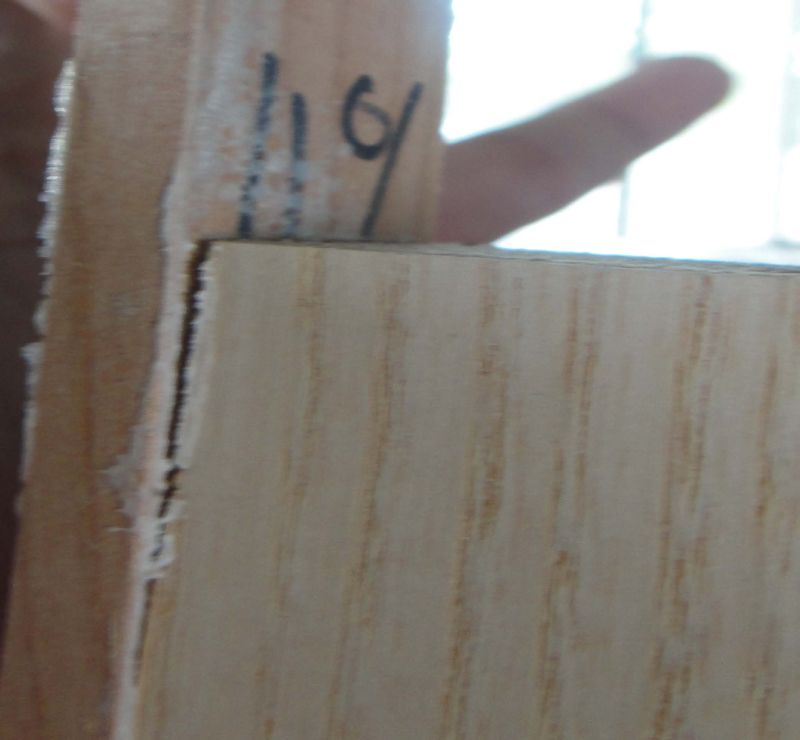
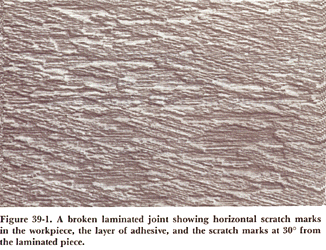
The American Institute of Timber Construction, an industry agency concerned with quality in laminated beams, noted more checking in and near glue joints made with abrasive planed lumber than from knife planed lumber when the joints were exposed to accelerated aging. This was only a preliminary study, so further testing was done. Additionally, in recent months, two furniture companies forwarded samples of glue-line failure problems from abrasive planed lumber to me for analysis (Figure 39-1).
To understand why there could be problems with abrasive planed lumber in gluing, we must analyze the basics. Abrasive planing removes material from wood by scraping. In this process, fibers near the surface, it was discovered by the U.S. Forest Products Laboratory, were crushed and weakened. This phenomenon has been called "sub-surface damage" (Figure 39-2).
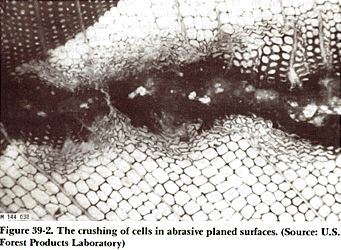
In addition to the crushing and distortion of these cells, they also are apparently less tightly attached to the rest of the wood. A comparison of typical surfaces, knife-planed (Figure 39-3)
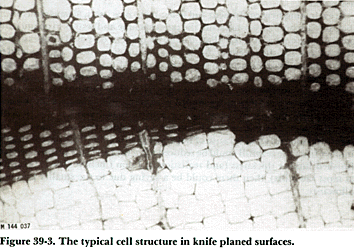
and abrasive-planed, further illustrates the problems. When abrasive planed surfaces are glued, then, it is analogous to trying to glue the bristles of two paint brushes together end-to-end when the bristles aren't fastened to the handle well.
One characteristic of a broken glue joint will be exceptionally high "wood failure." In fact, in Figure 39-1, the surface is nearly 100% wood failure: the glue did its thing; the wood came apart! Close visual examination of the failed surface, in fact, shows the scratch pattern from the piece above running at a 30 degree angle. The tests by the Forest Service on abrasive planed laminated beams confirmed this observation with wood failure being higher and glue separation being much greater for abrasive planed lumber. Interestingly, the U.S. Forest Service found the best abrasive results wereat 60-grit, not 80- or 36-grit.
What does this mean? Joints from abrasive-planed lumber are weaker than knife-planed due to surface and subsurface damage. This weakness will be further accentuated when the joint is exposed to wetting; the hypothesis is that the crushed cells will swell excessively trying to restore their original shape and that such swelling and resultant stresses will cause failures. Even when there is only slight subsurface damage, the fuzzy surface itself will still cause gluing problems in that it will require more adhesive than normal. (Returning to the paint brush analogy, gluing the bristles together requires more adhesive than just gluing the handles directly.)
However, by increasing the amount of adhesive (spread rate), it is possible (although admittedly we cannot describe when it is and when it is not possible) to obtain a fairly good bond when there is minimal subsurface damage, as the adhesive will penetrate past the fuzz down to "solid" wood.
This would apply to joints not exposed to wetting or exterior exposures. In any case, caution should be exercised in gluing abrasive planed lumber when the joint will be heavily loaded and high strength is required.
Although this is based on abrasive planers, the basic principles apply to abrasive sanders as well.
Abrasive Planing Yield Benefits
The typical abrasive planer for rough lumber uses two heads that are directly opposite each other, one above the other. As the lumber passes between these heads, equal amounts of material are removed from each side--if one head tries to remove more, the forces will push the lumber into the other head thereby providing uniform removal.
Further, the abrasive planer can take light cuts and can, therefore, clean up a board that in an old knife planer might have been rejected. (To be totally honest, new knife planers can also do wonders and, in some situations, a knife planer may cost less than an abrasive planer and may use substantially less power.)
In evaluating new equipment and listening to new users, always remember that they are probably comparing the new machine and results to an ancient piece of equipment. It is true that an abrasive planer, compared to an existing knife planer, has the potential due to a smaller planing allowance to produce thicker planed boards from the same thickness of rough lumber. However, unless this thicker planed lumber can result in improvements in yield in the plant in subsequent processing (that is, unless finished lumber sizes are changed or machines programmed to work more efficiently with thicker lumber) then there is no advantage or benefit. Stated another way, it will take the same amount of rough lumber to produce the same amount of furniture! Of course, if, because of improved planing, the thickness of rough lumber from the sawmill could be reduced a fraction and still provide correct finished lumber thickness (and realistically, I don't believe this is possible at most sawmills), then there could be a saving due to the smaller planing allowance.
Presurfacing
One special potential benefit from the abrasive planer is that by planing lumber green (green = above 50% MC), it will be more uniform in thickness. Uniformly thick lumber will reduce kiln drying time by as much as 25% (Forest Service results on 4/4 oak) and can save 10% of the energy used in a kiln when drying green-from-the-saw. Tests have shown there is no reduction in warp due to uniform thickness, but kiln capacity could be increased up to 11%. (Knife-planed green oak is much less prone to surface checking; this may not be true for abrasive planing due to the tearing effect mentioned earlier.)
Planing Air Dried or Kiln Dried
Air dried lumber that is planed fully (i.e., clean surfaces) will be much easier to defect in the rough mill, as the knots and other defects will be easy to see. An abrasive planer would have an edge over a knife planer in that a clean surface could be obtained on thinner boards more easily.
Lumber planed air dried or kiln dried on new planers will be planed to very close tolerances. This fact now permits reduced machining allowances in subsequent machining (e.g., molder allowance) and suddenly there are tremendous potential yield benefits!
Professor Gene Wengert is Extension Specialist in Wood Processing at the Department of Forestry, University of Wisconsin-Madison