American Chestnut Versus Chinese Chestnut
A discussion of the American Chestnut and the Chinese Chestnut, with regard to wood appearance and blight resistance. May 16, 2008
Question
I am wondering if this is American chestnut? I know that AC trees are extremely rare, like only 28 known to be alive in the US, but the homeowner who had this tree in their yard ate the nuts all the time, so I assume that rules out horse chestnut. Is there another edible chestnut besides AC? Also a lot of the boards have bad grain separation. If you drop them on the ground they just shatter along the grain.
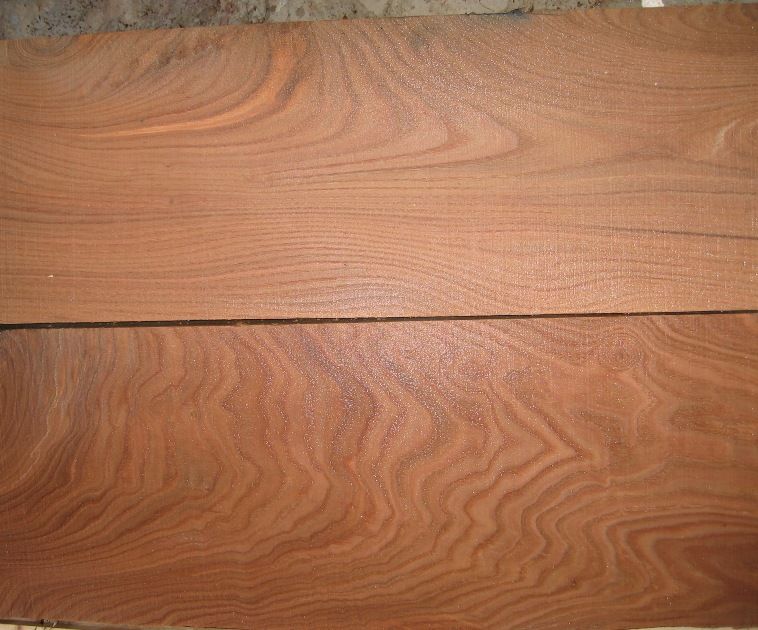
Click here for higher quality, full size image
Forum Responses
(Sawing and Drying Forum)
From contributor H:
Looks like butternut to me. If it is very soft like pine, it would support my guess.
From contributor J:
Butternut with ring shake. Either that or there are now only 27 chestnut trees.
From contributor T:
There are likely many more than 27 or 28 American chestnut trees in the wild. These trees may have developed some resistance to the blight. There are several trees commonly mistaken for American chestnut, foremost among them is the Chinese chestnut, host of the infamous blight that wiped out the American chestnut. The nuts are edible, and I was told the wood is not discernable from the American. To further complicate things, there are likely many thousands of hybrids of the American and Chinese chestnuts.
From Professor Gene Wengert, forum technical advisor:
The pure American chestnut tree will develop today in the wild or in a plantation to about 6" diameter and perhaps 25' high and then will die due to the blight. It will produce some nuts before death, which gives us seeds for the future. It also will root sprout. There have been a hundred years of reports about blight resistant true American chestnut trees, but such a tree has not yet happened. Hybrids, genetic crosses and other chestnuts (such as Chinese) apparently can survive the blight's attack.
From contributor G:
I was going to post what the good Dr. said. In the late 80's we cut over 200 ac in SKY and it had a field of about 5 ac on it that was all AC. At about 4" diameter they would start to die and a few made it to about 6" diameter. To walk it and look at it was something.
From contributor T:
It must be Chinese chestnut then, because this tree was huge - about 50" diameter. I will do some research on Chinese chestnuts and see what I can turn up.
From contributor V:
I dealt with a lot of American chestnut and Chinese chestnut. The board in the top picture has some cathedral grail that looks identical to American chestnut, but the rest of the grain in both boards is hard to identify because of the grain structure and the photo itself. The bottom board's larger cathedral grain is hard to identify also, as it is so comparable to ash and a few other woods. Seems darker colored than American chestnut, yet much lighter than Chinese chestnut, which is a darker form of tan and almost brown with a creamy white sapwood.
