Cherry Color After Aging
When cherry shelves are constructed years apart, how dramatic will the color difference be? May 8, 2004
Question
How much will cherry typically darken over the course of one to two years under normal conditions? I understand there are many variables and no one can know exactly. We recently did some clear cherry bookcases and the client thinks they might need more shelves in the future. If the future were in, say, two years, would new shelves be that noticeably different in color? Since they are shelves, I am inclined to tell them to hold off until they are sure they need them. I would think they could mix up the new shelves amongst the old and once loaded, as long as it is not a drastic difference in color, they probably wouldn't detect the shelves themselves. Is this a fair assumption?
Forum Responses
(Finishing Forum)
From contributor P:
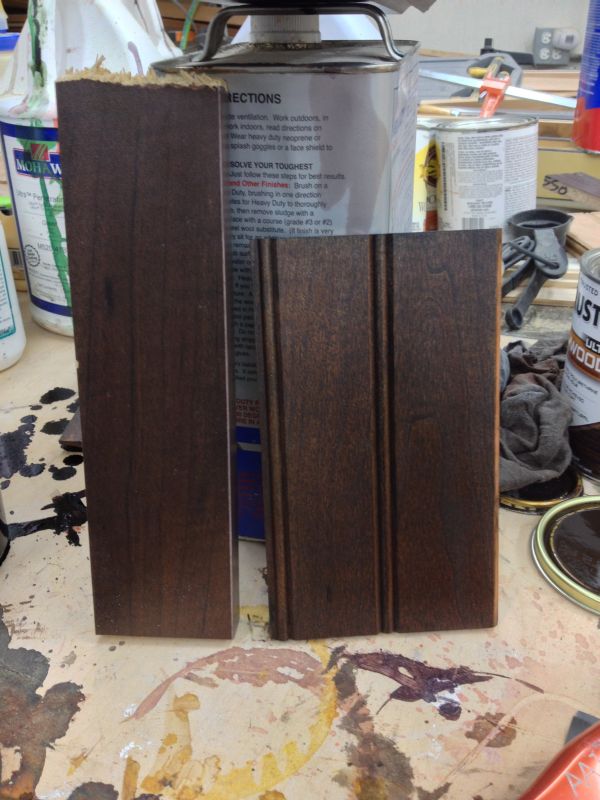
Cherry can darken quite a bit in a year or two. The sample below was placed in a brightly lit area for a week with the left end covered.

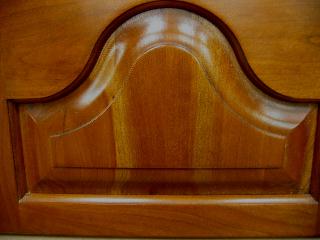
Here's a cherry door with a clear finish that's a few years old (maybe closer to 5 years?).
From the original questioner:
Thanks for the pics. In your opinion, would I be doing the client a service or disservice by advising them to wait the two years to see if they would need the shelves? Or would you suggest the pre-emptive measure and make the extra shelves now, in case? Worst case if we didn't, perhaps we have to tint the finish a little in a couple years? Or is that more trouble than its worth? We're only talking a couple hundred dollars for the additional shelves.
From contributor P:
I wouldn't make extra shelves and hold onto them in the case they may want them in two years. If they don't want them now, I'd let them know new shelves will take a long time to naturally age to the same color as the old shelves. You can dye or chemically stain (lye) fresh cherry to look very close to aged cherry. Let them know the match may not be exact. Give them the options and see which way they want to go.
From contributor M:
I would agree with on waiting and also dying the new wood to match the aged cherry. I'm about to do that exact thing. They bought cabinets that are about 1 year old and now I'm adding an island/soffit to their kitchen, which I'll need to match. The doors have a light dye on them, so that will be another factor to tackle.
From contributor A:
There are multitudes of cherry furniture, cabinets, and vanities made daily. You have no control over the color after you finish it. All you can do is make up samples and get one approved. When the color of the cherry wood changes, it is because of the wood and the conditions of the environment where the furniture is placed.
I think that too much is made about cherry wood and its color changes. It's not really that big of a deal. Just do a good job building and finishing the furniture. And always tell the truth.
From contributor S:
This illustrates one argument in favor of staining cherry to begin with. This is just an observation (not a judgment), but if you had stained the original cabinetry, you'd have less of a problem going back two years later to do new work that matches. I'm not advocating some sloppy heavy toned finish, but a little controlled dye and pigment work can be done that enhances, while maintaining good transparency. The color shift still happens, but it is not so dramatic. When you add cabinetry later, you'll find the color work more forgiving. Imitation of true natural cherry aging is a tough order. And then, even if you hit it close, you have to wonder what the effects of time will do to alter that. One is contending with the color shift either way, but I just think the problem is much less when you are matching to a finish that was stained to begin with.
From contributor C:
In my opinion, the natural change in the color of cherry is very dramatic in the first year or two. If you have to retrofit pieces, simply explain that it is furniture built to last a lifetime. For the first year or two of that lifetime, the color of the replacement parts may be significantly different. After that, politely emphasize that it’s a shelf. It’s not a table top. It’s not an end panel. It’s a … shelf.
To me, staining and toning are ways to minimize those effects. However, our modern colorants are engineered to more or less be fade resistant at our request. Wood is still wood, and it has not been engineered to do anything new or exciting.
Cherry that radically differed in color that was stained to reasonable uniformity should, in all probability, eventually be unmatched in color again in a year or two.
Some of the difference in opinion may stem from a difference in products. If it looks good before you finish it, it has a good chance of looking good after you finish it.
The comments below were added after this Forum discussion was archived as a Knowledge Base article (add your comment).
Comment from contributor D:
If you find the need to replace or add to existing cherry woodwork that has darkened over the past year or two, you can simply take the new wood and place it in direct sunlight for a few hours. I would suggest putting it in the sun from during the hours of 10 am til 4pm when the sun is at its strongest.
If your finish coat has a UV inhibitor it will slow the process. If you want to test this, take a piece of cherry, raw or finished, place an "X" with masking tape and place it in the sun. You will clearly see the "X" after you remove the tape. This will work on other wood species too, such as oak, but not to the degree as cherry. You will even see a difference with lighter stains.