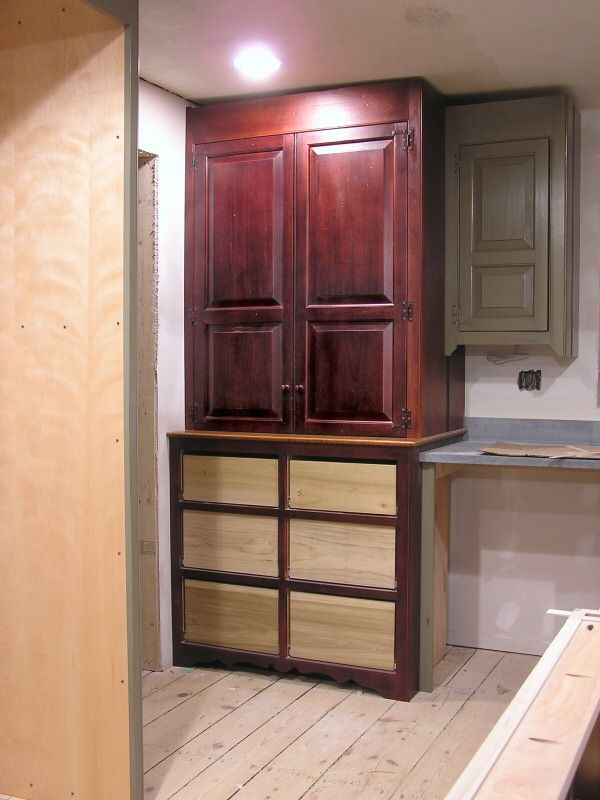
Cleaning Poly and Glue off a Glazed Cabinet
A craftsman gets advice on how to remedy a flooring contractor's and installer's errors. October 30, 2005
Question
The hardwood flooring contractor left poly on a new set of cabinets that are glazed. How do I get this off the cabinets without harming the glazed finish? There is also glue on the finish left from the installers, probably Titebond.
Forum Responses
(WOODnetWORK Forum)
From contributor W:
Why do you have to remove it, since the flooring contractor did it? And then the installers left glue on the cabinets, too? I would contact the responsible parties and have them take the appropriate action. This should all be covered in your contract with the homeowner or builder. On the other hand, if it's friends of yours that you recommended to the homeowner, explain to them that they messed up and to fork over the money required so you can be compensated for your time and effort by taking the messed up cabinets to a qualified refinisher in your area and having it redone. If you don't get it done right the first time, then every single detail of any work you performed will be nitpicked to death by the homeowner and it can turn into a real pain in the arse.
From the original questioner:
Thanks for the reply. I trim for another custom builder and only installed the stairway in this home. All other subs have been kicked out of this house and the homeowners have asked for my input. My thoughts are the same as yours, but I have not told the homeowners. I was hoping there may be another solution.
From contributor D:
Removing these indiscretions may be possible depending on the finish applied to the cabinetry. First you have to figure out if there is a finish applied on top of the glaze. To determine this, you are going to need a few different solvents. Naptha, denatured alcohol, lacquer thinner. Apply a little naptha to a clean rag, wipe (in an inconspicuous spot), and look at the rag. If the rag shows any of the glaze color, there is no finish. If no color is present on the rag, move to denatured alcohol. Use the same method, look at the rag. If the finish gets gummy, there may be a waterborne poly topcoat. If no marks to the finish, repeat process with lacquer thinner. If finish becomes tacky, there may be a lacquer topcoat. If no damage to finish, you may be dealing with a CV finish - at least a catalyzed finish. If the finish is hard enough, you may be able to scrape the poly off. For instance, if the cabinets have a conversion varnish topcoat, you will most likely be able to remove the poly by flat scraping the area with a razor. Poly relies on a mechanical bond to make it stick. The absence of this bond will more than likely allow the poly to be removed. Also, where is the poly on the cabinet? On the base, doors? In my experience, most floor finishers, even the really bad ones, don't usually get the finish up more than a few inches from the floor. Maybe all that you may need is to have someone refinish and reglaze the base.
Good luck and congratulations on doing good work and building trust with your clients. Sounds like the basis of a great business.
From the original questioner:
Thank you. It is a real treat for me to get input from thinking problem solvers. I contacted the flooring contractor and the cabinet installer and found that the cabinet installer mitered and glued the fluted corner pieces with gorilla glue. He then wiped the excess glue with a dry rag and smeared it along the corners and on the end skin and toe kick. I am getting more amazed each day. I now know the direction for the first step.
From contributor V:
Not to throw a monkey wrench into your plans, but if you touch it and are not able to fix it to the owner's satisfaction, they will come back on you and you will be left holding the bag. I once had a customer ask me to help him with moving a drier. He was an older man and I thought that I would be the nice guy and help him out. He dropped his end of the drier and gouged the floor. He said it was my fault that he had dropped the corner and I ended up replacing the entire linoleum floor at my expense. I was halfway into the contract and could see if I didn't, there would be major problems collecting the rest of the money that he owed me from my original agreement. As much as I like to take care of every customer, after being in business for over 30 years, I have learned some valuable lessons. One is don't assume the responsibility for someone else's mistakes, as if you touch it and can't fix it, you will be left holding the bag, and the last guy who touches it will be the one they remember!
From contributor D:
I do understand where you are coming from. Let's also remember that if the questioner can not remove the poly as suggested, he is no worse off than where he started. Meaning, he is faced with having to strip the finish and redo the entire finish. I am not suggesting that he do any of this work without settling on a price, having a signed contract and fully informing the client of the procedure he is attempting.
After all, our primary goal when given the opportunity to speak with clients is to inform (teach) them and guide them in the right direction. Let's get back to your thought that if something goes wrong, the last person to touch it is to blame. Conversely, if the project is a success, the last person also gets the credit. (Nothing ventured, nothing gained.) The word of mouth these clients will generate for your candor and creativity will reap rewards for years to come.
From contributor C:
In a previous thread, I spoke of using hot water or steam to remove latex from poly. The same conditions apply here, i.e. dissimilar thermal expansion rates will often (not always, unfortunately) break the mechanical bond.