Today's
Sponsors:


Royce Ayr Cutting Tools

RT Machine Co.

Safety Speed Cut

Sand-Rite Manufacturing

Sandman Products

Sawmill and Woodlot Magazine

Schultz Forming Products

SCM Group USA, Inc.

SCM Group

SCM

Sears Trostel Lumber Co.

Shade Dri

Shomaker Lumber Company

ShopBot

SII Dry Kilns

Silvaris

Simantech

Single Source Cabinet Supplies

SIS Machinery

SK-USA

SketchList

SlipCon USA, Inc.

SnapDragon Associates, LLC

SNX Technologies

South State Machinery

Southeast Tool, Inc.

Sovereign Machine, Inc.

North Pacific Lumber

Northstate Hardwoods

Northtech Machinery

NPO BARS

O'Shea Lumber Company

Old Mississippi Brick and Heart Pine Company

Omnitech Systems

Onsrud Cutter

Open the Door Products

Opti-Sand

Optisol for Project Scheduling

Original Saw Company

Osborne Wood Products

Paragon Enterprises

Patton Cabinet Doors

Peninsula Hardwoods

Penn Sylvan International

People Logic Software Corp.

Pinske Edge

Pioneer Lumber Company

Pioneer Millworks

Plogic Solutions Ltd.

Pond Cove Paint

Porter-Cable

Precision Drive Systems

Premium Specialty Hardwoods

Prime Estimating and Software Services, LLC

Primo Woodworking Machinery

Pro.Woodworker.com

Pro100

Professional Hardware & Supply Co.

Professional Machinery Group

PYTHA

Quality VAKuum Products, Inc.

Quick Machinery Company

Quickscrews International Corporation

QuickScribe

QuikDrawers

R&R Drummond, Inc.

R.A.W.

R.D. Billhofer Company

Rangate

Rawles-Aden Lumber Corp.

RazorGage

Rex Lumber Company

Riethmiller Lumber

Ritter Manufacturing Inc.

Rockler Woodworking and Hardware

Roger Shaw and Associates

Rose Machinery

Routech

RouterCAD


Compressor and Air Pipe Setups       Thoughts and advice on setting up a compressor and air lines for a shop. October 13, 2008

Question
I am going to be running an overhead air line about 50" with a few drops - one man shop, 5 hp compressor. I'm convince that copper is the way to go. At the big box they have "L" or "M" copper tube (1/32 or 3/64 wall, or vice versa). Which is ok to use?

I think I read or heard somewhere that the water separating filter should be located some distance from the compressor – is this true? Also, should the main line pitch back towards the compressor and the drops go up then down?

Forum Responses
(Dust Collection and Safety Equipment Forum)
From contributor L:
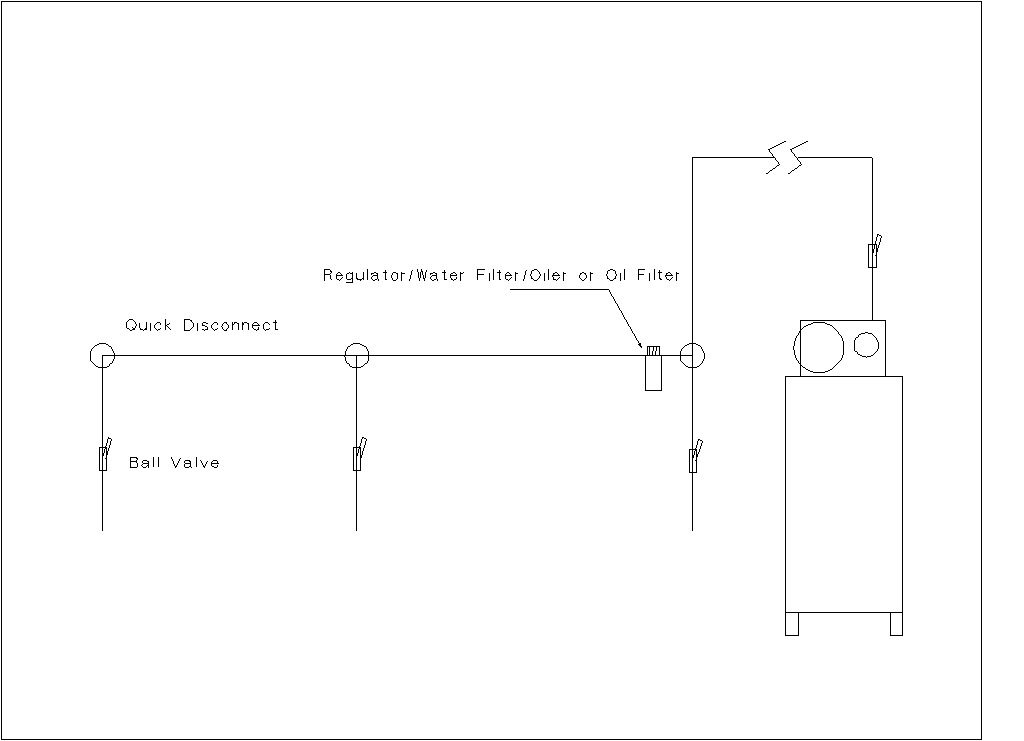
You should keep the water separator as far as you can from the compressor. It's not a bad idea to have a slight back tilt for the condensation to go back to the compressor. Have a drop and ball valve and at each quick connect to remove water from that point. Below is a small sketch.

Click here for full size image


From contributor B:
You might find that regular air hose is a lot more flexible. PEX is also an option if you don’t have any real air hogs. (I don't know if you can get hose over 1/2"). Both are easy to install and very easy, compared to copper, to reconfigure.

Disclaimer: I have only permanently installed one line (50' run to pocket hole machine) with air hose. I intended to install an additional line to the bander, but just hooked up my portable compressor instead for now. I believe I will run more hose soon so I too can stop coiling and uncoiling hoses to spray, use nail guns, etc.


From contributor J:
As a former air systems engineer, I used to design compressed air systems for a living. I will give you an overview of the ideal compressed air system and you can take what you want and go from there.

Your 5hp air compressor probably sits on a tank that should be more than adequate for your system. (Ideally you would install another tank on the opposite side of the system.) Copper isn't totally ideal (it has a higher internal resistance, especially at the joints) but it is the best for you application.

Whatever you do, don’t install PVC or plastic. They can explode under pressure – very dangerous! Either wall thickness of Copper is rated for your pressure ranges, but I always like to go with the thicker since it is safer and easier to sweat.

You don't really need a moisture filter as your tank will condense most of the water vapor while it is sitting there. (A particulate filter is always a good idea). Also, you can't filter water if it is in vapor form - you have to condense it first and then separate (remove) it.

This is only important if you will be spraying paint, etc with your compressed air. You can do this with a desiccant or refrigerated air dryer and moisture separator. You will want to have a way to remove the water from your tank - they make automatic drains, but you could just get away with emptying it frequently. Also, having your looped air system slope away from your compressor and installing a drop at the lowest point with another water drain is a good idea. (Your idea of sloping the system toward your compressor drains the moisture back into your tank and is not a bad idea either, but it is better have a moisture drop at the lowest point of your loop - don't let this fill up with water)!

Your system should loop around back on itself for maximum and equal flow to all drops. As far as your drops, you said they should go up then down. This is another way to prevent condensed moisture from getting to your tools. This is a wise move and I recommend that you do it.

As far as other tips, install a few more drops than you need. With copper it is much easier to add them when you install your system. Also, fix all your air leaks quickly. They make your system much less efficient and put a lot more wear on your compressor. If you can hear the leak, it is a very significant leak in terms of compressed air. You should inspect your installation under pressure with soap/water for smaller leaks. Although not as important, they add up quickly!



Would you like to add information to this article?
Interested in writing or submitting an article?
Have a question about this article?


Have you reviewed the related Knowledge Base areas below?
  • KnowledgeBase: Knowledge Base

  • KnowledgeBase: Dust Collection, Safety, Plant Management

  • KnowledgeBase: Dust Collection, Safety, Plant Management: General


    Would you like to add information to this article? ... Click Here

    If you have a question regarding a Knowledge Base article, your best chance at uncovering an answer is to search the entire Knowledge Base for related articles or to post your question at the appropriate WOODWEB Forum. Before posting your message, be sure to
    review our Forum Guidelines.

    Questions entered in the Knowledge Base Article comment form will not generate responses! A list of WOODWEB Forums can be found at WOODWEB's Site Map.

    When you post your question at the Forum, be sure to include references to the Knowledge Base article that inspired your question. The more information you provide with your question, the better your chances are of receiving responses.

    Return to beginning of article.


    Refer a Friend || Read This Important Information || Site Map || Privacy Policy || Site User Agreement

    Letters, questions or comments? E-Mail us and let us know what you think. Be sure to review our Frequently Asked Questions page.

    Contact us to discuss advertising or to report problems with this site.

    To report a problem, send an e-mail to our Webmaster

    Copyright © 1996-2009 - WOODWEB ® Inc.
    All rights reserved. No part of this publication may be reproduced in any manner without permission of the Editor.
    Review WOODWEB's Copyright Policy.

    The editors, writers, and staff at WOODWEB try to promote safe practices. What is safe for one woodworker under certain conditions may not be safe for others in different circumstances. Readers should undertake the use of materials and methods discussed at WOODWEB after considerate evaluation, and at their own risk.

    WOODWEB, Inc.
    RR4 Box 265A
    Montrose, PA 18801

    Contact WOODWEB


  •   Home » Knowledge Base » Knowledge Base Article