Today's
Sponsors:


Italpresse

J & G Machinery

J and B Hardwood Co.

J&P Machines

J. Gibson McIlvain Company

JLT Clamps, Division of James L. Taylor Mfg.

JMHsoftware.com

Joos USA Inc.

KCD Software

Kentucky Pacific Lumber

Kerber Farms and Mill

Keystone Wood Specialties

Keytrix Data Systems

Kleiberit Adhesives USA, Inc.

Komo Machine

Kreg Tool Company

Kremlin Rexson - EXEL North America, Inc.

Lacy Cypress Inc.

Laguna Tools

Leadermac USA

Leitz Tooling Systems

Lewis Lumber Products

Lignomat

Limtech Industries, Inc.

Logosol, Inc.

Lumber Resources

Lumber Smith

M.L. Campbell

MACHINEKING.com

MARTIN Woodworking Machines Corp.

Mastercam - CNC Software

Maya Positioning Equipment

Mereen-Johnson Machine Company

Merritt Woodwork

Microvellum

Middle Valley Lumber

Mikron Woodworking Machinery

Mill Outlet

Millwork Inc.

MLS Machinery

Monarch Metal Z Clip and Panel Clip

Mountainside Wood Products

Mozaik Software, Inc.

MultiCam Southeast

Multicam, Inc.

Nail Gun Depot

National Decon

New England Drawer

New England Kiln Drying Association

NEWCNC.com

Newman-Whitney

Norwood Portable Sawmills

Nyle Dry Kiln Systems

O'Shea Lumber Company

Old Mississippi Brick and Heart Pine Company

Oliver Machinery Co.

Hoffmann Machine Company

Holz-Her US Inc.

Hot Melt Technologies

Howard S. Twichell Co.

Hvalsoe Sawmill Ltd.

ICA North America

Impact Search and Placement

Industrial Air Solutions

Integra Precision Tooling

InTrading

IpeDepot.com

irsauctions.com


Contaminants in High-Gloss Finish

      Is dust causing the flaws in this otherwise mirror-shine finish? August 26, 2004

Question
Problem:
Tiny dust particles fall on the finish during the finishing process and create bumps (illustrated in the bottom right hand corner). See the photo at the bottom left. I suspect that since the finish (General Finishes Oil & Urethane Topcoat) is so thin, any small particle can break the surface tension and cause these bumps. How can I avoid the dust? For the specifics of my problem read on.

Details:
Attached to this message are three pictures of the bench and an illustration of the problem (or at least what I believe the problem to be). On this purpleheart bench, I wanted to use a high gloss finish to show off the wood. I'm having lots of trouble achieving the mirror-like shine. I started the finishing process with two coats of Danish oil to bring out the wood’s character. I then added coat after coat (now roughly 11) of Gloss General Finishes Arm-R-Seal Heavy Duty Oil & Urethane Top Coat. Is this an orthodox method of finishing?

However, with the exception of the dust problem, it looks amazing (see top two photos). It dries rock hard to a mirror shine. The Arm-R-Seal is great because it’s thin, and levels very well. There are no visible brush marks whatsoever. The problem (I believe) is that it’s so thin (almost water thin) that even the tiniest dust particle will break the surface tension, causing a bump once dried. I’m guessing that with thicker cuts of urethane or lacquer, dust particles will just rest on the surface and not cause large bumps once dried. I’ve used small sample pieces to try buffing out the finish, however I’ve never been able to achieve anything close to the sheen that I get without buffing. In short, what I’d like to do is stick with the finish I’m using, but somehow eliminate dust from the equation. I’ve tried suspending a plastic barrier over the bench (and slightly over the sides). I lower it so that it’s about two or three inches from the surface after I’m done applying the finish. It works, but not great; there’s still a lot of dust falling on the surface. The picture you see is the best result I’ve gotten so far.

One reason I think this method (of not buffing out the final coat) may be possible is Bob’s response to the Knowledge Base article on buffing out a lacquer finish (Buffing Out a Lacquer Finish). He said that his company used to buff out their finishes, but transitioned to spraying on the final sheen because it produced a more resilient finish. How does he, or others in the industry, avoid dust on the final coat? Is there some way I can create a dust-free environment or enclosure to apply my final coat? Is there a better way to approach this?
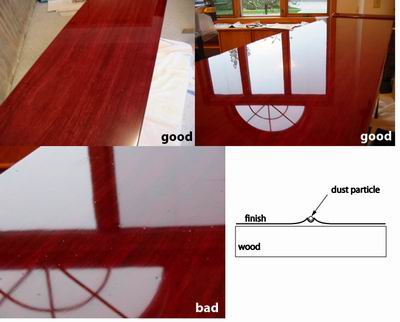
By the way, the two upper pictures labeled "good" are pictures taken at flattering angles. The photo at the bottom left is one taken at a not-so-flattering angle... I would like the bench to look like the top photos when viewed from any angle.

Forum Responses
(Finishing Forum)
Looks more like fisheye than dust... tough to tell by the pics. If it is fisheye, then you have contamination on your piece and this will continue to happen. Do the spots re-appear in the same spots after you lay out another coat? If you believe it to be fisheye, then do a search on this site for it. There have been a lot of post regarding that problem.


"How does he, or others in the industry, avoid dust on the final coat?"

Avoiding dust is one thing. Eliminating it entirely is another. That requires a Rolls Royce finishing room; out of reach even for most trade finishers.

1. The way professionals do a gloss finish is to rub it out. Miniscule specs such as you are contending with are taken care of easily in the rubbing process.

2. The longer a finish takes to dry at the surface, the more dust will show. Professionals use fast drying finishes, such as lacquer and other high tech coatings.

3. It is not realistic to expect a quality gloss finish unless you intend to rub it out. If I am not rubbing out the finish, I stick with a satin or semi-gloss sheen at most. In a satin sheen, these tiny dust specs are far less conspicuous.

I'd say 11 coats of finish is more than enough film thickness already. Perhaps if you let that finish cure out really well (a month at least), you can polish it out to a marvelous result.

Polishing finishes gets into instruction that is way beyond the reach of anything here. That is not to say it is too hard for anyone to learn, just that more detail is needed.


From the original questioner:
This finish seems pretty fisheye resistant, although I have been very carefully cleaning the surface before each coat. It took a lot of experimenting with samples for me to decide that dust was the problem. In certain lights I can see things falling on it and creating the bumps that you see in the picture. Are there dryers that I can add to the topcoat to make it dry faster? Can I help it dry by using a dehumidifier or is humidity not a factor in the drying time of an oil and urethane topcoat?


If it's possible, you could make a ventilation fan, dust scrubber or something that sucks up and out of your room, whether it's a dedicated room or a temporary setup. I've seen it done in a small room where the dust collection sucks up. The floor was very lightly dampened with water. I haven't done it yet.


First thing you need to do is get a painter's file or Nib File to remove the bumps from the dust. Sanding is just going to remove more of the finish, leaving less to rub out, making more dust to get into the new coat of finish.

When you get the nib file you will use it on only the effected areas. It sort of works like a shaver, scatting over the smooth area and removing the high spot.

Next wet sand and then buff. Wet sand with an air sander, working your way down to the finest grit you can get your hands on. Use a catsup bottle, fill it with warm soapy water and add mineral spirits to help lubricate the paper better. Squirt and sand as you go.

You will notice that a bumpy area feels different from a smooth area even through the sander. You will feel the drag on the sander (even a tiny bump) when the surface feels the same all over. Wipe it with a terry towel to pick up the mess. Check the surface very carefully. Where there are high spots you will notice an area around the spot that's still shiny. Go after this area again and wipe with the towel to see if the shiny spot is gone.

Go to a finer grit paper and again keep at it till everything feels the same. This is important as at this point you can no loner see the difference as the scratches are too fine.
When you're done with the finest paper, start with the buffing. I use 3M products exclusively. You will find something you like to use.

Did you use a sealer such as dewaxed shellac between the Danish Oil and the finish coat? Did you give the Danish oil ample time to harden and seep out of wood pores before top coating? Some oils need one week to really dry... Also, fisheye can be caused by dust, not because of the fact that it's dust, but because certain dust particles react with or repel certain finish coats. If you can not find the source of the dust that is reactive (it could be from anything in the room, including your spray-on antiperspirant or hand lotion), it might be better to switch to something such as a quick drying lacquer. Have you called tech support for that product also? Can you put on 11 coats without problems?


From the original questioner:
I'm not sure if I can use that many coats, but I sure hope so. Even though I used 11 or so coats, I suspect it's probably only about 5 coats thick because of all the sanding between coats. I'll try calling the tech support line for General Finishes to see what's happening.


I would like to comment on the importance of the rubbing and buffing of a finish to get the high gloss desired. This is the only way to get a spectacular high gloss, dust- or contaminant-free surface. To achieve this 'off the gun' is asking for too much. That is not to say it can't be done, but in cannot be done with the same results as rubbing and buffing. You aren't completing the job without the final steps!


What your picture shows is fisheye. Dust in the finish would have the exact opposite effect of your illustration. The surface tension would make the finish cling to the dust and make a mountain out of a mole hill. What is breaking the surface tension is oil or silicone. There is either external contamination or your oil was not dry. Check the Knowledge Base for possible solutions.


Yes, I too believe it is fisheye and it may be coming from dirty air lines and tank that is not drained at regular intervals.

Would you like to add information to this article?
Interested in writing or submitting an article?
Have a question about this article?


Have you reviewed the related Knowledge Base areas below?
  • KnowledgeBase: Finishing

  • KnowledgeBase: Finishing: General Wood Finishing

  • KnowledgeBase: Finishing: High Speed Production

  • KnowledgeBase: Finishing: Refinishing

  • KnowledgeBase: Woodworking Miscellaneous

  • KnowledgeBase: Knowledge Base


    Would you like to add information to this article? ... Click Here

    If you have a question regarding a Knowledge Base article, your best chance at uncovering an answer is to search the entire Knowledge Base for related articles or to post your question at the appropriate WOODWEB Forum. Before posting your message, be sure to
    review our Forum Guidelines.

    Questions entered in the Knowledge Base Article comment form will not generate responses! A list of WOODWEB Forums can be found at WOODWEB's Site Map.

    When you post your question at the Forum, be sure to include references to the Knowledge Base article that inspired your question. The more information you provide with your question, the better your chances are of receiving responses.

    Return to beginning of article.


    Refer a Friend || Read This Important Information || Site Map || Privacy Policy || Site User Agreement

    Letters, questions or comments? E-Mail us and let us know what you think. Be sure to review our Frequently Asked Questions page.

    Contact us to discuss advertising or to report problems with this site.

    To report a problem, send an e-mail to our Webmaster

    Copyright © 1996-2013 - WOODWEB ® Inc.
    All rights reserved. No part of this publication may be reproduced in any manner without permission of the Editor.
    Review WOODWEB's Copyright Policy.

    The editors, writers, and staff at WOODWEB try to promote safe practices. What is safe for one woodworker under certain conditions may not be safe for others in different circumstances. Readers should undertake the use of materials and methods discussed at WOODWEB after considerate evaluation, and at their own risk.

    WOODWEB, Inc.
    335 Bedell Road
    Montrose, PA 18801

    Contact WOODWEB


  • WOODWEB Celebrates Craft Beer Week


      Home » Knowledge Base » Knowledge Base Article