Today's
Sponsors:


Mereen-Johnson Machine Company

Merritt Woodwork

MFG in Honduras

Micro Fence

Microvellum

Middle Valley Lumber

Mikron Woodworking Machinery

Mill Outlet

Minimax

Mirror Reflections

MLS Machinery USA, Inc.

MLS Machinery

Modern Woodworking Magazine

Moldingknives.com

Monarch Machinery

Morbidelli

Moulder Services

Moulder Techniques

Mountainside Wood Products

Multicam, Inc.

NAP Gladu

Nebraska Tool

NEMI

New England Kiln Drying Association

NexGen

Hoffmann Machine Company

Holz Her U.S. Inc.

Howard S. Twichell Co.

Hvalsoe Sawmill Ltd.

ICA North America

Icy Straits Lumber

IDM

Impact Search and Placement

Indiana Hardwoods

Industrial Air Solutions

Integra Precision Grinding and Manufacturing

InTrading

Invicta Woodworking Machines

IpeDepot.com

irsauctions.com

Italpresse

J & G Machinery

J and J Barn Wood

J&P Machines

J. Gibson McIlvain Company

Jiffytops

JIT Hardware Supplies, Inc.

JMHsoftware.com

John G. Weber Co.

Joos USA Inc.

KCD Software

Kerber Farms and Mill

Keystone Wood Specialties

Keytrix Data Systems

Kiln-direct.com

Kleiberit Adhesives USA, Inc.

Kreg Tool Company

Kremlin

Lacy Cypress Inc.

Langelier Lumber Ltd.

Leadermac USA

Lewis Lumber Products

Lignomat

Logosol

Lumber Resources

Lumber Smith

M.L. Campbell

MACHINEKING.com

Macoser, Inc.

Mahros

Maine Timber Works

Maine Woods Company

Mann and Parker Lumber Co.

Martin Lumber

MARTIN Woodworking Machines Corp.

Mastercam - CNC Software

Matthews Mill

Maya Positioning Equipment


Distinguishing Western Hemlock from Amabilis Fir       Tips on how to tell apart two very similar trees. April 20, 2006

Question
I was wondering someone might be able to help me with the identification or the differences between western hemlock and amabilis fir?

Forum Responses
(WOODnetWORK Forum)
From contributor A:
I recently asked the same question for a different species of Dr. Wengert and got this response back:

"Send a sample to the US Forest Products Lab in Madison, WI
Eugene Wengert, Emeritus Professor and Extension Specialist of Wood
Processing
President, The Wood Doctor's Rx, LLC
2872 Charleston Dr, Madison, WI 53711-6502
(608) 271-4441”


From Gene Wengert, technical advisor Sawing and Drying Forum:
A quote from IDENTIFYING WOOD by Bruce Hoadley:
"I would rate hemlocks and firs as the most difficult of all conifers to separate visually." (He means using up to 10x magnification).Under the microscope, it is easy to separate the two using the presence of ray tracheid cells, which are found in hemlock and not fir.
(Note: He is talking about the true firs and not Douglas-fir.)


From contributor B:
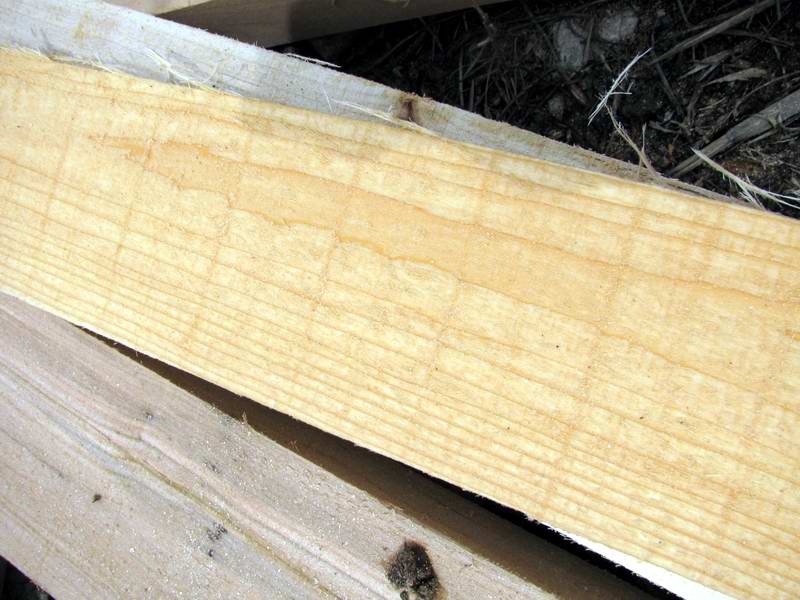
There are easily identifiable differences in the leaves, cones and seed, even in silhouette. Looking at the grain of western hemlock vs amabilis fir shows their distinction clearly with a trained eye. I agree the average urbanite would have difficulty if they don't work with wood. You should be able to find tree identification keys to separate the two groups without digging out the microscope.

For example:
amabilis fir:
The seeds are heavier than seeds of most Pacific Northwest conifers except noble fir.
Seeds each contain a single wing but often fall from the upright cone axis by pairs on ovuliferous scales, as the bracts contort and tear themselves from the cone-a process that does not require wind.

western hemlock:
Empty cones often persist on the tree for 2 or more years. Cone scales of western hemlock open and close in response to dry and wet atmospheric conditions. Under wet conditions, seed may be retained in the cones until spring. Ripe cones are not upright. Hemlock seed germinates well on most any moist organic surface. You can often find a green carpet of seedlings germinated on a rotten log or sometimes in a standing dead tree stub (often western red cedar). Also, decent sized hemlock (12 inch dbh) can be found growing out of the top side of a rotten western red cedar log. Their roots will migrate around the log and into mineral soil under the log.


Would you like to add information to this article?
Interested in writing or submitting an article?
Have a question about this article?


Have you reviewed the related Knowledge Base areas below?
  • KnowledgeBase: Knowledge Base

  • KnowledgeBase: Lumber and Plywood

  • KnowledgeBase: Lumber & Plywood: Wood Identification


    Would you like to add information to this article? ... Click Here

    If you have a question regarding a Knowledge Base article, your best chance at uncovering an answer is to search the entire Knowledge Base for related articles or to post your question at the appropriate WOODWEB Forum. Before posting your message, be sure to
    review our Forum Guidelines.

    Questions entered in the Knowledge Base Article comment form will not generate responses! A list of WOODWEB Forums can be found at WOODWEB's Site Map.

    When you post your question at the Forum, be sure to include references to the Knowledge Base article that inspired your question. The more information you provide with your question, the better your chances are of receiving responses.

    Return to beginning of article.


    Refer a Friend || Read This Important Information || Site Map || Privacy Policy || Site User Agreement

    Letters, questions or comments? E-Mail us and let us know what you think. Be sure to review our Frequently Asked Questions page.

    Contact us to discuss advertising or to report problems with this site.

    To report a problem, send an e-mail to our Webmaster

    Copyright © 1996-2009 - WOODWEB ® Inc.
    All rights reserved. No part of this publication may be reproduced in any manner without permission of the Editor.
    Review WOODWEB's Copyright Policy.

    The editors, writers, and staff at WOODWEB try to promote safe practices. What is safe for one woodworker under certain conditions may not be safe for others in different circumstances. Readers should undertake the use of materials and methods discussed at WOODWEB after considerate evaluation, and at their own risk.

    WOODWEB, Inc.
    RR4 Box 265A
    Montrose, PA 18801

    Contact WOODWEB


  •   Home » Knowledge Base » Knowledge Base Article