Today's
Sponsors:


Vintage Wood Products

VortexTool Co. Inc.

VyTek

W. Moore Profiles, Ltd.

W.L. Fuller

Wagner Electronic Products

WalzCraft Industries

WEIMA America, Inc.

Weinig Group - USA

Western Dovetail

Williams and Hussey

Wisconsin Knife Works

WMIA

WMMA

Wood Doctor's Rx, LLC

Wood Technology Inc

Wood-Mizer

WoodCabinetDoors.Com

WoodenBoat

WoodFinder

WoodJobs.com Search Consultants

WoodLINKS

Woodmaster

WoodPlanet Inc.

WoodSprayGuns.com

WOODWEB

Woodworker's Supply/woodworker.com

Woodworker's Directory

Woodworking in America

Wright Timber

Specialtytools.com

Speed Sander

Spink Lumber

Sprayguncaptain.com

Stefani

Steve H. Wall Lumber Co.

Stiles Machinery

Stiles Shop Solutions

Stoneys Hardwoods

Super Source Tooling Inc.

Supergrit Abrasives

Superior Wood Products

T-Tool USA LLC

Target Coatings

TaylorCraft Cabinet Door Company

Techno CNC Routers

Template Services

The Veneer Store

Thermwood Corporation

Tiger Wood Ltd.

TigerStop

TigerwoodDecking.com

TimberKing

Timesavers Inc.

TMS Machinery Sales

Tomlin Architectural Millwork

Tooling on the Web

Toolstoday.com

Top Drawer

Touch Up Solutions LLC

Tractivity

TradeJobPlacement.com

TradeSoft

Trakware Systems Inc.

TRB Flooring Company

Tropical Hardwoods

True North Cedar

Ubidmachinery Inc.

UC Coatings Corp.

Unique Building Supples

Unique Machine & Tool

University of Wisconsin

UWMO Auctions

VacDry Kilns

Vacuum Pressing Systems, Inc.

Vacuumpods.com

Valspar

Vecoplan LLC

Vector Art 3D

Vectric Ltd.

Veneer Systems Inc.


Jigs for shelf pin holes       Speeding up the drilling process. March 23, 2002

Q.
I have to drill holes for shelf pins in five bookcases. I am looking for a jig or some type of template to speed up the process.

Forum Responses
1/4 inch thick peg board has holes that are spaced at one inch. A piece of this, cut to size, makes a great short run jig that produces good results. I prefer to use a brad point drill for the holes. Work safe.


There are jigs available for locating and free hand drilling or using on a drill press that are for 5mm boring on 32mm centers. Pretty much the industry standard for case works. %mm shelf pins of several types are readily available. To speed up the process, a line boring machine is quite common.


I use a plunge router with a 1/4" straight bit and a guide bushing. The jig is a 6"x 96" piece of thin plywood with holes (the size of the guide bushing) every inch. Drill the holes on a drill press with a fence for accuracy. Then glue a block on the strip to align it with the top of the cabinet side. Mark start and stop points on the jig and you should be set. Always line the same end of the jig with the same end of the cab parts.


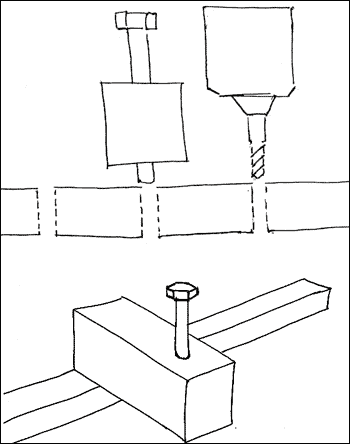
We made our own drilling jigs using the fixture shown below. The fixture uses a block of wood with a 1/4” hole to hold a 1/4” bolt that can drop into the hole drilled by a 1/4” drill bit. The entire fixture clamped to the drill press table. You drill the first hole and slide the jig over until the sliding bolt falls into the hole. Then drill the second hole (and so on). The holes are equally spaced automatically. We’d use a piece of 3/4” hardwood for the actual shelf hole jigs. They held up well but were easily made in batches and discarded when worn. When complete, the jigs were hand-held (or clamped using spring clamps) to the case sides either before or after assembly and the shelf holes drilled using a portable drill.

The hole-to-hole distance is determined by the distance between the block of wood holding the sliding 1/4” bolt and the drill. That flexibility allowed us to vary hole spacing for specialized applications like positioning shelves directly behind mullions in glass doors.

The upper illustration shows the holes being drilled into the shelf hole jig. The lower illustration shows the sliding bolt fixture itself. The fixture should be fastened to a fairly long piece of 3/4” ply to assist when making long jigs.
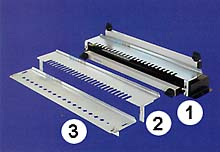


I use a piece of 1/4 ply 4 1/2 wide with 3/8 diameter holes bored at desired increments 2 inches from edge. I drill holes with a vix type bit that has a 5mm bit and a 3/8 guide. When jig is flipped over, you can drill a partition and not drill into holes on opposite side.


I use the drop pin type jig for drilling sequential holes. However, to prevent the threads on the bolt from tearing the hole edges, I use 1/4 inch bronze rod (also called brazing rod) that I get from a welding supply house. Trying to find brass rod has been very difficult.


Purchase a flat metal ruler, drill hole size using the inch markings, clamp down and use. Cheap to make and easy to use.


Would you like to add information to this article?
Interested in writing or submitting an article?
Have a question about this article?


Have you reviewed the related Knowledge Base areas below?
  • KnowledgeBase: Cabinetmaking

  • KnowledgeBase: Cabinetmaking: Commercial Cabinetry

  • KnowledgeBase: Cabinetmaking: Custom Cabinet Construction

  • KnowledgeBase: Cabinetmaking: General

  • KnowledgeBase: Cabinetmaking: Residential Cabinetry

  • KnowledgeBase: Cabinetmaking: Store Fixtures

  • KnowledgeBase: Woodworking Miscellaneous

  • KnowledgeBase: Woodworking Miscellaneous: Woodworking

  • KnowledgeBase: Knowledge Base


    Would you like to add information to this article? ... Click Here

    If you have a question regarding a Knowledge Base article, your best chance at uncovering an answer is to search the entire Knowledge Base for related articles or to post your question at the appropriate WOODWEB Forum. Before posting your message, be sure to
    review our Forum Guidelines.

    Questions entered in the Knowledge Base Article comment form will not generate responses! A list of WOODWEB Forums can be found at WOODWEB's Site Map.

    When you post your question at the Forum, be sure to include references to the Knowledge Base article that inspired your question. The more information you provide with your question, the better your chances are of receiving responses.

    Return to beginning of article.


    Refer a Friend || Read This Important Information || Site Map || Privacy Policy || Site User Agreement

    Letters, questions or comments? E-Mail us and let us know what you think. Be sure to review our Frequently Asked Questions page.

    Contact us to discuss advertising or to report problems with this site.

    To report a problem, send an e-mail to our Webmaster

    Copyright © 1996-2009 - WOODWEB ® Inc.
    All rights reserved. No part of this publication may be reproduced in any manner without permission of the Editor.
    Review WOODWEB's Copyright Policy.

    The editors, writers, and staff at WOODWEB try to promote safe practices. What is safe for one woodworker under certain conditions may not be safe for others in different circumstances. Readers should undertake the use of materials and methods discussed at WOODWEB after considerate evaluation, and at their own risk.

    WOODWEB, Inc.
    RR4 Box 265A
    Montrose, PA 18801

    Contact WOODWEB


  •   Home » Knowledge Base » Knowledge Base Article