Joints for a HEAVY Tabletop
A tough project has a tricky angle: how to fasten the legs to a heavy table when there's no shelf or apron to control racking. A furniture-maker gets advice from colleagues. July 5, 2005
Question
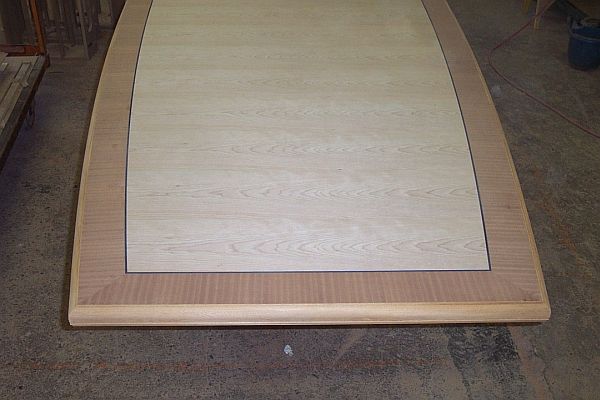
I have a customer who wants me to build a table out of white oak 3" thick. The top is to be 48" wide and 78" long. The customer brought four pieces for legs that are about 4" to 5" in diameter, and wants me to turn them to straight-round and attach them with mortise and tenon joints directly into the top. The customer wants to avoid any other bracing. I was able to let the customer let me thin the wood to 1 1/2" in the center and only leave the full thickness around the outside edges, but I estimate about 220 pounds just for the top. Does anyone have suggestions to make these joints (legs) safe and secure?
Forum Responses
(Cabinet and Millwork Installation Forum)
From contributor R:
I made a table similar to that years ago. I took 3/8 thick steel plates about 8 inches square and drilled and tapped them. I then rabitted them into the top to make them flush. I screwed them into the top using countersunk screws and pl premium construction adhesive. The reason I went with the spin on the legs is because it’s easy to assemble and the screw holes never strip.
I then used the heaviest railbolt I could find in the legs - these just threaded into the plates nice and strong and were removable. My legs were round, but if you use square you’ll probably have to tighten the plate on the leg and then affix the table to obtain the correct attitude.
As far as strength goes, it turned out amazingly strong because of the over-sizing of everything and the thickness of the top, the legs, etc. (Make sure you drill a relief hole for a bolt to go through the plate into the top a short distance).
From contributor T:
The steel idea is excellent. I use a lot of steel to overcome these designs, but if you are not happy with using steel, then definitely build a sub-top or sub-frame to connect all four legs and you should be solid, except for the leg at the floor which is going to need a tenon to keep the leg from getting kicked out.
From the original questioner:
Great suggestion about the steel – it didn’t even cross my mind. I had a design all worked up with a sub-frame, and was trying to figure a way to eliminate the kick out problem with lags or something at the top above where the pivot point would be. I think since the legs do contain the core, I will drill deep and lag the plate on to the leg itself, then put a couple smaller screws into it to keep it from twisting, and attach the assembly to the tabletop.
From contributor T:
If the table is not attached to the floor, then whenever the client tries to move it the legs will rack no matter what kind of screw you use at the top. It would be best to have a full shelf close to the floor, or at least halfway down to stabilize the four legs at the bottom.
From contributor R:
How close to the corners will the legs be? I think the steel plates could still work, just put the leg end in a corner of a square plate. Just to confuse more, how about a long bolt (12") through the top, countersunk, into a center hole in the leg? Meet the end of the bolt with a perpendicular intersecting side bore in the leg to slide in a washer and nut. Tighten it and plug the holes. You could even square the countersinks and plug with an end-grain piece to faux a tenon end.