Home » Knowledge Base » Knowledge Base Article What's New  |  Site Map 


Today's
Sponsors:


ATEMAG

Atlantic Machinery Corp.

Auton Motorized Systems

AWFS

B.H. Davis Company

Bailey's Inc.

Bainbridge Manufacturing

Baker Products

Banks Hardwoods

Barn Detail

Barn Door Lumber

BC Wood Specialties Group

Beautiful WoodForest Products

Beaver Tools

Benz Incorporated

Berenson Hardware

Best Cabinets

BetterVacuumcups.com

Biesse Group America

Binks

Black Bros. Co.

Blackhawk Machinery

Brazilian Direct Ltd.

Brown Wood Products Co.

Byrd Tool

C.R. Onsrud

Cab Parts

Cabinet Door Service Co.

Cabinet Pro

CabinetCRUNCHER Cutlist & 3D Cabinet Design Software

Cabinetmakers Association

CABPARTSPRO

CAD CAM for the Home and Small Shop

CADCode

Cag Lumber

Camco, Inc.

Carbide.com

Carolina Woodworking Consultants

Carter Products

Carvewright

Carving Technologies

Cash Coatings

Castle

Catskill Timber Industries

Central Hardwoods

Charles G.G. Schmidt Co.

Chicago Dowel Company, Inc.

3M Corporation

5 Star Tooling

A Brazilian Wood Depot

Abrasive Resource

Accu-Right Squareness Gauge

Accu-Router, Inc.

AceCo Precision Wood Tooling

Active Machine & Tool

Air Cleaning Systems

Air Handling Systems

Aktrin Furniture Information Center

Alan McIlvain Company

Algoma Lumber Co.

All Star Adhesives

Alliance Millsoft

Allied Machinery Inc.

AllRout

Amana Tool

Ameitech South

American Fabric Filter Co.

American Institute of Building Design

American National Woodworking Knife

American Rotary Converters

Anchorbeam Timberworks

Andreou Machinery

ANEST IWATA USA, Inc.

Antique Building Materials

Anver Corporation

Apollo Sprayers Inc.

Arbor Processing Inc.

Architectural Elements

Arkansas Wood Doors

ArtCam


WOODWEB DISCLAIMS any and all RESPONSIBILITY and LIABILITY for the accuracy and application of the information below. Readers agree to evaluate the significance and limitations of the information provided, and accept full responsibility for the application of this information. Read More ...

Would you like to add information to this article?
Interested in writing or submitting an article?
Have a question about this article?


Keeping Plywood Flat       Pros discuss causes, cures, and prevention of warping in plywood. July 9, 2005

Question
I am wondering, what is the best way to stack 4x8 sheets of plywood? Also, are there any tricks I can use to flatten some cabinet shelves that have bowed/warped?

Forum Responses
(Cabinetmaking Forum)
From contributor R:
I do not think that it is possible to flatten bowed or warped plywood. I once had a couple of sheets of 3/4" red oak plywood that were badly bowed. I lightly moistened them on both sides and then lay them on the bottom of a stack of 40 sheets of 3/4 melamine.

Although I always knew they were there, I left them on the bottom of the pile for nearly 10 years (of course the stack of melamine would sometimes dwindle down to a couple of sheets but it would get replenished promptly). Then one day I needed to pull those sheets of oak plywood when I ran short on a job. Those sheets quickly sprang back to their original bowed state in a matter of minutes. I think that a plywood straightener can only be purchased from the same outfit that sells board stretchers.


From contributor J:
The best way to stack 4x8 sheets of plywood is horizontally flat. I would recommend turning the shelves over and letting the crowned plywood work in your favor to defy gravity.


From contributor R:
I would suggest laying them on the grass in the sun during the summer with the bow up. The moisture from the ground will wet the short side of the plywood, and working in combination with the sun drying the longer side of the sheet, it will be flat as a pancake in half a day.


From contributor S:
Contributor R is the closest to a correct answer, if one exists. Putting the sheet on the grass will do two things. One, it will introduce moisture into the dry side, and two, it will remove moisture from the wet side. If this is a moisture problem, it will correct it.

When you store your panels flat, you need to make sure that you have a cover sheet on top - this well help to maintain equal moisture on both sides of the panel. Otherwise it will cup/bow. It will shrink to the side that has less moisture (dry side). Think of it as shriveling up.

Introducing moisture to this side or removing moisture from the other side will help to correct this. Putting it on the grass in the sun will both introduce moisture and remove it. This is not always the cause of warping, though. Sometimes the panels are not glued well, and there is not anything that you can do to change that.


From contributor K:
Moisture is rarely the problem. When it is, both sides exposed to air will flatten the sheet. If they're flat, they'll stay flat unless temporarily unbalanced on one side by moisture. Some nice looking knotty alder was giving me grief with its bow shape. After looking closely at the edge of the sheets I realized they weren't symmetrical - that is, some on one side were different thicknesses than those on the other side.

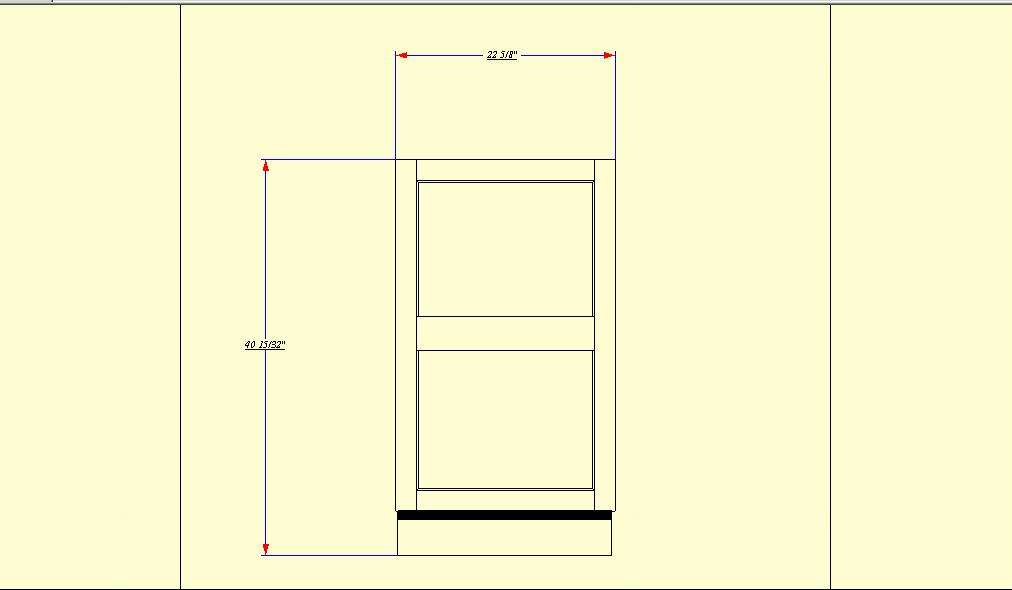
There really isn’t any solution except maybe moistening one side and working fast. This isn’t any help if it's to be used as a refrigerator panel though. I have a piece of DF 3/4" ply about 22" x 66" that is over 40 years old. It's been used as a ramp, table-top on saw horses, and generally abused in every way short of using a flame-thrower on it – and it's perfectly flat.


From contributor H:
To the original questioner: The best way to store plywood is in pallet racking, with a cover sheet on the bottom, and one on top - ten feet racking works well if you are using standard 4x8 plywood. It’s flat, easily accessible, takes up little space, limits humidity problems, and isn’t too expensive.


Have you reviewed the related Knowledge Base areas below?
  • KnowledgeBase: Knowledge Base

  • KnowledgeBase: Cabinetmaking

  • KnowledgeBase: Cabinetmaking: General

  • KnowledgeBase: Lumber and Plywood

  • KnowledgeBase: Lumber & Plywood: Storage


    Would you like to add information to this article? ... Click Here

    If you have a question regarding a Knowledge Base article, your best chance at uncovering an answer is to search the entire Knowledge Base for related articles or to post your question at the appropriate WOODWEB Forum. Before posting your message, be sure to
    review our Forum Guidelines.

    Questions entered in the Knowledge Base Article comment form will not generate responses! A list of WOODWEB Forums can be found at WOODWEB's Site Map.

    When you post your question at the Forum, be sure to include references to the Knowledge Base article that inspired your question. The more information you provide with your question, the better your chances are of receiving responses.

    Return to beginning of article.


    Refer a Friend || Read This Important Information || Site Map || Privacy Policy

    Letters, questions or comments? E-Mail us and let us know what you think. Be sure to review our Frequently Asked Questions page.

    Contact us to discuss advertising or to report problems with this site.

    To report a problem, send an e-mail to our Webmaster

    Copyright © 1996-2008 - WOODWEB ® Inc.
    All rights reserved. No part of this publication may be reproduced in any manner without permission of the Editor.
    Review WOODWEB's Copyright Policy.

    The editors, writers, and staff at WOODWEB try to promote safe practices. What is safe for one woodworker under certain conditions may not be safe for others in different circumstances. Readers should undertake the use of materials and methods discussed at WOODWEB after considerate evaluation, and at their own risk.

    WOODWEB, Inc.
    RR4 Box 265A
    Montrose, PA 18801

    Contact WOODWEB