Log trailers
Bought, homemade and home-improved varieties. October 9, 2002
Question
I am looking at either buying or building a small log trailer like the one from NovaJack. Theirs seems pretty well built and priced right, too. What do you think of these?
Forum Responses
Save your money and learn how to winch logs onto a cheap, low to the ground double axle trailer from the side. Low cost and goes anywhere (this is for big logs, not for a lot of little stuff).
From contributor P:
This trailer works behind my four wheeler. It has a single axle, but the wheels will flip and "walk" through the rough places. I winch the logs up the side on a metal ramp. Quite simple.
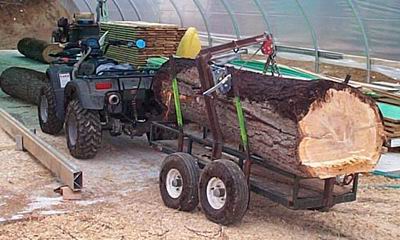
Where do you come up with the axles, wheels and tires? Are the tires low pressure turf or 4 wheeler tires?
From contributor K:
I am in the process of building a log trailer. I am using 2 mobile home axles. I bought them with good wheels and tires for $50/axle. On top of these sets 2 6x6x12' I beams. The cross pieces are also 6x6x6'. I have 4 of them bolted and welded on. I am working now on the uprights, trying to come up with a way for them to pivot (lay down) for rolling on logs too big to lift. It should be plenty sturdy and woods-worthy.
From contributor G:
I have a 24 ft flatbed gooseneck trailer (3 axle) that used to have those trailer house tires (9-14.5) and I just converted the drums and rims to heavy duty 16 in - 3750 lb rated rims and Goodyear G159 tires. That combination allowed me to keep the 7500 lb per axle rating and 22500 trailer rating. The 9-14.5 tires have gone up to $170 per tire and very few of them would last over 30 miles, especially in the summer.
The $50 per axle may not prove to be a very good deal unless you will not be loading them up close to their maximum rated load. Believe me, it's no fun trying to cut off the tread of a steel belted tire that is wrapped around the axle with a pocket knife while lying under a loaded trailer along side of a busy highway. I have seen those trucks that move mobile homes with racks with 20-30 spares along. If you are just using the trailer in the woods and not on the highway, they will work fairly well. It's the heat buildup that just destroys them.
For trailer parts, try Northern Tool or Redneck Trailer Supply.
Just remember, for hauling logs, decide on how strong you need the trailer to be and then double it.
From contributor K:
Thanks for the insight on the tires. Fortunately, most of my logging is done within a few miles of the mill, so it will mainly be a "woods" trailer. I think I will pick up another set of tires, just to be safe.
Contributor G, my tire man got me some tires for my mobile home axle equipped trailer that are just as good as any of the tires for "equipment trailers". They are made for these axles and will hold up to continued highway use with a full load. They cost me $100.00 per tire, but they are worth it in the long run.
I recently found a tire that will fit the mobile home axles (8X14.5). It is a Dynatrac brand with an F load range. Capacity says 2835 lbs. at 100 psi cold. My tire salesman charged me $47.60 per tire - balanced. They seem to work well, and last much longer.
On my log trailer [2 6000#axles] I welded 2 pieces of 2x6 tubing across 7 feet apart. For bolsters, I took 18" pieces of tubing and welded flat stock on either side leaving 6" extended on the end. Standing these upright on the ends of the horizontals, I drilled 2 holes through the sandwich. One acts as a hinge (bolted) and the other is the keeper. Put a 4' 2x6 in the end of the bolster, pull the pin, hinge the 2x6 down and you have ramps. Roll the log up and raise the ramp, and pull up to the next one. You can load from either side, butts to the front preferred.
From contributor A:
Contributor G, how did you convert the drums over? Did you buy new axles? Does this setup use brakes all the way around or just on the front one or two axles? I'm in the mobile home axle problem myself, and the brakes for the 12" drums are $120 per side. I'd rather straighten it out once.
Contributor A, change from mobile home drums to 8 lug. I had to change the inner race and bearing. If the brakes are shot or non-existent, it's cheaper in the long run to get new brake axles equipped with the proper drum. Around here it's 250 a brake axle and 250 for the complete hanger kit.
From contributor G:
Contributor A, on the first axle I just changed drums. You need to know the wheel bearing sizes so they can match that to the drums you will need. On the remaining two axles it was cheaper to buy the complete axle since I needed brakes.
I believe that most states now require brakes on all axles if you are over some weight limit, but I can't remember what it is. I have always had brakes on all 3 axles.
From the original questioner:
I am looking to build something more along the lines of contributor P's trailer, just maybe a little wider. It will only be used for retrieving the occasional log from folks looking to get rid of them, tree trimming crews, and a few grade logs that I can get my hands on, mostly in the 8 to 12 foot range. I like NovaJack’s design with the dump trailer and will probably design mine similarly to use for other light hauling jobs.
The comments below were added after this Forum discussion was archived as a Knowledge Base article (add your comment).
Comment from contributor J:
Are all of you guys out there big Paul Bunyan types? I'm 5'5", 130 lbs and I can load my log hauler in about ten minutes with a 20' log of almost any diameter. There are no hydraulics and I never lift the log with a separate piece of machinery. I can go into the bush or into town and do the same thing. I tow it with my 4x4 Toyota. It cost me maybe 500. I simply made an upside down U and added a long tongue and wheels. A couple of heavy duty truck strap winches and a bar to turn them with. The axle is removable in between the wheels and you drive over the log, lift it up with the straps and replace the axle, then lower the log onto the axle and tie it down with the same straps and winches. You're good to go.
