Today's
Sponsors:


Mereen-Johnson Machine Company

Merritt Woodwork

MFG in Honduras

Micro Fence

Microvellum

Middle Valley Lumber

Mikron Woodworking Machinery

Mill Outlet

Minimax

Mirror Reflections

MLS Machinery USA, Inc.

MLS Machinery

Modern Woodworking Magazine

Moldingknives.com

Monarch Machinery

Morbidelli

Moulder Services

Moulder Techniques

Mountainside Wood Products

Multicam, Inc.

NAP Gladu

Nebraska Tool

NEMI

New England Kiln Drying Association

NexGen

Hoffmann Machine Company

Holz Her U.S. Inc.

Howard S. Twichell Co.

Hvalsoe Sawmill Ltd.

ICA North America

Icy Straits Lumber

IDM

Impact Search and Placement

Indiana Hardwoods

Industrial Air Solutions

Integra Precision Grinding and Manufacturing

InTrading

Invicta Woodworking Machines

IpeDepot.com

irsauctions.com

Italpresse

J & G Machinery

J and J Barn Wood

J&P Machines

J. Gibson McIlvain Company

Jiffytops

JIT Hardware Supplies, Inc.

JMHsoftware.com

John G. Weber Co.

Joos USA Inc.

KCD Software

Kerber Farms and Mill

Keystone Wood Specialties

Keytrix Data Systems

Kiln-direct.com

Kleiberit Adhesives USA, Inc.

Kreg Tool Company

Kremlin

Lacy Cypress Inc.

Langelier Lumber Ltd.

Leadermac USA

Lewis Lumber Products

Lignomat

Logosol

Lumber Resources

Lumber Smith

M.L. Campbell

MACHINEKING.com

Macoser, Inc.

Mahros

Maine Timber Works

Maine Woods Company

Mann and Parker Lumber Co.

Martin Lumber

MARTIN Woodworking Machines Corp.

Mastercam - CNC Software

Matthews Mill

Maya Positioning Equipment


Making Your Own Wood Shakes or Shingles       what's the difference, how long they will last, and more. September 17, 2008

Question
Has anyone out there ever saw or used wood shingles? I have a bandmill and a plot of land with cherry, hickory, maple and hemlock. I've always heard of cedar being used or some other tropical hardwood. It would be used as siding on a new house that I'm building, but just as an accent on two large dormers. What do you think?

Forum Responses
(Sawing and Drying Forum)
From contributor S:
Sure, you could make your own shingles but on a new house and just for an accent I'd use commercially made western red cedar shingles. Before everyone could go to the store and buy what they wanted shingles were made out of whatever wood was at hand. Oak, cedar or other long lasting wood would be used on important buildings with lower grade shingles used on outbuildings and barns.


From Gene Wengert, forum technical advisor:
Shingles are used for an exterior roof. Shakes can be used for siding, interior or exterior. Shingles must be made of a decay resistant material (that is why cedar is used and the other species you mentioned will not work). They must not split when nailed or when exposed to wetting and drying. That is why white oak is not desired. They also must be fire retardant treated in many areas of the country.

Wood shingles may also have special requirements before the home can be insured against fire. This might affect you if you have a mortgage, and will certainly affect the resale of the home. You also need to check with the building inspector about what he/she will require.


From contributor G:
Old growth douglas fir is another wood used for shakes and shingles.


From contributor S:
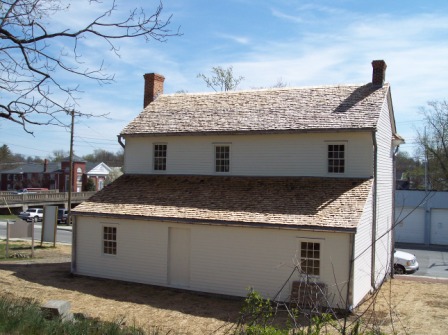
Here's a house in Kentucky with handsplit white oak shakes. This photo came from the Tarheel shingle mill in North Carolina. I've been told the white oak shakes will last at least 50 years, if applied properly.


Click here for full size image


From contributor A:
I was taught that shingles were sawn and shakes were split. I looked at the Cedar Bureau web site and for the most part that runs true with them. They say a shingle is sawn on both sides and a shake can have a split face and one face sawn.

Cedars, chestnut, white oak, black locust, osage, redwood, rock elm, yellow poplar and one old house I repaired had walnut shakes. Would not use hickory or maple for sure and I do not know about hemlock. Cherry is rot resistant but would seem like it would cup a lot and I could find better uses for it. Have sawn lots of shingles on my WM with the attachment they have and have split a many shake with a froe.


From contributor I:
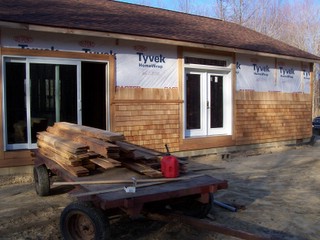
I sided the house below with cherry. 1/2 in boards off the circle mill, chopped to length, and I started nailing. Cupping was not a problem.


From Gene Wengert, forum technical advisor:
Contributor A is indeed correct that shakes are split (which gives them a uniform thickness as uniform as splitting can be end to end, as splitting follows the grain and the grain is parallel and does not taper). The shingles are sawn, usually giving them taper from end to end and therefore using less wood than a shake.

So, someone had the idea of making a thick shake and then re-sawing it at an angle so that it tapers and also so that the one side was smooth. Certainly, if this product is called a shake, it would have more appeal than if it were called a shingle. As the shingle or the sawn shake use less wood, they are financially preferred for large areas such as roofs today.

Of course, since only the heartwood has any decay resistance of note, and sapwood is more prevalent today with smaller logs, most shingles or shakes used for roofing are treated to resist decay and may be fire retardant treated as well.

I am curious what color that they cherry siding on Contributor I's house is as the cherry ages. Is it as elegant as I think it might be? Did you use only cherry heartwood? Did you have variable widths?


From the original questioner:
Thanks everyone for their replies. I've never heard of anyone using cherry before, but now that I do I might be more interested in using them. I live up here in the Northeast, so cherry grows almost everywhere. I live on a large plot of land that used to be a farm, so finding good quality cherry won't be a problem. I too, have thought of better things to do with cherry lumber, so that's why my barn is filled to the top with all kinds of lumber that I'm sawn. I use a Norwood model bandmill - it's low production, but it was so cheap that I was able to buy it and cut wood as a hobby.

I'm curious, were the boards that you cut 1/2" all the way though, or were they tapered? Did you dry the wood at all, or put it up wet? I've built Adriondack chairs out of cherry, so I can attest to the rot resistance (the galvanized screws rotted first). I've also used black locust for a small wooden bridge that I've made. It's about 20' long and uses 3 12" larch (Larix laricina) logs for the beams. It's weathered to a beautiful grey, versus the cherry which didn't have as uniform of a color (it has black splotches).

One more thing – Contributor I, did you have any problems with the cherry touching the housewrap? I've heard that surfactants in cedar can destroy Tyvek's moisture resistance. Gene, do hardwoods have surfactants?


From contributor D:
Shakes are usually tapered as well. I split a bunch by hand when I was a kid. If you turn the block and split the shake off alternate sides, they come off with a taper. If you don't flip the block, you get a shake with no taper. It works for cedar anyway.


From Gene Wengert, forum technical advisor:
I have watched them make shakes at Colonial Williamsburg and the shakes are fairly uniform in thickness, end to end but then they use a draw knife to taper them well.


From contributor I:
I wouldn't go looking for good cherry logs to do this. Most of these were fence trees, freebies or ones that needed down anyway.

My father in law and I sawed every stick in this house, except the roof deck and trusses. For the siding we would saw entire logs into a wagon load of 1/2" by mostly 6" and 8" boards. No taper. We cut the boards to 12" length and set the string for a 5" reveal. Under the starter row there is a 1/2 x 4 at the bottom to kick it back. We put them up just as fast we could and then sawed some more. The picture below is of the south side after two years. I plan on putting a sealer on as well.


Click here for full size image


From the original questioner:
Thanks for the pictures. They're very helpful and the house looks beautiful! I can see what you mean about not needing clear logs. The pieces that you used have a lot of character, which I think makes the house look even better. So did you end of hand nailing or using a pneumatic? Did you pre-drill so the pieces went up green too?


From contributor D:
If you split them all off the same side of the block they won't be tapered. If you flip the block each time they will be tapered. Don't know why this works but it does. I've done it myself as well as installing many shake roofs. All the shakes we installed were split and tapered. Maybe it only works for red cedar.


I am recently retired after 45 years in the shake and shingle industry, 10 as a shingle sawyer, with the last 20 as a shingle inspector for Intertek Testing Services. Don't waste your time trying to manufacture your own shingles unless it is really important to utilize some of your own trees on your home.

Go buy a few bundles of 18 inch No. 1 grade red cedar shingles for the dormers. You can also purchase these as sidewall products in a variety of styles with mill run faces or grooved or sanded faces. These come in rebutted and resquared with a regular straight butt or with a variety of other butt shapes such as round and etc.


Would you like to add information to this article?
Interested in writing or submitting an article?
Have a question about this article?


Have you reviewed the related Knowledge Base areas below?
  • KnowledgeBase: Knowledge Base

  • KnowledgeBase: Primary Processing

  • KnowledgeBase: Primary Processing: Sawmilling

  • KnowledgeBase: Woodworking Miscellaneous


    Would you like to add information to this article? ... Click Here

    If you have a question regarding a Knowledge Base article, your best chance at uncovering an answer is to search the entire Knowledge Base for related articles or to post your question at the appropriate WOODWEB Forum. Before posting your message, be sure to
    review our Forum Guidelines.

    Questions entered in the Knowledge Base Article comment form will not generate responses! A list of WOODWEB Forums can be found at WOODWEB's Site Map.

    When you post your question at the Forum, be sure to include references to the Knowledge Base article that inspired your question. The more information you provide with your question, the better your chances are of receiving responses.

    Return to beginning of article.


    Refer a Friend || Read This Important Information || Site Map || Privacy Policy || Site User Agreement

    Letters, questions or comments? E-Mail us and let us know what you think. Be sure to review our Frequently Asked Questions page.

    Contact us to discuss advertising or to report problems with this site.

    To report a problem, send an e-mail to our Webmaster

    Copyright © 1996-2009 - WOODWEB ® Inc.
    All rights reserved. No part of this publication may be reproduced in any manner without permission of the Editor.
    Review WOODWEB's Copyright Policy.

    The editors, writers, and staff at WOODWEB try to promote safe practices. What is safe for one woodworker under certain conditions may not be safe for others in different circumstances. Readers should undertake the use of materials and methods discussed at WOODWEB after considerate evaluation, and at their own risk.

    WOODWEB, Inc.
    RR4 Box 265A
    Montrose, PA 18801

    Contact WOODWEB


  •   Home » Knowledge Base » Knowledge Base Article