Stitches Telegraphing Through Cherry Veneer
Veneer pros help troubleshoot an puzzling bleed-through problem: stitches showing through over time in a Cherry veneer layup. January 11, 2007
Question
Check out the zigzag stitch on the center seam in the picture below. This is F/C fig. cherry with finish. Panels are manufactured as 1 ply cherry face with Kuper Stitch and glued with phenolic glue to 2 plies poplar. Panels are sanded and photographed before shipping to customer with no visible sign of bleed through. After customer applies finish, this bleed through begins to appear, after several months on most panels, during the cabinetmaking stages. All efforts to reduce UV have been taken. We cannot reproduce this in our face veneer before finish. This has also been seen with qtr. Honduran mahogany, aspen and eucalyptus, but mostly cherry. Any ideas?
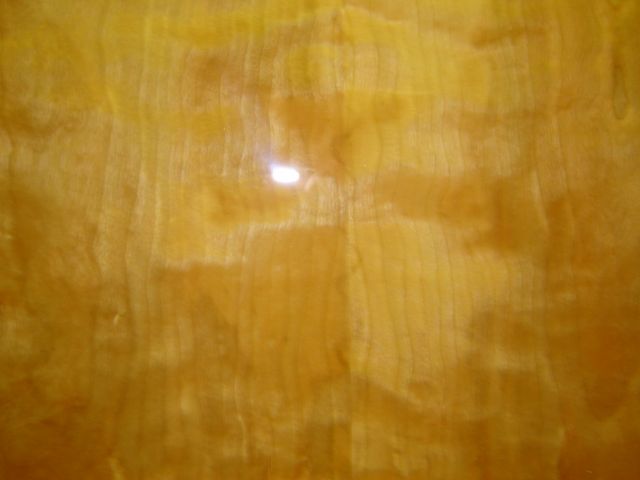
Click here for higher quality, full size image
Forum Responses
(Veneer Forum)
From contributor C:
If you are making the panels, press them with the glue thread up (outside). If you have a vendor making these, insist they use a Diehl splicer or similar. With thin veneers and a good sanding job, this is a common result using stitchers. For our panel products, we only use stitcher joints for backs or other low quality surfaces.
From contributor R:
What is the material used to make the thread on zigzag stitching of veneer, and will it fill up the sanding belt when the final sanding is done after pressing? I have seen this defect on stock hardwood veneer from my industrial suppliers before, but it seems to be that as I tried to sand it out (thinking it is leftover from factory sanding), what actually happens is that the veneer has been sanded through. To the questioner: could it be that you are sanding too much veneer off after pressing?
From the original questioner:
Thanks. No, I don't believe *we* are sanding off too much face veneer. The customer applies the finish sand and gloss finish to the panels. We only do a pre-sand to remove most of any white veneer tape that may be used. The idea of applying the Kuper Stitch to the face side sounds strange, but I'll talk to others here to see if that sounds possible. I think I'd also question the amount of buildup on the sanding belts the stitch would cause? Also, we manufacture our own panels. We have a glue weld seam splicer that can be used on certain species, but not all customers like it. The glue joint won't accept stain the way the veneer does, so they prefer the stitch. It's only after much time that the stitch begins to appear.
From contributor C:
Quick reply:
1-Nylon thread with a hot melt type of glue.
2-Will clog belts. Could remove after pressing with a hot iron and plastic scraper.
3-Of course it is sanded too much, but you should be able to sand 50% of the veneer away if needed. Light woods will telegraph the thread.
There are many people, especially in Europe, that use these machines. I would rather not have this as a potential problem. It could be more heat and pressure is needed in the press you are using. Have to experiment. Maybe you should just buy faces spliced with an edge gluer.
From contributor C:
If you are getting glue marks after staining with your edge gluer, you are doing something wrong. We do many hundreds of panels a week and rarely have that problem. Even with dark finish on cherry, etc. (notice I said rarely).
From John Van Brussel, forum technical advisor:
What was the thickness of the cherry veneer? How much veneer was removed in sanding? Does the customer sand further? Was the glue thread clear or a dark color when applied to the veneer? Which glue thread are you using? 1220 or 2210? What type of glue was used for pressing? What pressure, temperature and time were used for pressing?
From the original questioner:
The raw veneer is .0195-.205" thick. We remove a max of .003-.004" from the face side of panel. Our customer definitely applies a finish sand - can't tell you how much they remove? Our current thread is a clear 1220 - we've used this for years. We recently got a sample of 1210 and are considering switching - we understand it has half the glue. We use a PGF glue for pressing our face veneers. For a 4x8 panel - 280 psi, 300 degrees, at 4.5-5 minutes press time.
From contributor C:
Wow! 280 PSI - is that correct? What kind of press is that? That would be 1,290,240 lbs pressure on a 4x8 or 640 tons of hydraulic pressure.
From the original questioner:
My bad - we have 2 types of pressure gauges on our presses. It is 280 bars. Does that make more sense?
From John Van Brussel, forum technical advisor:
I am assuming PGF is phenolic glue film. What type of press do you have? 280 bar would be 280 x 14 = 3920psi. You would need a mammoth frame to withstand the torsional forces for this amount of pressure. Do you have a chart on your press to determine the correct pressure settings for different sizes?
From the original questioner:
PFG - correct. On one press, the platen is 5x10, with 3 different cylinder settings (8,10,12) depending on length of load. For a typical 4x8, we use 8 cylinders and the manometer (bars) is set for 260-280 per the charts provided based on square inches. The chart for PGF is a 200 PSI chart. Does this make sense? We've pressed this way for years.
From contributor M:
The delayed exposure of your stitcher thread may be due to the residual glue left by the thread, which has deposited adhesive in the pores of the cherry veneer. The delayed "revealing" of this condition could be caused by the photo reactivity of cherry. That is, as the cherry darkens, the stitch pattern is revealed because the glue is blocking, masking or "clogging" the cherry and preventing it from changing color.
From the original questioner:
Yes, that's the opinion we're leaning towards also. Our recent decision is to try the same thread with half the glue on it. We'll be trying that in the next few weeks to see how it handles, if it holds the seams as well, etc.