Table Top Breadboard End Repair
A woodworker gets advice on re-attaching breadboard table ends that were never properly attached to begin with. July 20, 2011
Question
I’m refinishing a homemade table (the customer’s father made) that has breadboard ends that weren’t installed properly. They were simply glued on to the end grain of the oak top. Needless to say the ends of the breadboard ends are coming loose and need to be repaired before I refinish. Since this is a repair and I am not constructing from scratch, what’s the best and easiest way to re-attach them properly? I don’t really want to go the route of tongue and groove, because it would shorten the table top length somewhat and take a lot of time. Maybe a wood spline into a slot cut into the end of the table top and breadboard end? Or is there a good way to utilize biscuits for this?
Forum Responses
(Furniture Making Forum)
From contributor D:
If it were me I'd cut them off and make new ones set in a traditional tongue and groove. You may feel more comfortable with biscuits or dowels or whatever, but really it's not any more difficult or time consuming. A large groove could be cut with small passes, with sacrificial scrap pieces clamped to each side to eliminate blowout. My feeling is, since you're repairing it, you might as well make it better than it was before. As far as your concern for not making it any smaller, you could groove both pieces and utilize a loose spline like you were thinking, or just make new breadboard ends, only bigger ones. In any case, just gluing to end grain is pretty much going to come apart again. Biscuits might hold it together, but I think it'll surely be prone to some separation.
From contributor C:
I agree. I'll just add that if the budget is minimal you could use screws in slotted holes and then plug the holes. Still not the right way, but it will work and will at least be a slight step up from the original method.
From contributor J:
You could install a few loose tenons, glued into the main tabletop but left unglued in overwide slots in the breadboard end (except for one on the middle, which could be tight and glued).
From contributor U:
If you have a horizontal boring machine, I would dowel it together. I've built dozens of dining table tops that way and never had one fail. I usually use 1/2" x 2" dowels on 4" centers. If your top is only 3/4" thick, I'd use 3/8 x 2 dowels.
It sounds like 1/2" dowels on 4" centers all the way across the ends of a dining table is a recipe for disaster. Unless you elongate the dowel holes in all but the center, you are trapping the main field of the table with the breadboard and something will crack. These tables you've done were solid wood?
From contributor R:
Loose tenons. Mortise the top and breadboard making all but the center mortise on the breadboard wider (1/4 to 1/2 inch should suffice) than the mortises in the top. Fit and glue in your center tenon to the top. Dry fit the other tenons. Slide your breadboards on and center drill each M/T in the breadboard. From the bottom if you don't want to go all the way through. Pull your breadboards off and slot all the tenons except the center one. Glue the tenons in the top and peg them in the breadboard. The breadboard will stay tight and aligned while being allowed to float.
From contributor U:
Yes, these tables were all solid wood. Mostly alder, but I've also done it with oak, walnut, cherry, pine, and mahogany. Maybe I'm just lucky, but in 25 years I've not had any failures with this type of joint. It's certainly not the only way to do it, but it's been working for me. Here's a photo I shot today of one I did in knotty alder about ten years ago.
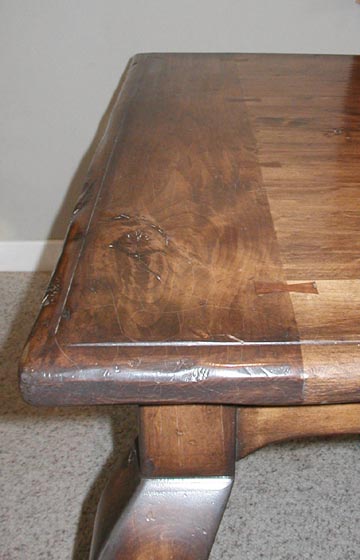
Click here for higher quality, full size image
From contributor O:
This is a good application for the Festool Dominoe - going along with what Contributor J suggested with the loose tenons. Making the oversize slots is easily done without compromising the alignment of the top to bottom fit. It's an expensive fit if you don't have the tool but do you have a Festool friend?
From the original questioner:
I wish I had a Festool Domino. I just bought their 6" random orbit sander and mini dust extractor and absolutely love it. Festool is definitely on my short list for tool brands now. As for the table top, I discussed it with my client, and he didn’t want to spend the extra money to fix the breadboard ends. I simply removed them (they popped right off) cleaned up the ends and routed a matching cove in the end grain, refinished the top and everything turned out well.