Troubleshooting Shrinkage Cracks in a Veneer Tabletop
Water-based glue may have caused expansion, then shrinkage, leading to gaps between the veneer pieces. June 10, 2006
Question
I just finished a project, and after a few days, the cocobolo seems to have shrunk in width, causing seams. It had to have shrunk because all the seams are becoming gapped, including where it meets the maple inlaid border. I cleaned the material with acetone to get the oils off, then glued them together with Titebond I. Then I did the same procedure, then glued them to the substrate. Why is this happening?
Forum Responses
(Furniture Making Forum)
From contributor F:
What exactly did you make/build? How thick was the exotic wood? Was the maple inlayed into the cocobolo? Other than that, as Gene often says, wood will not change dimension or shape unless there is a change in its moisture content.
From the original questioner:
I made a table that has a cocobolo top, maple inlay border, then alder legs and aprons. I resawed the cocobolo into 5/32" veneer, then glued them together and let them dry. Then I sanded the veneer sheet and cleaned it with acetone, then glued it to the substrate. After putting the legs and apron together, I put a ledger strip along the inside of the aprons. This strip holds the cocobolo top and makes the legs and aprons flush with the top. Then after gluing and setting in the veneered top and letting it dry, I routed a 1/4" x 1/4" groove around the seam where the cocobolo meets the legs and aprons, then inlayed a maple border. If you look down on the table you can see the top of the alder legs and aprons, then a maple inlay, then the cocobolo veneer. Now the strips of cocobolo are shrinking in width, causing gaps between each strip and between it and the maple. This is after it had 1 coat of wipe on poly. What caused this to happen?
From contributor R:
Is the cocobolo shrinking, or is the substrate expanding? If you used Titebond to glue the veneer to the substrate, the water coming out of the glue into the substrate may have caused it to expand. If that is the case, you may get lucky and have it come back as the moisture fully evaporates - which could take some time if it has to penetrate the oily cocobolo veneer.
An analogy might be the scenario with biscuit joining. A number of people have discovered, to their dismay, when they did a glue up using biscuits, and then sanded the slab immediately after it came out of the clamps, that several days later there were depressions in the surface, coincidentally right where the biscuits were. The cause was the surface swelling where the biscuits were. Then they sanded that flat, then the wood settled, and now there is a depression.
From the original questioner:
Sounds feasible. I will give it a while and see what happens. How long should I wait before I give up, sand the top again, fill the gaps, then refinish?
From contributor D:
Is the maple inlay glued to the substrate and the apron? It sounds to me that it is. And is your top glued to your base? If so, that's an oops. The maple didn't need to be 1/4", it should've been thinner than the cocobolo so that when it moved, the maple would go with it, and not stick to the sub and base. And your top needs to only be screwed to the base with holes big enough to allow the screws to move with the top. If your top had been solid wood and the conditions were right, you might have a pile of kindling now instead of gaps.
Probably the better fix would be to have your maple on the base and have some sort of tiny bevel or something where the maple and cocobolo meet so when (not if) there is movement, it will look minimal. But I'm no expert.
From the original questioner:
Unless I missed something, I don't think the top will move as if it were a solid top. The substrate is ply and the cocobolo veneer is glued to it. The maple is glued to the apron, which is irrelevant to the situation, because it is long grain to long grain and it isn't moving anyway. The only thing that is visibly changing is the cocobolo, and I'm assuming that it was either the initial glue-up where the water from the glue soaked into the cocobolo, or it had something to do with the humidity in southern Cali. It's been pretty hot and seemingly humid lately. No matter what, if it were around the edge only, I may think you are on track, but once again, it is all the seams of the cocobolo only. The cocobolo is cut into 3 1/2" sections, then resawn and then bookmatched. So every 3 1/2", a gap is forming. It is not pushing out - each individual piece of cocobolo is shrinking in width away from each other and away from the border. I will see if I can get a picture posted of the actual gapping tomorrow. I may have built it wrong, I admit. But I think it will be good for everyone to see it before they make that judgment, because I don't think so, having just watched how David Marks built the exact same table using the exact same methods. He used a different exotic, though. It was sweet. Looked like a red suede blanket.
From contributor D:
You'd be surprised how much plywood really does move. And I only believe it because I've observed it with these two eyes of mine, and I still argued with my eyes for a day or two, but I finally accepted it. Not only will wood expand/contract in width across the grain, but the length will do the same; usually not as much, but it definitely moves. These are a couple of reasons I hate doing veneer and inlays. Eventually, something moves. But like you said, there's no way to tell without seeing it. Is there any way you could remove the shrunken coco?
From the original questioner:
Here is a picture of the table. The white lines you see are dust collecting in the gaps that are forming. I think I will wait a few more days, then sand, fill, and finish, take it as a learning experience and be happy with my new table (not meant to be mine).
I believe ply moves too - I wasn't doubting you. I just feel that if it were the ply expanding, I would see gaps in the border or somewhere along the outside of it, not in the middle between the veneer. I guess it could have expanded left and right, but we are talking a total of 1/16 or better over the whole top. Very weird.
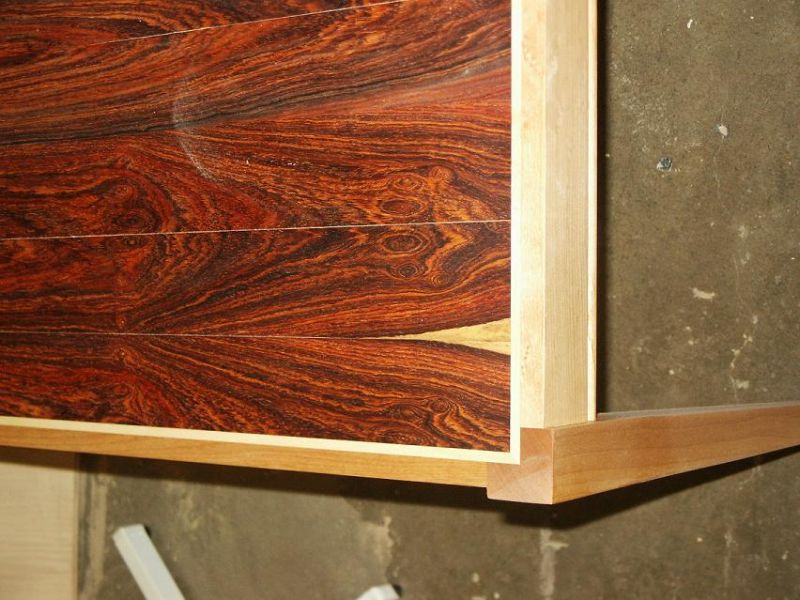
Click here for full size image
From contributor J:
As far as plywood moving, in normal house construction, both roof decks and subflooring are spec'd to leave 1/8" gap between sheets just because they can move that much. Gone are the days of any kind of quality in sheetgoods. Stuff today is about one step away from garbage.
From contributor D:
How long after resawing did you glue up the veneer?
From the original questioner:
After sanding it all smooth, I didn't touch it for roughly 24 hours. Then when I got ready, I used acetone, then glued up, let dry overnight, then sanded again. Seemed fine for about 3 days.
From contributor E:
If you used Titebond to glue this sawn veneer down, that is your problem. First, the Titebond puts excess moisture into the veneer, then when it dries out, it shrinks back down. Also, Titebond is not a rigid glue; it will allow cold creep. I would only use a urea resin glue for any kind of veneer work.
From contributor D:
Next time, if you've got the time, saw the veneer and let it sit for a couple of weeks, stacked so air can get to it. It could've had a high MC, and thinner wood will dry faster than thick, no matter what kind of glue you use. I don't believe Titebond will cause wood to shrink more than it normally would. Swell it, yeah. Make it shrink more when swelling goes down, no.
From the original questioner:
Thanks for the responses. I don't know what happened. All I know is that everything was tight when it got glued to the substrate, then it wasn't. Good thing this project was more for personal experience and not a customer. I build mainly custom cabinetry such as kitchens and entertainment centers. Building furniture is a passion I long to learn. Doing the joinery is no problem, but I am new to exotic materials and veneering. Especially resawing. Anyway, live, learn, do better next time. And do it all without throwing the project across the room.
From Gene Wengert, forum technical advisor:
Regarding the suggestion to let the veneer sit before using it, it is important to let it acclimate to a dry environment. Oftentimes, letting it sit in a shop over the weekend without any heat or HR control, the RH will be high and the veneer will expand. If you use this veneer on Monday morning, trouble is likely. I suggest having a small plastic enclosed room with a dehumidifier in it for storage.
In cases like this, I note that the surface opening is wider than the base (or bottom side) opening. This indeed confirms that the veneer was too wet. The adhesive you use was indeed a source of moisture; this may be the main problem or it could have been that the veneer was slightly high in MC and the adhesive added enough to make the MC issue a problem. Next time, try using a PUR without water - follow instructions, especially regarding ventilation.
The comments below were added after this Forum discussion was archived as a Knowledge Base article (add your comment).
Comment from contributor P:
The original poster is indeed experiencing many of the challenges of cocobolo I have experienced. After doing much research, I have learned a couple of important lessons about this wood: First, the recommendation to use a urea resin glue for veneering is quite accurate (a "tropical" epoxy can also work). Second involves finishing cocobolo. It will not take an oil finish directly.
Cocobolo has natural anti-oxidants that will prevent an oil-based finish from curing. Even wiping off the surface oils with a solvent will not solve this problem. Sealing the surface with shellac (alcohol and shellac flakes only) and then applying an oil-based topcoat or using a water-based poly are about the only options.
Comment from contributor M:
I would cut it all back down and glue the veneer to MDF. Then I would glue a veneer to the back. Use cold set veneer glue. Then band with 1.5"-2" maple (mitered and biscuit jointed). Mount the top to the leg/apron frame (don't combine the end grain legs into your top).