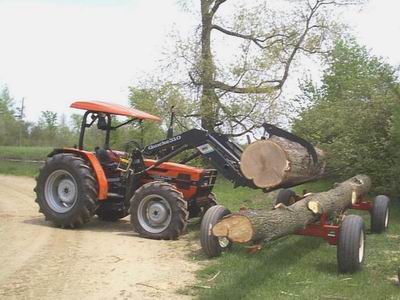
West Coast Live Oak Uses
This discussion of Live Oak lumber characteristics includes some info about the "Sudden Oak Death" disease that is plaguing the West Coast. July 30, 2007
Question
Can useful lumber be made from coast live oak? I have a client who lost a large one to sudden oak death and wants to have it milled up for use as furniture parts. Also, is bay laurel the same thing as myrtlewood?
Forum Responses
(Solid Wood Machining Forum)
From Professor Gene Wengert, forum technical advisor:
Live oak warps like crazy, so it is generally not used for lumber or furniture. What state are you in? This information about SOD killing live oaks is indeed interesting and I hope you are not in the South.
Bay laurel is not the same as myrtle.
From the original questioner:
I'm on the west coast of California, in the coast range, south of San Francisco about 40 miles. I made two vanities and 2" thick countertops, a linen closet, and mirror frame out of the bay laurel. The quartersawn grain was the best looking, but it was all nice. The rather bilious yellow color mellowed before long into a more pleasant tan.
From contributor F:
If you mill it, be sure to have it kiln dried to kill insects. I worked for a guy who air dried a bunch of it, but the bugs jumped on it quick. We thought maybe they were in the bark and moved into the wood tissue after sawing.
From Professor Gene Wengert, forum technical advisor:
SOD is a fungal disease that is presently confined to the West Coast and is killing a huge number of oak trees. The fungus is related to the same one that caused the Irish potato famine. It is relentless. Due to the different weather on this side of the Rockies, this disease does not seem to have taken hold (yet). It is spread through the roots and leaves of other plants mainly. One of those is rhododendron. So, nurseries have to be very careful about transporting ornamentals. I do not recall seeing that the lumber must be kiln dried.
From the original questioner:
By the way, California coastal white oak has only two commercial uses, as I've been told: it makes the dead flat best firewood [BTU's per pound] and for wooden parts which must resist immersion in water, it is said to resist decay in wet environments extremely well.
From Professor Gene Wengert, forum technical advisor:
Live oak (Quercus agrifolia) is in a different grouping than red oak or white oak. Therefore, live oak is different than Coastal white oak (I believe you mean Quercus garryana, also called Pacific white oak and Oregon white oak) and is different than California black oak (Quercus kelloggii... in the red oak group).
What makes live oak so different is the twisted grain. It is impossible to split, which was an advantage when it was used for sailing ships such as Old Ironside... that is supposedly how the ship got its name, as the wood did not split and shatter.
From the original questioner:
Yes, I meant Coastal live oak. Is there such a thing as Coastal white oak? There are some nice oaks here - valley oaks, white oaks (local), red oaks, very pretty stuff. Black acacia, much like acacia koa, beautiful grain and color, harder than Chinese algebra. The other common local acacia, with the yellow flowers, blooming yellow starting now, grey-green bark. Major allergens. Reds, blues, greens, blacks, yellows. Crazy beautiful wood. Koa pales next to some of this stuff.
The bay laurel. Who thinks this stuff is worth even firewood? I'm impressed with the stuff I've worked with... nutmeg, buckeye, madrone, eucalyptus. One of the most beautiful pieces of furniture I ever saw was eucalyptus, creamy white grained with teardrop shaped features running through on the bias which were translucent cream colored.
About six years ago I purchased maybe 350 board feet of local pine (came down in a major winter storm which coincidentally killed a couple people). The miller was the local minister, still climbing trees and milling lumber in his eighties. I used it for all kinds of unimportant projects for a couple years until I saw that it was really beautiful stuff. Now I'm down to the last few board feet, and it's precious to me. Golden, with many warm and interesting grain features.
I bought 250 BF of California walnut about eight years ago, a tree which was cut or fell in Palo Alto. Every BF of that tree is absolutely awesome - color, grain, mineral features, burl, unbelievable. It's dark featured and needs to be shown in a bright place, or it recedes. Look in your backyards, folks.