What's a Tough Top Coat Over Tung Oil?
Tung oil gives a deep, rich tone to fine wood. But how do you protect it from occasional water spills? March 30, 2008
Question
I recently made a top for a kitchen cabinet out of maple that has been under 20 feet of water for at least 107 years. I live on the site of an old sawmill from 1891. I am going to try first bleaching it with oxalic acid, then hand rubbing several layers of pure tung oil on it. Is there anything that you can put over the tung oil to make it impervious to stains from coffee cups, coke cans, etc? I was told that there is no difference in old sunken maple and the new stuff as far as porosity. I spent many months drying this lumber to the proper MC (8%) and from what I've read here, maple is very hard to stain, so I'm just going to leave it in its natural state.
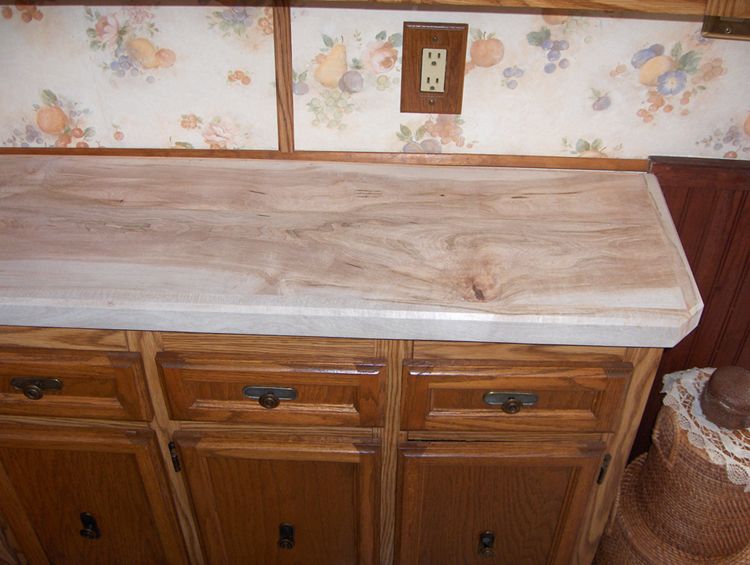
Click here for higher quality, full size image
Forum Responses
(Finishing Forum)
From contributor C:
Why would you want to bleach it? And why oxalic acid? I see no iron staining on the surface. I see absolutely no reason to bleach that surface.
From contributor D:
Use a Danish oil instead. If you want color, then get an oil with color in it. Put at least one coat of clear oil on first, though. I second the don't bleach.
From contributor U:
Wipe-on poly or spar varnish will work on top of tung oil. This should protect the top from water damage, but it will show wear, so you will need to reapply every year or so. Okay if it is in your house, but not in a client's. The best way would be an epoxy finish without the tung oil.
From contributor H:
You want to take what is probably old growth timber and bleach it? Why rob it of its dignity? Forget the tung oil, Danish oil. Apply a pale golden stain to pop the color and clear coat with 2-3 coats of spar varnish. Don't forget to do all six sides. It's a beautiful piece of wood. If you wanted it to look clear and bright, you could have banded a piece of maple ply.
From contributor J:
That does look like a beautiful piece of wood.
From contributor V:
I have done a lot of pieces with the finish you want to do, minus the bleach. I have used regular polyurethane, Danish oil, or even a custom mixture I learned a long time ago. It has poly, pure tung oil, and turpentine. The last one takes a few more coats but pops the grain really well. Got it from Michael Dressner.
From contributor C:
The only thing that is going to withstand the rigors of kitchen or bathroom environments as a top finish for extended use is either epoxy or polyester.
From contributor R:
My kitchen looks as good today as it did the day I painted it and I used oil based enamel. That was over 12 years ago! My bathroom was done a few years later with Benjamin Moore Regal brand latex paint and it looks just magnificent, or as Billy Crystal would say, maaaa-vell-us.
From contributor C:
You painted your tops with oil base enamel?! If you like that look, that is fine. I have not used oil base enamel for tops ever, but yes, it is very durable and would hold up well. But for a clear coat, I am saying nothing including oil enamel holds up as well as polyester.
From contributor R:
The tops were faux Lumachella and Broccatello all done in oils and latexes and topcoated in their clear respective coatings.
To the original questioner: if you have your mind set on bleaching this top, so be it. Oxalic acid is one of the milder bleaches we use, and the outcome can be easily reversed if you don't like the initial results. Tung oil (real and pure) yields a beautiful finish both in sheen and water resistance. The beauty is, the more coats you apply, the more protection you offer the wood. Chinese artifacts brought up from the deep that were finished many years ago with tung oil are as beautiful today as they were a hundred or so years ago. Chinese finishes falling into the category of oil finishes were accomplished in almost a ceremony type fashion. Very many coats were applied and allowed to properly cure before another coat was applied.
If I chose the route the questioner decided upon, I would apply a few coats of carnauba wax on top of the dry and cured tung oil. This could fit the bill for the initial question about offering extra protection against the dreaded coffee cup and Coke can syndrome.
The comments below were added after this Forum discussion was archived as a Knowledge Base article (add your comment).
Comment from contributor I:
Tung oil should work really well on its own. I would thin down the first couple of coats with pure turpentine, as substitute tends to yellow. You will need to apply further coats without thinning until you build up a really good finish which should be quite resilient. Top up your coat from time to time depending on the amount of use your table will get. Wear a mask if you sand the oxalic as it’s awful. You should not have used it in this instance as the wood will develop its own color with age.
Comment from contributor K:
I would skip the bleaching, do a thorough sanding and then go with several coats of oil-based polyurethane. The grain will show nicely and you will have a very protective finish.
Comment from contributor J:
That is a beautiful piece of wood and for the top I would apply three coats of oil modified Helmsman's urethane by brush (at least a 4" but I like the Wooster 6"). Let that finish cure out for a few weeks and it will be thick, clear and stand up to daily wear pretty darn well. As with urethanes it is slow drying but abrading between coats and tacking it properly for the final coat will leave a flawless finish with a lot of build to back it up.

