Question
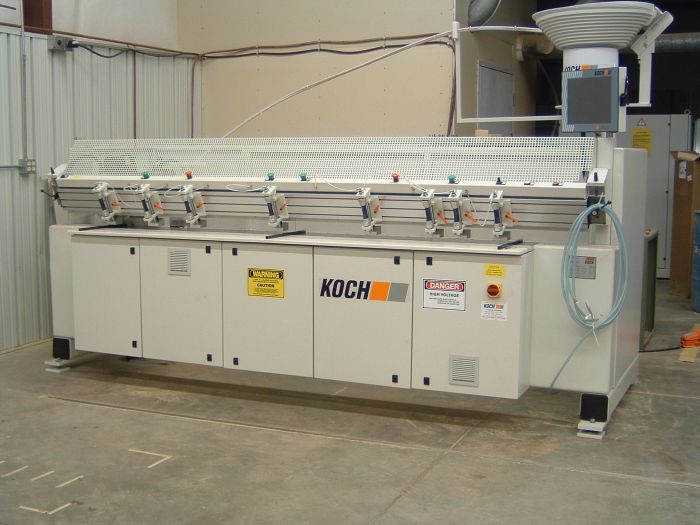
We cut our boxes on a flat table router and are moving toward doweling to enable us to bid on larger commercial projects where it is required. Back in the day when we were cutting on a pair of sliders, we doweled with a manual gun. Obviously the bore/insertion machines are the way to go, but I fail to see the need for this machine to be CNC driven versus a fixed head machine. Accuracy, speed and cost seem to either be a wash or favor the fixed table, so what are the advantages (or disadvantages) of going CNC with this particular machine?
Forum Responses
(Cabinetmaking Forum)
From contributor B:
You can write your program to set dowels anywhere along the edge, not just on 32mm centers. I place mine 30mm from the front edge and 50mm from the back edge. The back is inset 19mm so the decks have a dowel more or less the same distance from each edge. The rest of the panel is divided up equally with a logic statement that loses or adds dowels as the depth of the cabinet changes. I see CNC as an advantage. Next step is to lose the dowels, glue and case clamp and have the machine drill for comfirmat screws. In my opinion, way better and faster.
I still haven't made up my mind either, and have not asked any machinery rep as to whether or not we can get the borer dowelers to do the confirmats at the same time.
The most important thing, I was told, was the ability of the CNC to read the barcode of a screen to machine setup that strives for the speed, but you still require the flexibility to move around.
Here are a few advantages that come to mind:
1) Ease of use: you don't need to know where and how many dowels to insert. Program that designs your casework does that for you with very little input. On fixed head machines, you have to engineer your casework with the limitations of the fixed head machine in mind. We use Microvellum and we have to only specify where to insert the first and last dowels and the maximum distance between the rest and the program does the rest.
2) Speed: most CNC dowel inserters can read a barcode on your label and call up the program instantly and bore and insert a dowel every second. Throw the panel on another stop and execute a mirror program with one push of a button.
3) Accuracy: CNC accuracy is apparent. Add to it less likely chance of panel movement, as one hole is drilled at a time instead of up to eight at a time, requiring robust clamping.
When MV isn't used, you can easily program at the control for a few odd and end parts. We’ve found other uses for the machine also. We do a lot of odd things in store fixtures so we’ve made jigs that allow through boring or to hold parts that have a profiled edge.
We’ve got the timer on the case clamp set at 5 minutes. That serves to set the pace for completing a case. All face boring for panels is done on a Komo, nested.