Question
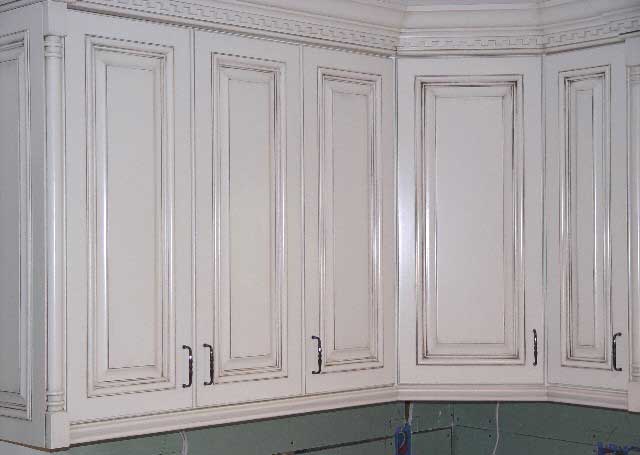
I am looking for some advice for the following effect: A designer recently showed me cabinets that were painted off-white. They also had a dark brown glaze, which was primarily in the recesses of the profiles. Very little was left on the panels or frames of the door. The glaze was very transparent and you couldn’t see any. The tops of the profiles were sanded or wiped to bare wood.
This wasn’t random - rather the whole profile around the door was the wood showing through. There is also a light and random worm-holing throughout. There are five or six holes in any one area. My biggest question is , where in the process you do the rub through? I'm sure this can be done with lacquers or pre-cat, but I also would like to know if you can, and if anyone has done it with water-base? Also, can it be done with NC and just clear coat with pre-cat?
Forum Responses
(Finishing Forum)
From contributor S:
You can do the finish with nitrocellulose (NC) lacquer, pre-cat, or water-base, but you should stick with the same system throughout. One possible problem with NC or pre-cat lacquer is yellowing of the finish; you may want to use a water-clear (water-white; "WW"), non-yellowing finish. On the other hand, using a finish that is yellow adds to the aged look of the finish. It'll depend on the sample you have and what your designer wants, as well as what wood working finishes your suppliers have.
Here are the steps I'd use with a lacquer;
Apply the first coat of paint (pigmented lacquer), let it dry, and sand it aggressively till it’s smooth. Go ahead and sand through where you want the wood to show.
Apply a second coat of paint with the same sanding.
Make the worm holes.
Seal it with a wash-coat of vinyl (WW if your topcoats are).
Scuff it and sand smooth with maroon scotchbrite.
Watch your solids contents for each coat to avoid going over the maximum dry film limit if you use pre-cat lacquer; I'd thin the paint and vinyl, and keep the coats around 2-3 wet mils each. I'm starting on a kitchen that sounds almost exactly the same; without the worm holes. The designer added the rub-throughs on this job.
For the worm holes, a small drill bit works fine. Drill after the paint so the holes are dark. You can use anything you want for distressing. I usually use a variety of hand tools and a paint scraper. Just go for dents and dings that happen over time (take a look at some old furniture at the thrift stores). Don't overdo the distressing or make each piece look just the same.
