Home » Knowledge Base » Knowledge Base Article What's New  |  Site Map 


Today's
Sponsors:


Tongass Forest Enterprises

Tooling on the Web

Toolstoday.com

Touch Up Solutions LLC

Tractivity

TradeJobPlacement.com

TradeSoft

Trakware Systems Inc.

TRB Flooring Company

Tropical American Tree Farm

Tropical Hardwoods

UC Coatings Corp.

Unique Machine & Tool

University of Wisconsin

UWMO Auctions

VacDry Kilns

Vacuum Pressing Systems, Inc.

Vacuumpods.com

Vecoplan LLC

Vector Art 3D

Vectric Ltd.

Veneer Systems Inc.

Veneer Technologies Inc.

Vintage Perkins

VortexTool Co. Inc.

VyTek

W. Moore Profiles, Ltd.

W.L. Fuller

Wadkin North America

Wagner Electronic Products

WalzCraft Industries

Webb Abrasives

WEIMA America, Inc.

Weinig Group - USA

Western Dovetail

Williams and Hussey

Wisconsin Knife Works

WMIA

WMMA

Wood and Wood Products

Wood Doctor's Rx, LLC

Wood Tech Enterprises, Inc.

Wood Technology Inc

Wood-Mizer

Wood-Ply Lumber Corp.

WoodCabinetDoors.Com

Woodcraft Supply Corp.

WoodcraftPlans.com

WoodenBoat

WoodFinder

WoodJobs.com Search Consultants

Woodland Dimension Products

WoodLINKS

Woodmaster

WoodPlanet Inc.

WOODWEB

Woodworker's Supply/woodworker.com

Woodworker's Directory

Wright Timber

SK-USA

SketchList

SlipCon USA, Inc.

SnapDragon Associates, LLC

SNX Technologies

SoCalMachinery.com

South State Machinery

South Texas Moulding

Southeast Tool, Inc.

Specialtytools.com

SprayGunWorld.com

Stairguy Stairbuilding Videos

Stefani

Steve H. Wall Lumber Co.

Stiles Machinery

Stiles Shop Solutions

Stor-N-Fold Systems

Super Source Tooling Inc.

Supergrit Abrasives

Target Coatings

Techno CNC Routers

Template Services

Teragren

The Cayce Company

The Veneer Store

Thermwood Corporation

TigerStop

TigerwoodDecking.com

TimberKing

Timesavers Inc.

TMS Machinery Sales


WOODWEB DISCLAIMS any and all RESPONSIBILITY and LIABILITY for the accuracy and application of the information below. Readers agree to evaluate the significance and limitations of the information provided, and accept full responsibility for the application of this information. Read More ...

Would you like to add information to this article?
Interested in writing or submitting an article?
Have a question about this article?


Air-Drying Time and the Need for Conditioning       If you air-dry lumber for long enough, it won't experience drying stress in the kiln; but you do risk lumber degrade. July 30, 2007

Question
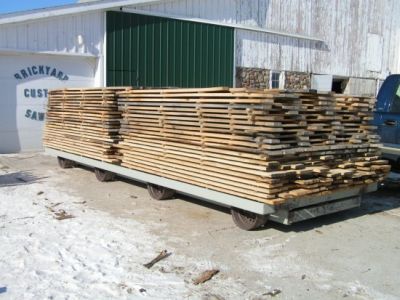
I have a question. Has anyone out there had a problem with not stressing lumber after kiln drying, if it has been air dried first? The kiln operator says it only needs to be stressed (steamed) after the kiln drying if it hasn't been air dried to 10-12 percent first. A friend of mine says it should always be stressed. I haven't had a problem so far. All my oak is air dried at least 1 year. The lumber pictured is two-year air dried and down to 10 percent, then it goes in the kiln for a month and is taken down to 6 percent. I take it back to the shop and stack it inside. It usually sits there for a month or so before I start using it.
Forum Responses
(Sawing and Drying Forum)
From contributor D:
I think someone has given you a lot of misinformation about drying lumber. I am guessing that you are talking about de-stressing, or conditioning, as it is commonly called. I believe most people will agree with me that you are going to extremes on the amount of time you are air drying. I would not let lumber air dry that long because of the risk of degrade, not to mention the fact I couldn't afford to keep that much inventory tied up. Oak can develop stress if allowed to air dry too fast in hot weather, but if it is kept in the shade and out of the wind, you should be okay. Also, the only way I could imagine taking a month to dry lumber from 10% to 6% in a kiln would be to leave the kiln shut off for at least 3 weeks.

In the past I have dried close to 100,000 bf of red oak 3-4000 bf per load in an Ebac dh kiln. I would air dry it to about 30% (1 1/2 to 2 1/2 months depending on the weather), then I would dry it in the kiln at a rate of about 1% per day. Drying this slow would not let any stress build up in the lumber. I never conditioned it and my customers said my lumber was the best they had ever used. I now have a Nyle and dry my oak at about 1 1/2% to 2% per day (still much slower than the big companies dry). At this rate of drying, I condition it for a few hours and have no problems.

I think if you look in the Knowledge Base here at WOODWEB, you will get a lot of useful information about drying your lumber. I think it would be advisable for your kiln operator to learn more about drying also.


From Professor Gene Wengert, forum technical advisor:
You have been correctly informed about drying stresses. That is, air-dried lumber that has been air-dried for a year will not have any drying stresses, so the lumber will not need to be conditioned (or steamed).

I do agree with contributor D that such long drying time can result in excessive quality loss. On the other hand, long air drying for white oak will result in a vanilla aroma that the wood will have. Such wood is ideal for wine barrels, as the wine will pick up this flavor. But for all other uses, you are wasting time and perhaps losing quality.

I do agree with contributor D that your kiln drying time is too long. What is your average outside RH? If you can get the wood down to 12% MC, then it is 65% RH. Make sure that you start the kiln at a humidity no higher than 65% RH and preferably closer to 50% RH. Note that you cannot damage the wood at this point (except by over-drying).


From the original questioner:
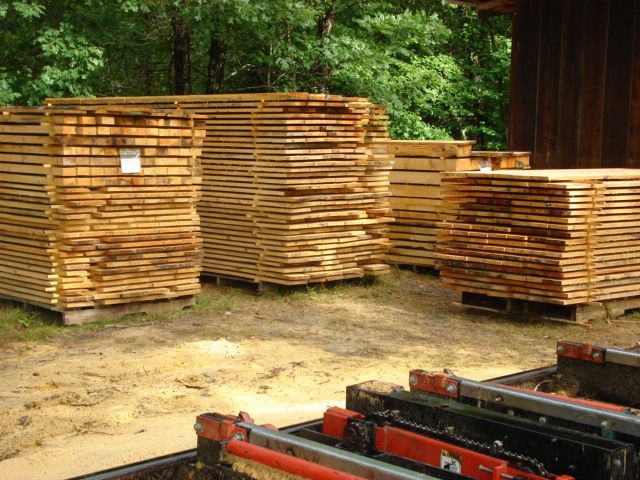
Thanks much. I only have room to store about 2k bdft of oak inside at a time. I do a harvest every other year of about 5k to 6k bdft. I keep the oak out of the sun while air drying. I'm up here in Shell Lake, WI. (Go Badgers!) It's in northwestern WI, which gives us about 5 good months of air drying time a year. I don't think a whole lot happens in the winter. The kiln I use is very small (about 2k bdft) and I'm not sure of what the kiln temp is or why it takes so long, but I will be asking. I will also go through the wealth of info that Doc has posted on this site.


From contributor B:
Contributor D, to achieve 1 percent a day, what is your compressor set at? I have never dried oak. I was always worried about drying it too fast. Is your wood at 30 percent MC when you start out? I suppose for 2000 feet your compressor is running less than if you had 3000 feet.


From contributor D:
When I was drying lumber with the Ebac kiln, it was an LD3000 model with a 3/4 hp compressor. Ebac called this model a 3000 bf dryer. With 3-4000 bf per load, I would run the compressor at 100% to dry at about 1% (or slightly less) per day. I now have a Nyle L200 which comes with a 2 hp compressor. Nyle calls this a 4000 bf dryer and says it will remove about 2% per day from this much lumber. One big factor that will affect the drying rate in your kiln is how well it is sealed. In the kiln I have now, I installed a 6 mil plastic vapor barrier in the walls and ceiling and painted the interior walls with mobile home roof coating. In the 10'x24' sliding door I used the roof coat but no plastic. I damaged 2 different loads of oak before I realized I was losing a large amount of moisture through the door. To show you how much, the 3000 bf load of ash I have in the kiln now dried from 70% to 30% in 2 weeks with the compressor off. Outside temp averaged 15 degrees. Inside temp of 95 degrees was maintained with a 4 kw heater. My point is, every kiln will have different characteristics, so start with a conservative schedule and learn how fast your kiln can dry. Sorry I can't be more specific, but you are right, a little too slow is better than too fast with oak.
Have you reviewed the related Knowledge Base areas below?
  • KnowledgeBase: Knowledge Base

  • KnowledgeBase: Primary Processing

  • KnowledgeBase: Primary Processing: Air Drying Lumber

  • KnowledgeBase: Primary Processing: Kiln Operation


    Would you like to add information to this article? ... Click Here

    If you have a question regarding a Knowledge Base article, your best chance at uncovering an answer is to search the entire Knowledge Base for related articles or to post your question at the appropriate WOODWEB Forum. Before posting your message, be sure to
    review our Forum Guidelines.

    Questions entered in the Knowledge Base Article comment form will not generate responses! A list of WOODWEB Forums can be found at WOODWEB's Site Map.

    When you post your question at the Forum, be sure to include references to the Knowledge Base article that inspired your question. The more information you provide with your question, the better your chances are of receiving responses.

    Return to beginning of article.


    Refer a Friend || Read This Important Information || Site Map || Privacy Policy

    Letters, questions or comments? E-Mail us and let us know what you think. Be sure to review our Frequently Asked Questions page.

    Contact us to discuss advertising or to report problems with this site.

    To report a problem, send an e-mail to our Webmaster

    Copyright © 1996-2008 - WOODWEB ® Inc.
    All rights reserved. No part of this publication may be reproduced in any manner without permission of the Editor.
    Review WOODWEB's Copyright Policy.

    The editors, writers, and staff at WOODWEB try to promote safe practices. What is safe for one woodworker under certain conditions may not be safe for others in different circumstances. Readers should undertake the use of materials and methods discussed at WOODWEB after considerate evaluation, and at their own risk.

    WOODWEB, Inc.
    RR4 Box 265A
    Montrose, PA 18801

    Contact WOODWEB