Question
I have a project that will require the use of a router table. I have Porter Cable equipment. Most what I do is on the job site, not in the shop. I am looking for suggestions on which is the best router table made for general use, job site or shop.
Forum Responses
(WOODnetWORK Forum)
From contributor F:
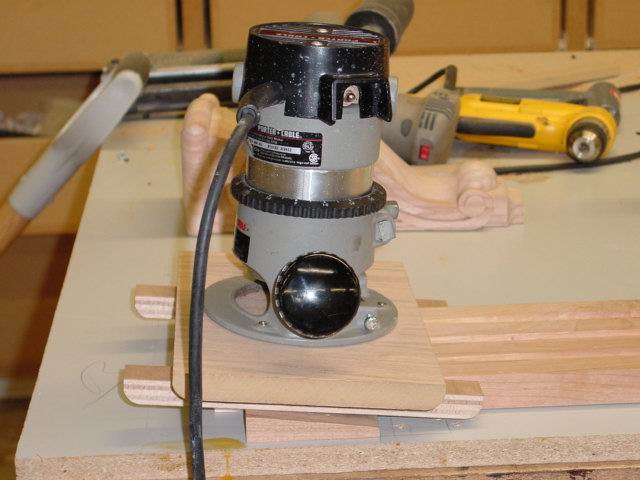
I guess you could always make one for the shop and one for the road. I have a nice heavy one in my shop that has a height of about 36" and a stand made from 4x4 material. Nice and solid to minimize vibration. Usually when I need one out on the road, I grab a scrap of .75" thick "whatever I can find" material and screw a router base to the underside. A straight piece of two by four and two F clamps make for a quick fence. Screw the table to the top of a couple of sawhorses and I'm in business. If I needed a router table a lot onsite, I would cut a piece of flat .75" MDF to about 20" x 36". I would laminate both sides with standard grade laminate scrap and then miter, clamp and glue a hardwood edging all around the edge. Bolt a router to the underside and cut a hole with the router and a plunge style bit. I would make a 2"x4"x36" fence from some dry stuff. This would be easier to transport than a shop model with a stand. On site, I would support the table with sawhorses or whatever was convenient, or maybe even make some sort of knock-down stand and cart to take to the job site.
The table. Use melamine clad MDF, 1.25 thick about 24" X 30" or so. It helps if it is banded. A nice feature is to route a T-trac guide. Seal all of the exposed MDF with polyurethane or Watco oil. Several coats. Even the routed opening for the router plate and the T-trac. Table top size is directly related to what kinds of work the router table will see. The choice of material you make the top from vary widely. I've mentioned MDF. Phenolic is another option. If your shop is tight on space, you might consider having one of your table saw's extension wings machined to accept a router plate.
The router plate/lift. If you can afford it, go with a router lift. There are two or three that are very good. I use a JessEm Master Lift with a PorterCable Speedmatic 7518 router. Bench Dog is another decent lift. Most of the router plate and lift manufacturers have templates available so that you can cut the router plate opening.
The fence. I use a Freud micro-adjustable fence as my sub-fence. Yep, as the subfence. I removed the Freud-supplied aluminum fence plates, and had larger ones machined for me (longer, higher, and thicker, tapped and threaded). I replaced the Freud-supplied split fence with one of my own design containing T-tracs on both fence surfaces. One that mates to the aluminum sub-fence, the other which can hold various jigs (hold-down, feather board, etc.).
The stand. Buy one or make one. You want one with some heft so the table will stay put. The MLCS catalog has a decent one, though a bit pricey. This is where your tastes come into play. You may want to put your own cabinet under the table top to house your router gear.
Kill switch. Get one and use it. Pay careful attention to the ergonomics of where it should be mounted. It may just save a fingertip. Rousseau has a decent one. A caveat here. Please do your own research and homework. I mention a couple of brands herein. I use them, I like these specific products, I find them to be very high quality, and I am really picky and tough.