Beading Face Frames on a CNC Router
Here's how one shop machines the joints for cabinet face frames using CNC equipment. January 21, 2007
Question
Is anyone using their CNC to haunch out beaded face frames? If so, would like to hear details.
Forum Responses
(CNC Forum)
From contributor K:
Yes, we are haunching as well as mitering our inset face frames on our Biesse Rover 24. We use counter-rotating 1/4" diameter bits so as to avoid chip out on the edge grain. Works like a charm!
From the original questioner:
Thanks for your response. Would like to know your setup. How are you holding the face frame and are you routing one haunch at a time, or are you laying out all routs like top, mid and bottom rail?
From contributor K:
Our retractable index pins are moveable around the perimeter of the table. They have a tapped hole in the ends as well. When the start button is pressed, the pins retract pneumatically with tremendous force. We attach a .5" thick x 1" wide x 4" long aluminum bar to the ends of the retractable pins to function as a clamp.
Regarding the haunches, yes, we are machining all of the haunches on each part at one time as well as mitering the ends if applicable. It is necessary to miter the ends on the router because they must have a fillett at the intersection of the flat end and the mitered bead area. This fillett radius is half the diameter of the router bit used to cut the haunches. Because we use a 1/4" bit for the haunches, the fillett radius is 1/8". Once the frames are assembled, the small radius is invisible unless you stick your nose in the joint.
From the original questioner:
I am a novice with the CNC. I have been going about it different - I was trying to use a 45 degree bit and clamp the face frame on its 3/4 edge and make the cut. If I understand you, you are making the cut on the face using a 1/4'' bit and by cutting the miter with the same bit the joints will seam together. When you say counter-rotate, does this mean you are climbing from one end of the cut and then using a conventional cut from the other end?
From contributor K:
Yes, we are machining the pieces lying flat on the table and using a straight bit. When I said we were using counter-rotating bits, I meant that we were using a right hand rotation to machine half of the haunch and miter, and a left hand rotation to machine the other half of each joint. All cutting is done with a standard feed direction, and no climb cutting is involved. This eliminates any tear out because the bit is always entering the edge of the part, and never exiting the edge.
From the original questioner:
Okay, I got it. Should be a piece of cake. Thanks.
From contributor J:
Contributor K, is your frame stock beaded at the moulder or is that done on the router?
From contributor K:
We bead the stock on the moulder, cut to length, and then process the joints on the router.
From contributor T:
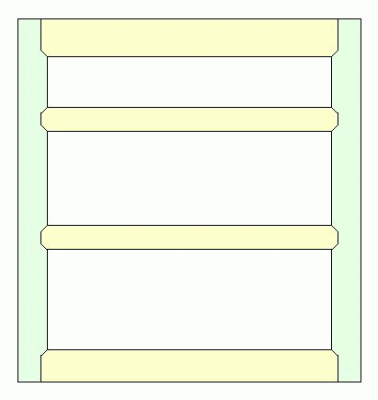
This sounds pretty interesting. I don't fully understand your clamping system, but I will take that part on faith. What I am curious about is process time. How long would it take you to load, machine and unload a face frame such as this? Do you process these six sticks one at a time or can you process several elements? Does the router also process a pocket hole for screwing the frame together, or do you use some other kind of fastener? If you started process at 8AM, how soon would this face frame be headed to the glue up station?
From contributor K:
First, the clamping system. The Biesse flat table router has a slotted aluminum extrusion that runs around all 4 sides of the table. The pneumatic index pins slide along these extrusions and can be locked at any location. The pins pop up when I select a program to run, and then retract when the start button is pressed to begin the machining cycle. Because the pins are dual acting cylinders, they are powered in both directions, up and down. By attaching a flat plate to the end of the pin, it becomes a hold down clamp as it retracts and pinches the stock between the plate and the spoilboard surface.
Regarding process time, it obviously varies based on the number of joints to be machined. We are processing one part at a time. The average cycle time including load, machine, and unload is approximately 1 minute per part.
We are not currently machining the pocket screw holes on the router, but that could certainly be added to the process. In all reality, the operator has down time while waiting for the machining process to complete. This down time can easily be used to process the pocket screw holes offline on a stand alone machine.
So, if you started the process at 8:00 am, you could have the 6 parts completely processed including pocket screw holes, and handed off to assembly, by 8:07. That may not be light speed, but it certainly beats the hand work.
From contributor T:
That is pretty impressive. We are about to build a fairly extensive project with face frames like this. We've done a lot of this and we are pretty good at it with our current method. I will track my labor minutes. I've developed an interest lately in some of the more esoteric things CNC could do for basic kitchen cabinets.
One of my interests is machining cabinet doors to finish dimension on a CNC router. We currently do this on an Altendorf slider, then proceed to maul the doors on the edge sander. I was contemplating trimming doors to size on a shaper because of the inherent advantages of insert tooling (so much sharper) and the lower skill requirements (edge sanders take a lot more talent).
I'm interested in a comparison of times and outcome for various methods. I can foresee the shop of the future being staffed with one man and a dog. The man's job is to feed the dog and the dog's job is to keep the man from touching any machines.
From contributor J:
Is it possible to do end cutting and joinery of solid wood pieces on a flat bed router? I am in the router learning process, so please correct me if wrong. To be effective and eliminate material handling for solid wood pieces, it seems like a pod and rail or grid table with pods is the best for solid woodworking. Do the flat table nested machines accept pods?
From contributor K:
Yes, most flat table machines can accept pods. I think you will find that a flat table machine will generally give you more flexibility when dealing with the multitude of machining setups you face as a custom woodworker. There is no doubt that a pod and rail machine will surpass a flat table for some operations, just as a flat table will outperform a pod and rail on other operations. I just think the flat table is the best all around option.
From contributor J:
Thanks. I am taking my time to learn about these mechanical marvels. I do have some advantage because I already have the dog contributor T mentions.
I’m still a little confused by the two types of flat tables. At IWF I watched a Venture 12 making interior door parts with what Homag calls a Grid Matrix option. The table is aluminum and the pods could be placed easily on this. They said it could also do nesting on panels. This seems like it would be the most versatile for cabinets and millwork. Holz Her had a similar setup and even a Meta option with the flat phenol resin panel and matrix combined. I take it the flat table is better for nesting, the matrix a good compromise for doing both solids and panels, and the pod and rail best for solid wood millwork. The pod tables require less HP for the vacuum and might be safer because the off cuts and dust drop out of the way.
