Today's
Sponsors:


Veneer Systems Inc.

Vintage Wood Products

VortexTool Co. Inc.

VyTek

W. Moore Profiles, Ltd.

Wagner Electronic Products

WalzCraft Industries

WEIMA America, Inc.

Weinig

Western Dovetail

Williams and Hussey

Wisconsin Knife Works

WiseWood Veneer

Wizard Industries

WMMA

Wood Doctor's Rx, LLC

Wood Source

Wood Technology Inc

Wood-Mizer

WoodCabinetDoors.com

WoodenBoat

WoodJobs.com Search Consultants

WoodLINKS

Woodmaster

WoodPlanet Inc.

WoodSprayGuns.com

WOODWEB

Woodworker's Supply/woodworker.com

Woodworker's Directory

Woodworking Network, a Division of Vance Corporation

Woodworking Technology

Wright Timber

Zipbolt

T-Tool USA LLC

Taghkanic CNC Services

TaylorCraft Cabinet Door Company

Techno CNC Routers

Template Services

Terminus

The Machine Warehouse

Thermwood Corporation

TigerStop

TigerwoodDecking.com

TimberKing

TimberTop Woods

Timesavers Inc.

TMS Machinery Sales

Tooling on the Web

Touch Up Solutions

Tractivity

TradeJobPlacement.com

TradeSoft

Tritec/GANNOmat

Tropical Hardwoods

TSI

UC Coatings Corp.

Unique Building Supples

Unique Machine & Tool

University of Wisconsin

Urban Evolutions

UWMO Auctions

Vacuum Pressing Systems, Inc.

Vacuumpods.com

Valspar

Vectric Ltd.


Condensate Drain Problems

      Ideas for keeping your air tank dry during operation. December 7, 2008

Question
We have a rotary screw compressor and a 200-gallon tank. We get an extreme amount of water in the tank this time of year. We have an automatic drain at the bottom of the tank, but the tank is old and has rust in it and the rust clogs up the filter all the time. Then the tank fills up with water. I pulled the automatic drain off and just put a hose on it and have been keeping it open a little. I did not think that this was a long-term solution so I purchased a large water filter and connected it to the drain outlet. I attached the automatic drain to the large water filter. It did not take long for the water filter to fill up with water. Every minute or so, the auto drain opens and pulls off some of the water in the filter.

I am just wondering if this is really going to work, or if I will have a problem later on. Am I forgetting something important? If the water keeps draining from the bottom of the air tank, it should work just fine. Is there a better solution?
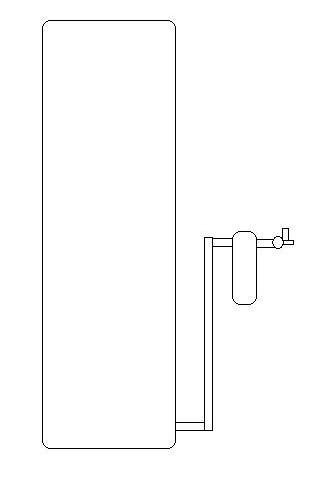

Click here for full size image

Forum Responses
(Cabinetmaking Forum)
From contributor R:
I don't think it is a problem putting a filter before your auto drain valve but the valve has to be below the bottom of the tank in order for the float chamber to fill and open the drain valve.


From contributor M:
The type of auto drain that I have is just a solenoid that opens a valve at set intervals for a set amount of time. It does not use a float.


From contributor R:
That type of drain valve could go anywhere. So it just drains whether it needs to or not? Seems wasteful.


From contributor D:
Is there not a drain cock on the underside of your tank (bottom, dead center)? The location you show only keeps water from filling the tank when the idea of the autodrain is to keep it dry. If there is a drain there (or a plug), raise the tank to make it accessible. Drain tank and flush well to clear the crud out. Install the autodrain on the underside drain.

I think ours runs about five to ten seconds on about a ten minute cycle. That junk you're filtering is also going the other way and will eventually cause problems in tools and (worse) paint lines. It doesn't matter how many filters you put in.


From contributor J:
We use a refrigerated compressed air dryer in between our compressor and the air lines. Are you using something similar? You need something to remove all the moisture from the air lines before it goes into any tools or equipment.


From contributor L:
Our system goes from the rotary screw compressor through an air to air cooler, coalescing filter, refrigerated drier, then the regulator before going into a loop system of copper piping. Every morning before the compressor is started we manually open the drain on the tank and the coalescing filter. The refrigerated drier has a timed auto drain. It is set for a short blow down time since most of the water has condensed out before it gets there. Timed drains are wasteful but are more reliable. All the condensate goes into a filter that separates the oil so the water can be let into the sewer. Ideally our air to air drier would be after the coalescing filter but it is located on top of the compressor room and used to pull cooling air through the room. We also have desiccant driers in front of several expensive major tools just to make sure! They color change when they need service.


Would you like to add information to this article?
Interested in writing or submitting an article?
Have a question about this article?


Have you reviewed the related Knowledge Base areas below?
  • KnowledgeBase: Knowledge Base

  • KnowledgeBase: Cabinetmaking

  • KnowledgeBase: Cabinetmaking: General


    Would you like to add information to this article? ... Click Here

    If you have a question regarding a Knowledge Base article, your best chance at uncovering an answer is to search the entire Knowledge Base for related articles or to post your question at the appropriate WOODWEB Forum. Before posting your message, be sure to
    review our Forum Guidelines.

    Questions entered in the Knowledge Base Article comment form will not generate responses! A list of WOODWEB Forums can be found at WOODWEB's Site Map.

    When you post your question at the Forum, be sure to include references to the Knowledge Base article that inspired your question. The more information you provide with your question, the better your chances are of receiving responses.

    Return to beginning of article.


    Refer a Friend || Read This Important Information || Site Map || Privacy Policy || Site User Agreement

    Letters, questions or comments? E-Mail us and let us know what you think. Be sure to review our Frequently Asked Questions page.

    Contact us to discuss advertising or to report problems with this site.

    To report a problem, send an e-mail to our Webmaster

    Copyright © 1996-2012 - WOODWEB ® Inc.
    All rights reserved. No part of this publication may be reproduced in any manner without permission of the Editor.
    Review WOODWEB's Copyright Policy.

    The editors, writers, and staff at WOODWEB try to promote safe practices. What is safe for one woodworker under certain conditions may not be safe for others in different circumstances. Readers should undertake the use of materials and methods discussed at WOODWEB after considerate evaluation, and at their own risk.

    WOODWEB, Inc.
    335 Bedell Road
    Montrose, PA 18801

    Contact WOODWEB


  •   Home » Knowledge Base » Knowledge Base Article