Reprinted with permission from Modern Woodworking.

By Dr. Fred M. Lamb
Think you’re stressed out! Look at what’s happening to wood these days. If your lumber supply is less than acceptable, try these solutions to a stress-free wood inventory.
Effective stress relief in wood is more important today then it was 10 or 15 years ago because of the change in two fundamental situations. First is the wood itself. The lumber today is more stress prone.
Secondly, our gang-rip-first rough mills are such that even a small amount of stress tends to create severe processing problems. The end result is that for many applications and many processing schemes, the material must be virtually stress free.
Stress Versus Moisture
Stress in wood causes warping or distortion of parts during processing. The best guide to determining whether warp in a piece of wood is caused by stress or by a change in moisture content is to determine when the warp first occurred. If the warping happened right at the end of the machining process (planer, moulder, ripsaw, etc.), then it is due to stress. If it happened one hour or one day or one week later, then the warp was caused by a change in moisture content. Stresses show up immediately upon machining.
How much stress?
Although it varies by species, in general, material that has been kiln-dried green-from-the-saw tends to develop the most stresses. Well air-dried material (that is, below 30 percent moisture content) will tend to have less stress. The difference is that on an air-dry yard, there is a small pick-up of moisture on the surface of the wood on a periodic basis.
What types of stresses?
In general, the above situation relates to casehardening or transverse stresses, which are regarded as the traditional drying stresses. These stresses occur because of the way moisture moves during drying (from the inside of the wood to the outside), the way in which wood dries (from the outside in), and the differential shrinkages associated with the radial, tangential and longitudinal directions.
These three factors together create a pattern of stresses that occur in the wood at the end of drying, that is, compression in the shell and tension in the core. This pattern of stresses is the phenomenon called casehardening.

In today’s wood processing systems, and with today’s lower intrinsic quality and lower grade wood, longitudinal stresses are as important an issue as the traditional casehardening stresses. Depending on the species, longitudinal stresses are a combination of longitudinal drying stresses, juvenile wood stresses, growth stresses and reaction wood stresses.
Procedures for Conditioning Lumber
The purpose of conditioning is to remove the casehardening or transverse drying stresses and to minimize the longitudinal stresses. The procedures are as follows:
- Begin conditioning when the wettest sample board reaches the target moisture content (that is, at the end of equalizing).
- Set the EMC (equilibrium moisture content) in the kiln to the target moisture content plus 4 percent. For example, if the target moisture content were 7 percent, then the conditioning EMC would be 11 percent. You would pick the appropriate dry bulb and wet bulb temperatures to achieve an 11 percent EMC in the kiln. (Note: If longitudinal stresses are a problem, try using an EMC of target plus 4.5 or even target plus 5.)
- Stop conditioning when the stress-test samples show no stress. Generally for 4/4 lumber it should take about six to 18 hours to condition the lumber depending on the species and the kiln. If it takes more than 24 hours for 4/4 lumber, you probably have hardware (kiln or equipment) problems.
- Cut both the prong-test for casehardening stresses and the finger-test for longitudinal stresses.
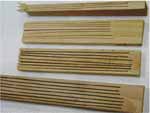
The casehardening test samples are full-width of the board, full-thickness of the board, and one-inch along the length of the board. The sample is turned on the end-grain and the prongs cut from the end-grain surface (Figure 1).
The longitudinal stress test samples are cut full-thickness of the board, about 11/2 inches or more across the width of the board, and about 15 inches along the length of the board. You need a pair of these samples each time since there are two different tests. For the first test, thin bandsaw cuts are made across the width of one piece. The rip lines run about 12 inches down the length of the piece. In this test, the saw kerf lines are perpendicular to the original surface of the board. For the second test, thin bandsaw cuts are made through the thickness of the other piece. Again, the rip lines run about 12 inches down the length. In this test, the saw kerf lines are parallel to the original surface of the board (Figure 2).
Conditioning is completed when there are no casehardening stresses or the stresses are removed to an acceptable level.
Some Operational Considerations
Stresses are relieved more quickly and more completely if the dry bulb and wet bulb settings are reached quickly and held accurately and consistently. The longer it takes to reach the set points, the more fluctuation in the settings; and the less accurate the settings, the more difficult it will be to remove the stresses, especially the longitudinal stresses.
Proper equalizing is a must for proper conditioning. It is difficult to remove all the stress from high moisture content lumber or lumber with a wet core.
The higher the dry bulb temperature, the better for conditioning. However, this may have an impact on other issues (color and machineability).
If the steam is too hot or there is too much condensation on the walls and floor (thus a recovery of the latent heat of vaporization), the dry bulb temperature will constantly be driven over set point. In this case, the proper depression will not be achieved and the stress relief will take longer and be less effective. Try turning off the heat and steam after equalizing to allow the kiln temperature to drop somewhat. Then turn on only the steam spray and bring up the wet bulb temperature. Hopefully, this will not drive the dry bulb above its set point. Then, turn on the heat to bring the dry bulb to its final set point. If this does not work and stress is still a problem, you may need to consider a desuperheater along with some kiln maintenance or cool mist sprayers for the kiln.
Fred M. Lamb is Professor and Extension Specialist, Department of Wood Science and Forest Products, Brooks Forest Products Center, Virginia Tech, Blacksburg, Virginia. Dr. Lamb can be contacted at 540-231-7256; Fax: 540-231-8868
Reprinted with permission from Modern Woodworking.
