Home » Knowledge Base » Knowledge Base Article What's New  |  Site Map 


Today's
Sponsors:


Biesse Group America

Biewer Lumber

Binks

Black Bros. Co.

Blackhawk Machinery

Brown Wood Products Co.

Byrd Tool

C.R. Onsrud

Cab Parts

Cabinet Door Service Co.

Cabinet Pro

CabinetCRUNCHER Cutlist & 3D Cabinet Design Software

Cabinetmakers Association

CABPARTSPRO

CADCode

Cag Lumber

Camco, Inc.

Carbide.com

Carolina Woodworking Consultants

Carter Products

Carvewright

Carving Technologies

Cash Coatings

Castle

Catskill Timber Industries

Central Hardwoods

Charles G.G. Schmidt Co.

Chicago Dowel Company, Inc.

CIM-Tech

Clear Lake Lumber

CNC Auto-Motion

CNC Parts Dept.

3M Corporation

5 Star Tooling

A Brazilian Wood Depot

Abrasive Resource

Accu-Right Squareness Gauge

Accu-Router, Inc.

AceCo Precision Wood Tooling

Activa

Active Machine & Tool

Air Cleaning Systems

Air Handling Systems

Alan McIlvain Company

Algoma Lumber Co.

All Star Adhesives

Alliance Millsoft

Allied Machinery Inc.

AllRout

Amana Tool

Ameitech South

American Fabric Filter Co.

American Institute of Building Design

American National Woodworking Knife

American Rotary Converters

Andreou Machinery

ANEST IWATA USA, Inc.

Antique Beams and Boards

Antique Building Materials

Anver Corporation

Apollo Sprayers Inc.

Arbor Processing Inc.

Architectural Elements

ArtCam

ATEMAG

Atlantic Machinery Corp.

Auton Motorized Systems

AWFS

B.H. Davis Company

Bailey's Inc.

Bainbridge Manufacturing

Baker Products

Banks Hardwoods

Barn Detail

Barn Door Lumber

BC Wood Specialties Group

BeamsRUS

Beaver Tools

Benz Incorporated

Best Cabinets

BetterVacuumcups.com


WOODWEB DISCLAIMS any and all RESPONSIBILITY and LIABILITY for the accuracy and application of the information below. Readers agree to evaluate the significance and limitations of the information provided, and accept full responsibility for the application of this information. Read More ...

Would you like to add information to this article?
Interested in writing or submitting an article?
Have a question about this article?


Construction Methods for Wide Wooden Gates       A discussion about building cedar outdoor gates, covering dimensions and adhesive choices. February 5, 2007

Question
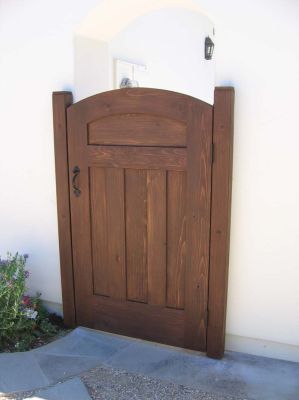
I have been making and installing cedar gates for a landscaping company for a while. Standard size has been 44" W X 6' H. I have made them from 1 1/2 cedar. They are made mortise/tenon construction with loose tenons for stile/rail joints. The company now wants wider gates 5' W X 6' H. I'm worried that the gate will sag over time. Should I go with thicker stock for the rails/stiles (2 1/4")? If so, should I use only solid thick stock, or can I laminate boards to make the thickness? The design will be similar to the photo.
Forum Responses
(Architectural Woodworking Forum)
From contributor L:
By a loose tenon, I assume you mean you mortise two holes and slip a flat dowel in both mortises. If you are using glue or epoxy, I don't see there being a problem. If you changed over to a real tenon instead of a loose tenon, then there would definitely be no problem.


From the original questioner:
Yes, they are flat dowels (loose tenons about 1/2" X 4" X 4" wider or narrower, depending on the rail). I use DAP Weldwood urea resin glue for the adhesive.


From contributor F:
Could you share where you are, climate, and cure time for the urea glue? Has the urea been all it should be, over time?


Form the original questioner:
My shop is located in Canoga Park (Los Angeles County, CA). Weather is typical San Fernando Valley weather: hot summers, coolish winters. Was just 118 near here a week ago. Humidity usually not so bad. I've used the DAP urea resin glue for about 3 years now. Never once had a problem for my uses. When it is really hot, the open time is not that great. I have to move fast if using it to glue faces on door stave-core stiles. Otherwise, it is easy to clean squeeze-out because it is water based.


From contributor G:
I make custom entry doors. Cope and stick with a loose tenon. If I make bigger (wider) garage doors, for instance, I try to make the stiles a little wider and the rails a little bit wider as the bearing surface of the shoulders on the rails have a lot to do with stopping the door sagging. You also need glue to keep things together. The sizes in your picture look fine.


From the original questioner:
Thanks a lot. I will increase the width of my rails.


From contributor J:
I worked in the marine industry for years and gained a great appreciation for epoxy glue. When you look at a rated strength comparison chart, epoxy has twice the strength of yellow glue. Use latex gloves (nerve damage as well as permanent skin cracking with years of constant use). Also, for the first ten minutes, you can wipe down and clean up with water. After that, acetone. The open time can be extended by keeping the mixture of catalyst and resin shallow (lined in plastic) in a large flat tray (cookie tray). But once it starts smoking, it's already kicked off. Also, the fumes of that smoke are toxic! As soon as it starts smoking, just pour water and let it sit a little, then discard. As with any glue, you can tint it by putting your stain or dry pigments right into the adhesive. Epoxy means the best strength commonly available! Okay - just my prejudice!


From the original questioner:
I use West System. Didn't know you could clean up with water (I thought lacquer thinner was best method). Only problem I have with epoxy is that it gets sucked into the grain (on end grain mostly) and keeps stain from penetrating that part. So, when I am making something to be stained, I stay away from using epoxy. Thanks for the tips.


From contributor E:
I've made a number of wide gates and in my experience, you must have diagonal bracing to keep the gate from sagging over time.

Have you reviewed the related Knowledge Base areas below?
  • KnowledgeBase: Knowledge Base

  • KnowledgeBase: Architectural Millwork

  • KnowledgeBase: Architectural Millwork: Doors and Windows


    Would you like to add information to this article? ... Click Here

    If you have a question regarding a Knowledge Base article, your best chance at uncovering an answer is to search the entire Knowledge Base for related articles or to post your question at the appropriate WOODWEB Forum. Before posting your message, be sure to
    review our Forum Guidelines.

    Questions entered in the Knowledge Base Article comment form will not generate responses! A list of WOODWEB Forums can be found at WOODWEB's Site Map.

    When you post your question at the Forum, be sure to include references to the Knowledge Base article that inspired your question. The more information you provide with your question, the better your chances are of receiving responses.

    Return to beginning of article.


    Refer a Friend || Read This Important Information || Site Map || Privacy Policy

    Letters, questions or comments? E-Mail us and let us know what you think. Be sure to review our Frequently Asked Questions page.

    Contact us to discuss advertising or to report problems with this site.

    To report a problem, send an e-mail to our Webmaster

    Copyright © 1996-2008 - WOODWEB ® Inc.
    All rights reserved. No part of this publication may be reproduced in any manner without permission of the Editor.
    Review WOODWEB's Copyright Policy.

    The editors, writers, and staff at WOODWEB try to promote safe practices. What is safe for one woodworker under certain conditions may not be safe for others in different circumstances. Readers should undertake the use of materials and methods discussed at WOODWEB after considerate evaluation, and at their own risk.

    WOODWEB, Inc.
    RR4 Box 265A
    Montrose, PA 18801

    Contact WOODWEB