Today's
Sponsors:


Merritt Woodwork

MFG in Honduras

Micro Fence

Microvellum

Middle Valley Lumber

Mikron Woodworking Machinery

Mill Outlet

Minimax

Mirror Reflections

MLS Machinery USA, Inc.

MLS Machinery

Modern Woodworking Magazine

Moldingknives.com

Monarch Machinery

Morbidelli

Moulder Services

Moulder Techniques

Mountainside Wood Products

Multicam, Inc.

NAP Gladu

Nebraska Tool

NEMI

New England Kiln Drying Association

NexGen

Hoffmann Machine Company

Holz Her U.S. Inc.

Howard S. Twichell Co.

Hvalsoe Sawmill Ltd.

ICA North America

Icy Straits Lumber

IDM

Impact Search and Placement

Indiana Hardwoods

Industrial Air Solutions

Integra Precision Grinding and Manufacturing

InTrading

Invicta Woodworking Machines

IpeDepot.com

irsauctions.com

Italpresse

J & G Machinery

J and J Barn Wood

J&P Machines

J. Gibson McIlvain Company

Jiffytops

JIT Hardware Supplies, Inc.

JMHsoftware.com

John G. Weber Co.

Joos USA Inc.

KCD Software

Kerber Farms and Mill

Keystone Wood Specialties

Keytrix Data Systems

Kiln-direct.com

Kleiberit Adhesives USA, Inc.

Kreg Tool Company

Kremlin

Lacy Cypress Inc.

Langelier Lumber Ltd.

Leadermac USA

Lewis Lumber Products

Lignomat

Logosol

Lumber Resources

Lumber Smith

M.L. Campbell

MACHINEKING.com

Macoser, Inc.

Mahros

Maine Timber Works

Maine Woods Company

Mann and Parker Lumber Co.

Martin Lumber

MARTIN Woodworking Machines Corp.

Mastercam - CNC Software

Matthews Mill

Maya Positioning Equipment

Mereen-Johnson Machine Company


Coping Wide Inside Angles on Crown Moulding       Advice on how to cope joints for open angles. August 31, 2009

Question
I have a 45 degree corner that is getting crown treatment. I don't want to miter it, and can't figure out the angle for the coping cut and how the flat cut meets the wall. Any takers on this one?

Forum Responses
(Cabinet and Millwork Installation Forum)
From contributor L:
Nest it in the miter saw like you would to cut an inside corner. Cut the molding. The profile line that the saw leaves is the line you follow with your coping saw.


From contributor B:
Are you talking about a bay window? Is the angle really 135 degrees? That would be a 22.5 miter with the crown upside down and sitting in its sprung position in the miter saw. The cut you need for the cope is the same as for a mitered corner. The other piece will be like an outside miter so it will fit to the wall.


From Gary Katz, forum technical advisor:
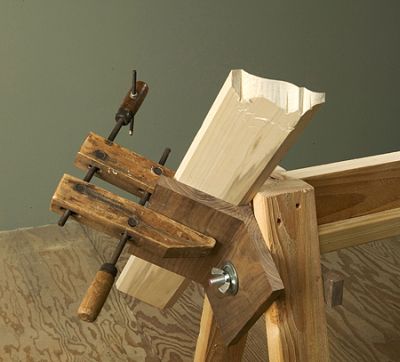
Ditto. That's a 67 1/2 degree miter - 22 1/2 is what it might say on your saw, but it's an obtuse angle and because of that, the cope has to be backcut more than a 90 degree inside corner. David Collins uses a nifty rotating jig for coping those corners - that allows you to turn the crown to the angle of the cope, so the blade on your saw can be held plumb - which is the easiest way to cut a cope without wasting energy on over-backcutting. But even then, you need a really long blade, and a lot of patience. For short runs, I miter them, pre-assemble the corners with nails and glue, and call it a day. And most of the time, those are short runs in octagon ceilings and stuff.


From contributor C:
What is it about this corner that it needs to be coped?


From the original questioner:
Thanks all... Gary, your answer regarding the steepness of the backcut was what I was looking for. On my mockups I was cutting the coped just like a standard inside corner (at 22.5 instead of 45) and coping away and getting really crappy results. Did get around to almost cutting what seemed to be the entire back off to get a good fit, but that just seemed odd to me.

Just wanted to make sure I wasn't missing something or doing something wrong. And without starting the never ending debate about coping v. mitering... I always cope inside corners, always! That's just how I roll... Thanks to all for the time and sharing of knowledge.


From contributor B:
You can also create clearance on the piece you are coping into. Just mark where the cope will fit and jigsaw most of the material away from that line back towards the wall, leaving the very bottom intact.

Would you like to add information to this article?
Interested in writing or submitting an article?
Have a question about this article?


Have you reviewed the related Knowledge Base areas below?
  • KnowledgeBase: Knowledge Base

  • KnowledgeBase: Architectural Millwork

  • KnowledgeBase: Architectural Millwork: Millwork Installer


    Would you like to add information to this article? ... Click Here

    If you have a question regarding a Knowledge Base article, your best chance at uncovering an answer is to search the entire Knowledge Base for related articles or to post your question at the appropriate WOODWEB Forum. Before posting your message, be sure to
    review our Forum Guidelines.

    Questions entered in the Knowledge Base Article comment form will not generate responses! A list of WOODWEB Forums can be found at WOODWEB's Site Map.

    When you post your question at the Forum, be sure to include references to the Knowledge Base article that inspired your question. The more information you provide with your question, the better your chances are of receiving responses.

    Return to beginning of article.


    Refer a Friend || Read This Important Information || Site Map || Privacy Policy || Site User Agreement

    Letters, questions or comments? E-Mail us and let us know what you think. Be sure to review our Frequently Asked Questions page.

    Contact us to discuss advertising or to report problems with this site.

    To report a problem, send an e-mail to our Webmaster

    Copyright © 1996-2009 - WOODWEB ® Inc.
    All rights reserved. No part of this publication may be reproduced in any manner without permission of the Editor.
    Review WOODWEB's Copyright Policy.

    The editors, writers, and staff at WOODWEB try to promote safe practices. What is safe for one woodworker under certain conditions may not be safe for others in different circumstances. Readers should undertake the use of materials and methods discussed at WOODWEB after considerate evaluation, and at their own risk.

    WOODWEB, Inc.
    RR4 Box 265A
    Montrose, PA 18801

    Contact WOODWEB


  •   Home » Knowledge Base » Knowledge Base Article