Home » Knowledge Base » Knowledge Base Article What's New  |  Site Map 


Today's
Sponsors:


ATEMAG

Atlantic Machinery Corp.

Auton Motorized Systems

AWFS

B.H. Davis Company

Bailey's Inc.

Bainbridge Manufacturing

Baker Products

Banks Hardwoods

Barn Detail

Barn Door Lumber

BC Wood Specialties Group

Beautiful WoodForest Products

Beaver Tools

Benz Incorporated

Berenson Hardware

Best Cabinets

BetterVacuumcups.com

Biesse Group America

Binks

Black Bros. Co.

Blackhawk Machinery

Brazilian Direct Ltd.

Brown Wood Products Co.

Byrd Tool

C.R. Onsrud

Cab Parts

Cabinet Door Service Co.

Cabinet Pro

CabinetCRUNCHER Cutlist & 3D Cabinet Design Software

Cabinetmakers Association

CABPARTSPRO

CAD CAM for the Home and Small Shop

CADCode

Cag Lumber

Camco, Inc.

Carbide.com

Carolina Woodworking Consultants

Carter Products

Carvewright

Carving Technologies

Cash Coatings

Castle

Catskill Timber Industries

Central Hardwoods

Charles G.G. Schmidt Co.

Chicago Dowel Company, Inc.

3M Corporation

5 Star Tooling

A Brazilian Wood Depot

Abrasive Resource

Accu-Right Squareness Gauge

Accu-Router, Inc.

AceCo Precision Wood Tooling

Active Machine & Tool

Air Cleaning Systems

Air Handling Systems

Aktrin Furniture Information Center

Alan McIlvain Company

Algoma Lumber Co.

All Star Adhesives

Alliance Millsoft

Allied Machinery Inc.

AllRout

Amana Tool

Ameitech South

American Fabric Filter Co.

American Institute of Building Design

American National Woodworking Knife

American Rotary Converters

Anchorbeam Timberworks

Andreou Machinery

ANEST IWATA USA, Inc.

Antique Building Materials

Anver Corporation

Apollo Sprayers Inc.

Arbor Processing Inc.

Architectural Elements

Arkansas Wood Doors

ArtCam


WOODWEB DISCLAIMS any and all RESPONSIBILITY and LIABILITY for the accuracy and application of the information below. Readers agree to evaluate the significance and limitations of the information provided, and accept full responsibility for the application of this information. Read More ...

Would you like to add information to this article?
Interested in writing or submitting an article?
Have a question about this article?


Crown Moulding Tips and Tricks       Trim carpenters discuss jigs, chopsaws, stands, and techniques for cutting and installing crown moulding. April 20, 2007

Question
I have recently begun installing cabinets after having been mainly a framer with limited interior finish experience. I have done quite a bit of base and trim, but am new to crown molding. Wondering if any of you experienced guys would recommend getting a crown jig. I have been looking at the one at cutncrown.com. They also mention something about tricks for making invisible splices. Any tips regarding crown or light rail installation will be appreciated.

Forum Responses
(Cabinet and Millwork Installation Forum)
From contributor J:
The easiest way to cut crown is on a regular chop saw with the crown leaning against the fence at the same angle it will be projecting from the wall or the top cabinet rail (called the "spring" angle). The top of the crown molding will be sitting on the bed of the saw and the bottom will be against the saw fence. That way, when mitering a 90 degree outside corner, you simply set the saw at 45 degrees and cut the molding. With sliding compound saws there are two angles to mess with, and adjustments are considerably more of a pain in the ass, and less accurate as well. Gary Katz has a good video on cutting crown molding that would be well worth your while. I wouldn't bother with buying a special jig for the chop saw if I were you.


From contributor A:
I agree with the above. If you want to try the cutncrown jigs, you can have ours for half the price since they just hang on the wall collecting dust.


From the original questioner:
Thanks for the replies. I am currently working with a friend who is grooming me to do jobs on my own in 2 or 3 months, so I am tooling up for when that happens. Right now trying to decide which portable saw I should buy. We have been working with a 10" Hitachi Work Site portable table saw; it is lightweight, around $200, and seems to do what we need. Is there any reason to go for a more expensive one such as a Dewalt or Makita? We have also been working with a Dewalt 12" compound slide and really like it but I own a 10" Makita miter saw and am wondering if upgrading to the Dewalt would be worth the expense. What do you recommend?


From contributor M:
With a 10" miter saw, you are going to run into a lot of crown you can't cut without laying it down. That isn't the type of cut you need to be starting out trying. A 12" miter saw is a must for you.


From contributor E:
The advantage to using some of those jigs (I have a different one but it works pretty well) is that you will be coping the crown instead of mitering it. Generally this is considered a superior joint for trim work. Since it is significantly more difficult and time consuming to do correctly, some guys avoid it. I use both methods depending on the job.

As for invisible splices, the best I know of is to use a scarf joint. Simply cut your first piece at a 45 as if it were going into a corner, then cut your next piece at the same setting. Makes for a very clean joint.

Last, if you're going to do all mitered cuts, another method of doing them is upside down and backwards. This is how I first started cutting and still use it today. It is harder to explain than to show. But you are basically marking your crown, flipping it upside down on the chop saw so it is against the base and fence, and cutting the miter at a 45. A couple test cuts on some scrap crown and you will get the hang of it.

And I agree with the need for a 12" saw. It doesn't have to be a slider (although for really big crowns they can be useful), just a simple 12" miter that bevels in at least one direction.


From contributor L:
I may be in the minority here. I prefer a compound angle slider and have used an 8.25" Hitachi for more than a dozen years. Learning to cut compound angles with the stock laying flat is easy. An advantage of the slider is that you can crosscut 12". Can't do that with a chop saw.

The Hitachi saw is small and relatively light compared to some of the other, more recent sliders. I've looked around and I'm not wildly impressed with what's available to replace it with. Most have clumsy design or too many useless bells and whistles. A feature I'd look for if going this way would be bi-directional bevel. Imagine scribing a long piece of base that now needs a miter. It's hard to get a clean cut with that wiggly edge against the fence, but if you can bevel the other way when making the cut...

From what I've seen in supply houses as well as in the field, it looks like the Hitachi 10" and the Dewalt 12" are the ones to chose from. That said, I'd easily buy another 8.25" again. It's been a real warhorse.

Remember, whatever you buy will see a lot of use over a lot of years. With that in mind, the difference between a $200 saw and a $600 saw is inconsequential, especially when you take into account how much the lumber that you're going to whack up costs. ;-)


From contributor K:
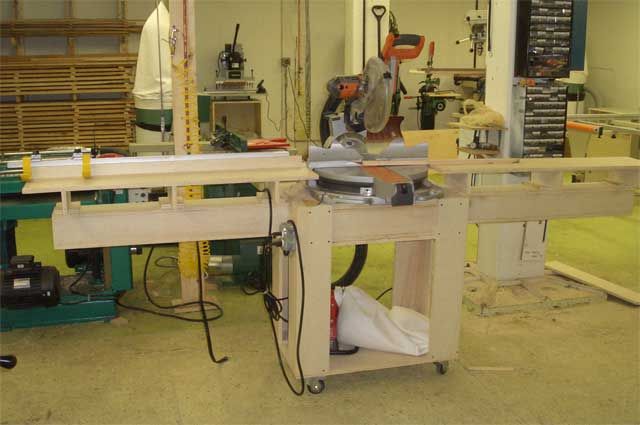
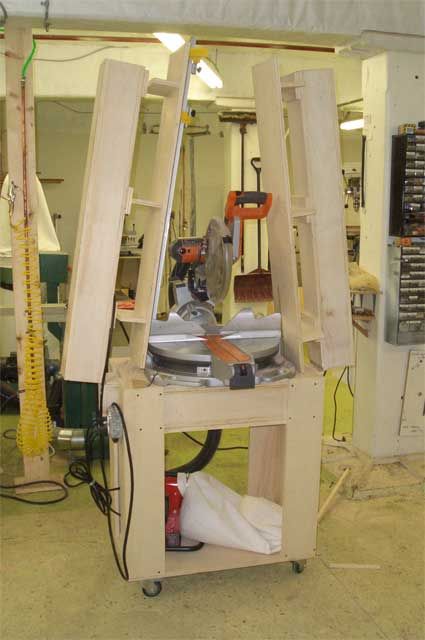
Here is a picture of my new 12" sliding Ridgid. I was going to buy another Dewalt but this one came with parts for life warranty and very easy adjustments. I'm telling you, I love this darn saw! It's pretty big, but much lighter than it looks. I do take it out for installs and renovations, but on a different stand. Hey, check out how my stand folds up to save space. Got the idea watching a ww2 movie with aircraft on a carrier.


Click here for higher quality, full size image

Very sturdy because it is torsion box design. No good for on site, but I have a folding Ryobi stand that does the job.

Click here for higher quality, full size image


From contributor L:
One trick we use is to always cut and install to the right. It seems easier.

The crown stops for the Delta 12" slider are worth it, really helps keep the quality up. Cheap too. And get a 23 gauge pinner for the joints, using a few 16 gauge nails in the top and bottom.


From contributor R:
You need at least a 12" - don't waste your money on a 10. Then you're gonna need the big Hitachi and wish you hadn't bought the 12. The only jig I use is two sawhorses and a hollow core door with two outriggers attached to the door and the spot for the saw accurately marked between the outriggers. The saw is screwed to the door. Then all you need is a piece of 1x2 or 1x3 scrap to screw across the outriggers where the spring line for the crown will be; really fast, accurate, and cheap!


From contributor N:
Cutting crown vertically nested (45/45) is quick, but if your returns are out in the slightest, it simply will not produce a precise corner. Most jigs stink. The written material cutncrown offers regarding unusual cornering is good. If one is not well trained in crown, I strongly recommend the Bosch digital angle finder ($100-150.00). This tool automatically calculates crown angles via cutting on the flat. Not only do you not have to carry a chart with you, but it will keep you cutting crown the right way - on the flat!


From contributor J:
There are all kinds of acceptable ways to do splices, and a lot depends on if there is one installer or two.

If one, you can cut the crown square across the face at a 30 degree bevel. Then you can glue it up and pound the second piece tight with the heel of your hand. That won't work with a 45 degree bevel, because the second piece up won't slide.

If you install with two guys, you can pre-make your splices on the floor if there is enough clear space. One method is to set your saw at the most acute miter angle it will go to, then cut both crown pieces flat on that angle. Put a couple biscuit slots in the joint, and screw a block to the floor to push against with a shim. Put the crown upside down, glue, then clamp across the joint while shimming till you get a perfect joint. Then hot melt a plywood gusset on the back - ripped on the spring angles and held back some.

The same can be done with a butt fit and biscuits, and with two guys installing - presuming you have good backing - it can be done in the air (without the gussett).

Naturally, you don't want to cut your "square" crown ends square. You want to cut them with a couple degree angle off the top so you can pound a shim between the wall and end of the crown to tighten up butt fits and inside corners.

Gary K. and a bunch of other trim guys use the Collins coping foot, and all swear by it. It would probably be a good idea to give one a try. I've never used one - and the blade I use is probably too coarse for the foot.


Have you reviewed the related Knowledge Base areas below?
  • KnowledgeBase: Knowledge Base

  • KnowledgeBase: Architectural Millwork

  • KnowledgeBase: Architectural Millwork: Millwork Installer


    Would you like to add information to this article? ... Click Here

    If you have a question regarding a Knowledge Base article, your best chance at uncovering an answer is to search the entire Knowledge Base for related articles or to post your question at the appropriate WOODWEB Forum. Before posting your message, be sure to
    review our Forum Guidelines.

    Questions entered in the Knowledge Base Article comment form will not generate responses! A list of WOODWEB Forums can be found at WOODWEB's Site Map.

    When you post your question at the Forum, be sure to include references to the Knowledge Base article that inspired your question. The more information you provide with your question, the better your chances are of receiving responses.

    Return to beginning of article.


    Refer a Friend || Read This Important Information || Site Map || Privacy Policy

    Letters, questions or comments? E-Mail us and let us know what you think. Be sure to review our Frequently Asked Questions page.

    Contact us to discuss advertising or to report problems with this site.

    To report a problem, send an e-mail to our Webmaster

    Copyright © 1996-2008 - WOODWEB ® Inc.
    All rights reserved. No part of this publication may be reproduced in any manner without permission of the Editor.
    Review WOODWEB's Copyright Policy.

    The editors, writers, and staff at WOODWEB try to promote safe practices. What is safe for one woodworker under certain conditions may not be safe for others in different circumstances. Readers should undertake the use of materials and methods discussed at WOODWEB after considerate evaluation, and at their own risk.

    WOODWEB, Inc.
    RR4 Box 265A
    Montrose, PA 18801

    Contact WOODWEB
