Home » Knowledge Base » Knowledge Base Article What's New  |  Site Map 


Today's
Sponsors:


Maya Positioning Equipment

Mereen-Johnson Machine Company

Merritt Woodwork

Microvellum

Middle Valley Lumber

Midwest Automation

Midwest Sandright

Mikron Woodworking Machinery

Mill Outlet

Minimax

Mirror Reflections

Mississippi Heart Pine

Miter Clamp

MLS Machinery USA, Inc.

MLS Machinery

Modern Woodworking Magazine

Mohawk Finishing Products

Moldingknives.com

Monarch Machinery

Morbidelli

Moulder Services

Moulder Techniques

Mountainside Wood Products

Multicam, Inc.

NAP Gladu

NCME

Nebraska Tool

NEMI

New England Kiln Drying Association

Newman Whitney

Norment and Lambert

North Pacific Lumber

Northstate Hardwoods

Northtech Machinery

Hermance Machine Company

High Point Grinding - Total Saw Solutions

Historical Plus Wood

Hoffmann Machine Company

Holz Her U.S. Inc.

Howard S. Twichell Co.

HSD USA

Hvalsoe Sawmill Ltd.

ICA North America

Icy Straits Lumber

IDM

Impact Search and Placement

Industrial Air Solutions

Industrial Maid

Integra Tooling

InTrading

Invicta Woodworking Machines

IpeDepot.com

irsauctions.com

Italpresse

J&P Machines

J. Gibson McIlvain Company

JIT Hardware Supplies, Inc.

JMHsoftware.com

John G. Weber Co.

Joos USA Inc.

KCDw

Kerber Farms and Mill

Keystone Wood Specialties

Keytrix Data Systems

Kiln-direct.com

Kleiberit Adhesives USA, Inc.

Koch Machinery and Systems

Komo Machine, Inc.

Kreg Tool Company

Kremlin

Lacy Cypress Inc.

Laguna Tools

Langelier Lumber Ltd.

LEUCO Tool Corporation

Lewis Lumber Products

Lobo Machinery Corp.

Logosol

Lord Parquet Industry Ltd.

Lumber Resources

MACHINEKING.com

Macoser, Inc.

Mahros

Maine Woods Company

Mann and Parker Lumber Co.

Martin Lumber

MARTIN Woodworking Machines Corp.

Mastercam - CNC Software

Matthews Mill


WOODWEB DISCLAIMS any and all RESPONSIBILITY and LIABILITY for the accuracy and application of the information below. Readers agree to evaluate the significance and limitations of the information provided, and accept full responsibility for the application of this information. Read More ...

Would you like to add information to this article?
Interested in writing or submitting an article?
Have a question about this article?


Custom Wood Garage Doors       Tips on how to create overhead garage door using real wood. December 26, 2006

Question
We have a customer who wants us to build a custom mahogany flat panel garage door. There are two different ways we can approach this project.

1) Find a garage door company who will supply panels, and we will skin the panels with mahogany.

2) Construct the entire garage door ourselves. If so, we would like some advice on how to do this. The size of the panels will be 20" x 16'-0" and 4 are required.

Forum Responses
(Architectural Woodworking Forum)
From contributor J:
Call a local overhead door company to see if they will supply only the hardware and install your panels. They might be agreeable. As for the panels, ask them for sizes, etc. or just duplicate an existing door panel. You never know, but they may get you a lot of work.


From contributor D:
We have done these about any way they can be done. Some are far more successful than others. Knowing what I know now, I would never sign up to do 16' wide; only single width. They simply get too heavy and will sag in the center.

Ticky-tackying your wood to factory made flush doors is easy and cheap, and will last from 3 to 7 years - if you are lucky. Make sure the door installers weigh everything, and use truly heavy duty rated hinges. The usual hinges are made from old beer cans, and bend if you look at them wrong. This makes your wood look very bad.

A better way is to mill in a piece of aluminum into the tops and bottoms of each horizontal panel to retain all those little parts and hold them into alignment. This helps eliminate the need for 27,000 stainless screws under plugs in the faces of all the parts.

The best situations are where you make the whole door, in a minimum of sections, and partner with a willing overhead door company where at least one employee can pass both a sobriety test and hearing test. Then you still need to supervise. Even though you don't know anything about overhead doors, the installers go dumb instantly with the slightest provocation - like a door made of real wood.

The door sections should be frame and panel, cope and stick mortise and tenon, Honduras mahogany or Spanish cedar or white oak, a full 2-1/4" thick, beveled overlaps at the horizontal joints, and designed to shed water and stand frequent refinishing.

We are currently involved in 5 pair of outswing carriage style doors in white oak. These will be real heavy, as an understatement.


From contributor B:
I too have made many garage doors over the years. I agree that a 16' door is a challenge, but not an insurmountable one. If you try to make a 16' door with frame and panel construction you are indeed looking for trouble. I don't know that I've ever seen a lumber yard sixteen footer that didn't sag in the middle.

That doesn't mean you can't be more creative, though, and come up with a frame and panel appearance without the weakness of frame and panel construction. One way would be to actually make a thin frame and panel door and back it up with 1/2" plywood. Don't put two 8' lengths together with a joint in the middle, though... that defeats the purpose. That is one quick and simple solution and there are many others that you could come up with as well.

I've made numerous horizontal board faced garage doors... both 9' and 16'. To do these I just lay out the face boards face down on the bench and build an attached 1x3 frame work on their back. If done carefully, it looks great on the face and presentable on the back.

The only other comment I'll make is to question your statement that you need 4 panels at 20" high. Most 7' high garage doors use about a 24" height bottom panel, two 20" center panels and 22" high top panel. Plus you need to calculate in for an overlap where each panel meets the next, typically about 1/2". Good luck… I'm sure you can pull this off.
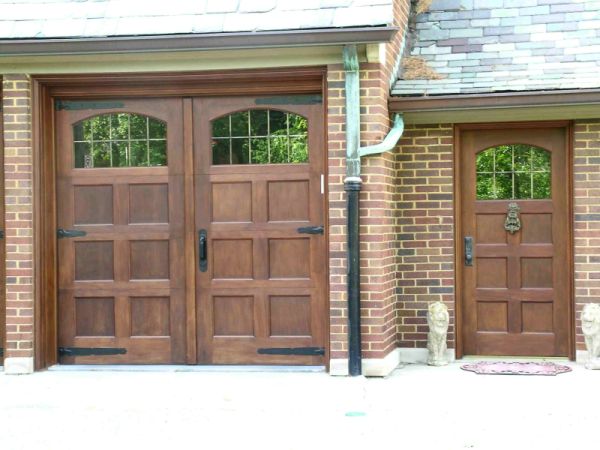
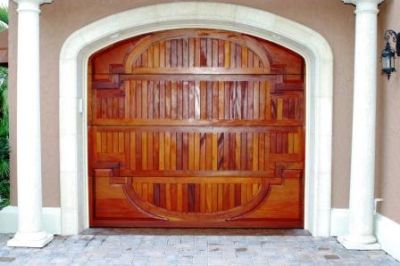

From contributor D:
Here is one of three overhead doors, with a matching entry for the carriage house. These were patterned after the original paired outswing doors. 2-1/4" thick, real frame and panel.


Click here for higher quality, full size image


From contributor A:
I have done two doors recently and I think it is easier to mount your work to the metal frames. Just have the garage door guy figure out the sizes and drop off the panels at your shop. Skin the panels and let him install them. That way, he figures the weight and deals with all the associated problems with installing a garage door.


Have you reviewed the related Knowledge Base areas below?
  • KnowledgeBase: Knowledge Base

  • KnowledgeBase: Architectural Millwork

  • KnowledgeBase: Architectural Millwork: Doors and Windows


    Would you like to add information to this article? ... Click Here

    If you have a question regarding a Knowledge Base article, your best chance at uncovering an answer is to search the entire Knowledge Base for related articles or to post your question at the appropriate WOODWEB Forum. Before posting your message, be sure to
    review our Forum Guidelines.

    Questions entered in the Knowledge Base Article comment form will not generate responses! A list of WOODWEB Forums can be found at WOODWEB's Site Map.

    When you post your question at the Forum, be sure to include references to the Knowledge Base article that inspired your question. The more information you provide with your question, the better your chances are of receiving responses.

    Return to beginning of article.


    Refer a Friend || Read This Important Information || Site Map || Privacy Policy

    Letters, questions or comments? E-Mail us and let us know what you think. Be sure to review our Frequently Asked Questions page.

    Contact us to discuss advertising or to report problems with this site.

    To report a problem, send an e-mail to our Webmaster

    Copyright © 1996-2008 - WOODWEB ® Inc.
    All rights reserved. No part of this publication may be reproduced in any manner without permission of the Editor.
    Review WOODWEB's Copyright Policy.

    The editors, writers, and staff at WOODWEB try to promote safe practices. What is safe for one woodworker under certain conditions may not be safe for others in different circumstances. Readers should undertake the use of materials and methods discussed at WOODWEB after considerate evaluation, and at their own risk.

    WOODWEB, Inc.
    RR4 Box 265A
    Montrose, PA 18801

    Contact WOODWEB