Today's
Sponsors:


Riethmiller Lumber

Ritter Manufacturing Inc.

Roberts WebForge, Inc.

Rockler Woodworking and Hardware

Roger Shaw and Associates

Rose Machinery

RouterCAD

RT Machine Co.

Safety Speed Cut

Sand-Rite Manufacturing

Sandman Products

Sawmill and Woodlot Magazine

SCM Group USA

Sears Trostel Lumber Co.

ShopBot

SII Dry Kilns

Silvaris

Simantech

Sinker Treasures

SIS Machinery

SNX Technologies

Solid Setup

South State Machinery

Southeast Tool, Inc.

Sovereign Machine, Inc.

Specialtytools.com

Speed Sander

Sprayguncaptain.com

Steve H. Wall Lumber Co.

Stiles Machinery

Stiles Shop Solutions

Super Source Tooling Inc.

Supergrit Abrasives

Oliver Machinery Co.

Omnitech Systems

Oneida Air Systems

Onsrud Cutter

Opti-Sand

Optisol for Project Scheduling

Orange Aluminum

Original Saw Company

Osborne Wood Products

Paragon Enterprises

Patrick Lumber Company

Penn Sylvan International

People Logic Software Corp.

Peterson Portable Sawmills

Pinske Edge

Pioneer Lumber Company

Planit Solutions

Porter-Cable

Preservation Solutions

Prime Estimating and Software Services, LLC

Primo Woodworking Machinery

Pro.Woodworker.com

Professional Machinery Group

PSL Optimization Software

Quality VAKuum Products, Inc.

Quickscrews International Corporation

QuickScribe

QuickWood, Inc.

QuikDrawers

R&R Drummond, Inc.

R.A.W.

RazorGage

Rex Lumber Company


Drawer Slide Adjustment for Flush Inset Cabinets

      The math and the hardware positioning and adjustment can get tricky when you're using tandem slides with inset face frame construction. July 6, 2011

Question
This is my first cabinet job with Blum tandem slides in a long time. I would like somebody to check my math for me. I am building flush inset cabinets. The literature says that the slide itself 470mm but the minimum box depth is 479.
The picture that they show is of an overlay cabinet. I am building flush inset.

Is there something I am overlooking here? If I build a cabinet box with 479 behind the faceframe will this work? Are there any differences to this depth if I used the heavier duty tandem called 568H.
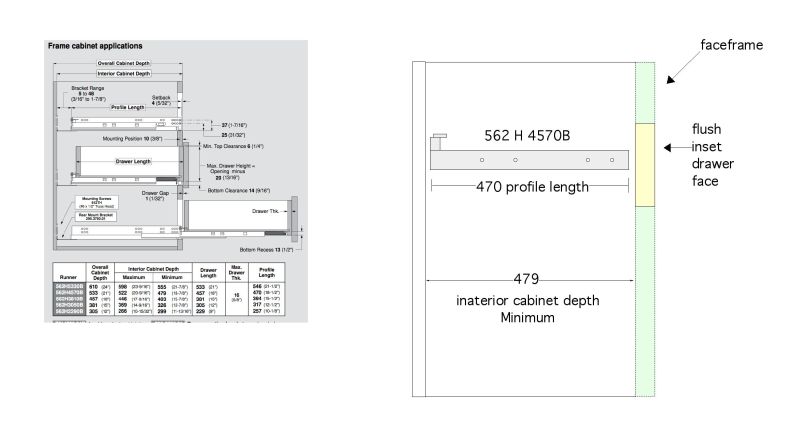

Click here for higher quality, full size image

Forum Responses
(Cabinetmaking Forum)
From contributor M:
479 = 470 length plus four set back plus five minimum rear bracket depth.
Generally yes you'd be ok with 479 depth, but for flush inset you should use the inset front clips which allow some in/out adjustment. Actually I think it’s all out adjustment from the 4mm set back, so it’s better to set them back a little farther, but unfortunately I don't have the set back dimension offhand. Maybe someone else can fill in the rest of the details.


From the original questioner:
When you say to use the inset clips, do you mean the orange gizmos at the front? How are they different than the other clips?


From contributor M:
Yes, the orange clips. They have special ones for flush inset that have the added in/out adjustment screw. The standard clips have no in/out adjustment.


From contributor S:
If you are using this stuff on a face frame application do yourself a favor and make a mock-up first. For example is Blum's formula assuming a "0" adjustment position, or half way into the adjustment? Will the drawers only adjust out, or in?


From contributor G:
Make your drawers the standard front to back depth (12, 15, 18, 21). If your drawer fronts are the same thickness as your face frames then you would set the slide 1/4" back from the rear side of the face frame.

The PV locks that have the adjustability will only adjust out, not in. So you want to make sure that your drawers are a little bit in from the front of the face frame so you can have the use of the adjusters. Blum says to put the slide back 5/32". I find that is usually perfect or slightly in front of the face frame. The PV adjusters have more than 3mm of adjustment.



Would you like to add information to this article?
Interested in writing or submitting an article?
Have a question about this article?


Have you reviewed the related Knowledge Base areas below?
  • KnowledgeBase: Knowledge Base

  • KnowledgeBase: Cabinetmaking

  • KnowledgeBase: Cabinetmaking: General


    Would you like to add information to this article? ... Click Here

    If you have a question regarding a Knowledge Base article, your best chance at uncovering an answer is to search the entire Knowledge Base for related articles or to post your question at the appropriate WOODWEB Forum. Before posting your message, be sure to
    review our Forum Guidelines.

    Questions entered in the Knowledge Base Article comment form will not generate responses! A list of WOODWEB Forums can be found at WOODWEB's Site Map.

    When you post your question at the Forum, be sure to include references to the Knowledge Base article that inspired your question. The more information you provide with your question, the better your chances are of receiving responses.

    Return to beginning of article.


    Refer a Friend || Read This Important Information || Site Map || Privacy Policy || Site User Agreement

    Letters, questions or comments? E-Mail us and let us know what you think. Be sure to review our Frequently Asked Questions page.

    Contact us to discuss advertising or to report problems with this site.

    To report a problem, send an e-mail to our Webmaster

    Copyright © 1996-2012 - WOODWEB ® Inc.
    All rights reserved. No part of this publication may be reproduced in any manner without permission of the Editor.
    Review WOODWEB's Copyright Policy.

    The editors, writers, and staff at WOODWEB try to promote safe practices. What is safe for one woodworker under certain conditions may not be safe for others in different circumstances. Readers should undertake the use of materials and methods discussed at WOODWEB after considerate evaluation, and at their own risk.

    WOODWEB, Inc.
    335 Bedell Road
    Montrose, PA 18801

    Contact WOODWEB


  •   Home » Knowledge Base » Knowledge Base Article