Drilling Problem
Participants help troubleshoot a "boring" challenge. February 25, 2005
Question
I'm trying to drill 16mm holes with our CNC machine. The holes are 48mm deep in solid wood (Meranti) perpendicular to the wood direction.
I use a 90mm long right hand tool, with 2000 rpm and a feed of 2m/min. Sometimes the drill gets stuck in the wood and sometimes the removed wood turns black. What should I do?
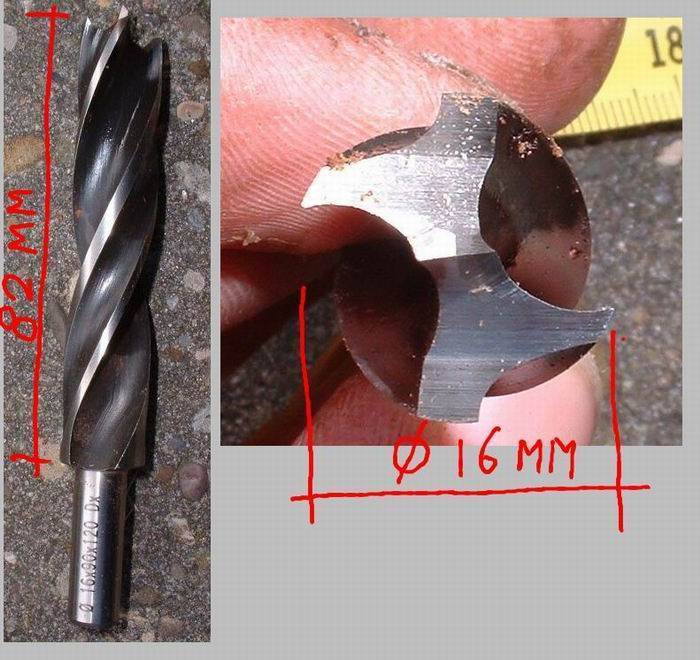
Click here for full size image
Forum Responses
(CNC Forum)
From contributor M:
As far as I can see from your picture, you are using a right hand, down shear bit. That is one of your problems. You are cutting almost 2 inches deep and your bit is compressing and pushing down dust, which in turn is burning both your tool and the wood. I didn't calculate your speed and feed rates or chip load, but here's what I do would do if I had the same job.
My tool of choice would be down shear 1/2", right hand tool. My program would cut this 16 mm hole in helical motion with 2 or 3 strokes. This way, I allow some chips to be removed before finishing cutting. If this is too complicated for you and if surface quality is not your concern, then try using an 16mm up-spiral tool.
From contributor T:
This is a brad point drill bit, probably not downshear. I don't think there is even such a thing as a downshear drill bit.
I can't offer any feedback on your speeds and feeds, but think about it for a second... 49mm = just under 2". If you were drilling that hole with a hand drill, would you plunge right through it, only pulling out and removing the chip load once the hole was to its desired depth? Or would you maybe try stepping it a little, drilling to the desired depth in 3 plunges? Drill 16mm in and all the way out, then 16mm in again and all the way out and finally 17mm in and all the way out. Any CNC should be able to step drill.
From contributor W:
I agree. When I drill holes in our solid wood doors (up to 2-1/4" thick), I usually drill in 1/2" increments. On our Biesse Rover I just drill the hole 1/2" deep then retract the bit, then drill 1" deep and retract and so on. This has worked very well for me, even with a 1/4" brad point drill.
From contributor I:
That is correct. You have to do what is referred to as "pecking." You must extract your chips or they will burn, as you have noticed. I think three strokes would be a minimum for the depth you are going. You might also consider switching to a spur point bit rather than the Forstener type bit you show in your pics. The spur point has a cutting head and a much narrower shank, which gives the chips a place to go until you retract.
From contributor M:
After a second look, I see it's a brad point drill bit. What I suggested is not a drill bit. Just a good, old-fashioned 1/2" cutting bit using helical routing on a CNC.
From contributor B:
Your rpm is too slow. Drill at 4000 rpm with the same feed. You may have to plunge to 1/2 depth, come out to clean the hole, and drill again to the full depth.
From the original questioner:
Thank you. I've tried peck drilling, first 24mm and then till 48mm deep, but the same problem occurred. I slowed down my feed to 1.5m/min and it worked fine.
Next week I can try a higher RPM. How can I determine if I should raise my RPM, or slow down my feed? And how can I determine the amount of cycles for peck drilling?
From contributor T:
Try testing different scenarios...
From contributor K:
I am assuming this is being done on a Weeke and with Woodwop. I have a similar problem with our Weekes (Woodwop 2.5) and have had to adjust the speed in the NC file with the NC Editor. The Weeke Woodwop seems to have a problem with steady feed speeds. The problem with changing the NC file is that it will be overwritten by the next NC generation. I now put all large diameter or depth drilling on our Alberti B-21s. They can drill a 35 mm hole at 32 mm depth, in one pass. The Weekes require me to program a routering operation for any diameter over 11 mm or depth greater than 17 mm.
From contributor C:
If you are drilling hardwood, use a carbide-tipped brad point drill, 1750 RPM at 70 IPM. Peck drilling will dull the bit. Anytime the bit is rotating in the hole and not cutting, it is getting dull. Faster RMP and peck drilling equals dulling.
I noticed your drill has a slower twist, which will normally eject the chips faster. It can also increase the torque requirement. Maintain a low spur for hardwood applications. Stay with HSS for softer materials if possible. If not, use lower RPM. Also, check moisture content of material. Above 7% in any material will cause the material to close back in on the hole being drilled. Additional back taper must be added to the twist to allow the bit to rotate freely and eject the chips.
From contributor Z:
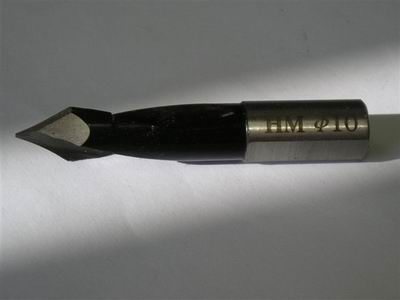
I use a carbide-tipped bit like this one that gives me 60 holes before I need to change. With a Hss drill, I can only get up to 7 holes. I am using it on very hard material - 18mm HPL.