Home » Knowledge Base » Knowledge Base Article What's New  |  Site Map 


Today's
Sponsors:


Tongass Forest Enterprises

Tooling on the Web

Toolstoday.com

Touch Up Solutions LLC

Tractivity

TradeJobPlacement.com

TradeSoft

Trakware Systems Inc.

TRB Flooring Company

Tropical American Tree Farm

Tropical Hardwoods

UC Coatings Corp.

Unique Machine & Tool

University of Wisconsin

UWMO Auctions

VacDry Kilns

Vacuum Pressing Systems, Inc.

Vacuumpods.com

Vecoplan LLC

Vector Art 3D

Vectric Ltd.

Veneer Systems Inc.

Veneer Technologies Inc.

Vintage Perkins

VortexTool Co. Inc.

VyTek

W. Moore Profiles, Ltd.

W.L. Fuller

Wadkin North America

Wagner Electronic Products

WalzCraft Industries

Webb Abrasives

WEIMA America, Inc.

Weinig Group - USA

Western Dovetail

Williams and Hussey

Wisconsin Knife Works

WMIA

WMMA

Wood and Wood Products

Wood Doctor's Rx, LLC

Wood Tech Enterprises, Inc.

Wood Technology Inc

Wood-Mizer

Wood-Ply Lumber Corp.

WoodCabinetDoors.Com

Woodcraft Supply Corp.

WoodcraftPlans.com

WoodenBoat

WoodFinder

WoodJobs.com Search Consultants

Woodland Dimension Products

WoodLINKS

Woodmaster

WoodPlanet Inc.

WOODWEB

Woodworker's Supply/woodworker.com

Woodworker's Directory

Wright Timber

SK-USA

SketchList

SlipCon USA, Inc.

SnapDragon Associates, LLC

SNX Technologies

SoCalMachinery.com

South State Machinery

South Texas Moulding

Southeast Tool, Inc.

Specialtytools.com

SprayGunWorld.com

Stairguy Stairbuilding Videos

Stefani

Steve H. Wall Lumber Co.

Stiles Machinery

Stiles Shop Solutions

Stor-N-Fold Systems

Super Source Tooling Inc.

Supergrit Abrasives

Target Coatings

Techno CNC Routers

Template Services

Teragren

The Cayce Company

The Veneer Store

Thermwood Corporation

TigerStop

TigerwoodDecking.com

TimberKing

Timesavers Inc.

TMS Machinery Sales


WOODWEB DISCLAIMS any and all RESPONSIBILITY and LIABILITY for the accuracy and application of the information below. Readers agree to evaluate the significance and limitations of the information provided, and accept full responsibility for the application of this information. Read More ...

Would you like to add information to this article?
Interested in writing or submitting an article?
Have a question about this article?


Drying Large Rounds - Preventing Splitting       Is it possible to dry these without problems? October 20, 2003

Question
I have rounds that I need to dry without splitting, but I don't want to invent the wheel if I don't have to. The rounds will come from green ponderosa pine and will be 4-5 inches thick and up to 48 inches in diameter. Does anyone have hands-on experience with preserving rounds in PEG (Pentacryl)? Are there better ways?

Forum Responses
(Sawing and Drying Forum)
I was told a long time ago that you couldn't treat wood discs that thick with PEG and get the process to work, and that you would have to soak the wood in the PEG solution for up to a year or more to assure enough penetration in the fresh wood cell walls (and even then not know if it was a long enough soak until the piece was dried without checking).


I am trying roughly the same thing, in cypress. The bowl turners use a dish soap and water solution when they turn bowls. Claim the bowls may dry out of shape, but rarely crack??


A dish soap solution does the trick. I have seen it myself. Have no idea how it would work for a huge round, but it's sure cheaper than PEG.


To dry rounds without splitting, you will have "to invent the wheel." There are ways to minimize the cracking, such as using PEG or other treatments. There are ways to hide the cracks, such as cutting into quarters and then gluing together after drying. However, there are no ways to stop shrinkage and the resultant cracks. Note that a turned bowl can shrink without cracking only because it is no longer a flat disc and even then it has to distort to dry.

All the treatments such as dish soap and water or PEG just prolong the drying process. It does not stop the process nor does it stop the cracking or distorting.


I have tried the soap on pieces 1 1/2 thick, rough turned bowls, and it did not work for me. Thin bowls do work.


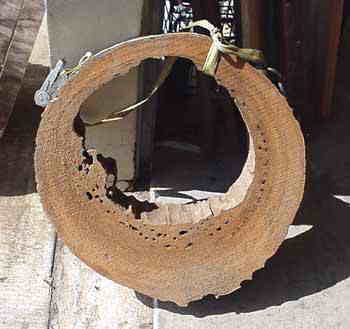
We have had success with preventing log slices from cracking by drilling a hole in the pith of the heart. It allows the wood to shrink with some relief in the center. I know this will not work for turning blanks but if you are just trying to save the round it should.


Is this hole about right?


Dry several disks and put a kerf (bark to pith) in each one in a different location. Then when dry, use one of the disks for a source of pie-shaped pieces; from the main disks, cut out any splits (use a piece shape) and put a new piece from the special disk into the hole.

Gene Wengert, forum technical advisor


To preserve (hardwood) discs I am doing the following: first cut them at about a 70 degree angle to the heart so the annual rings are not completely concentric. Then I seal them almost completely leaving the centermost rings unsealed. Slow dry, removing a little of the sealer from the center out occasionally. Sometimes you will get more small checks, but fewer monster checks. Also, wood should be seasoned on the log at least one year.


Did you know that disks can also be buried in fresh manure for a few months and will dry out without much cracking?

Gene Wengert, forum technical advisor


The comments below were added after this Forum discussion was archived as a Knowledge Base article (add your comment).

Comment from contributor R:
I attended a Woodworkers Show that featured Steve Russel, woodturner. He has been doing extensive testing to reduce spitting of green turnings. He boils his initially turned bowl stock for one hour per inch of thickness. Note: this means the water has to get to a rolling boil again with the wood in the water before the clock starts. He, along with multiple other woodturners, has reduced stock splitting by as much as 50%. The boiling water heats the lignum to allow it to realign to the existing shape of the reduced stock, thereby reducing internal stresses along with assisting the drying process.


Have you reviewed the related Knowledge Base areas below?
  • KnowledgeBase: Architectural Millwork: Lathe Turning

  • KnowledgeBase: Primary Processing: Air Drying Lumber


    Would you like to add information to this article? ... Click Here

    If you have a question regarding a Knowledge Base article, your best chance at uncovering an answer is to search the entire Knowledge Base for related articles or to post your question at the appropriate WOODWEB Forum. Before posting your message, be sure to
    review our Forum Guidelines.

    Questions entered in the Knowledge Base Article comment form will not generate responses! A list of WOODWEB Forums can be found at WOODWEB's Site Map.

    When you post your question at the Forum, be sure to include references to the Knowledge Base article that inspired your question. The more information you provide with your question, the better your chances are of receiving responses.

    Return to beginning of article.


    Refer a Friend || Read This Important Information || Site Map || Privacy Policy

    Letters, questions or comments? E-Mail us and let us know what you think. Be sure to review our Frequently Asked Questions page.

    Contact us to discuss advertising or to report problems with this site.

    To report a problem, send an e-mail to our Webmaster

    Copyright © 1996-2008 - WOODWEB ® Inc.
    All rights reserved. No part of this publication may be reproduced in any manner without permission of the Editor.
    Review WOODWEB's Copyright Policy.

    The editors, writers, and staff at WOODWEB try to promote safe practices. What is safe for one woodworker under certain conditions may not be safe for others in different circumstances. Readers should undertake the use of materials and methods discussed at WOODWEB after considerate evaluation, and at their own risk.

    WOODWEB, Inc.
    RR4 Box 265A
    Montrose, PA 18801

    Contact WOODWEB