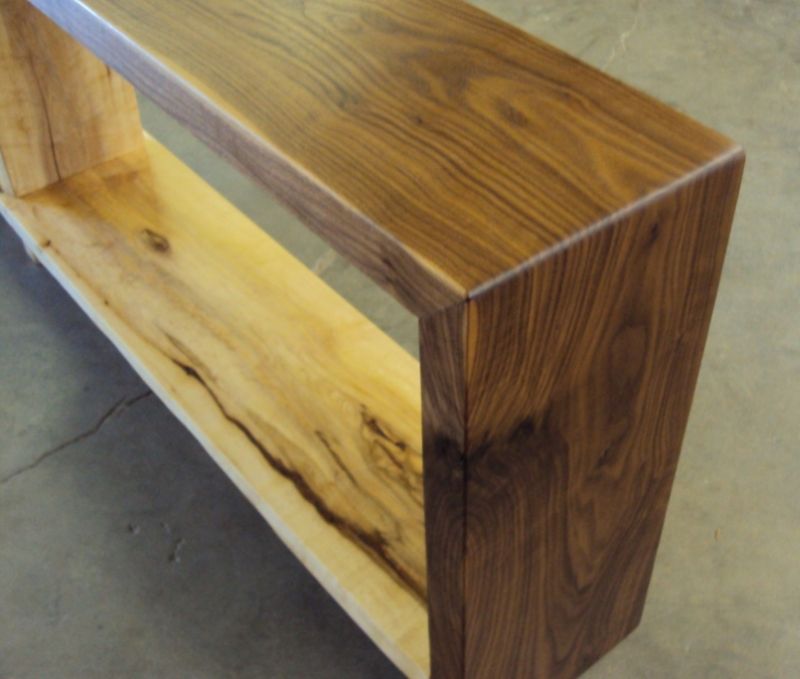
Drying Shrinkage Causes a Desktop to Cup
A typical example teaches a lesson about moisture changes and wood movement. January 14, 2008
UPLOADED_FILE>
Question
I recently glued up a desktop using highly figured hard maple. The top is 26" front to back. I used three boards approximately 8 inches wide to keep it looking as much like one board as possible. I stored these boards in my garage for about a year, then brought them in the shop for three weeks before gluing up. They were kiln dry boards to begin with. The day after I took them out of the clamps, it had cupped about 3/8" from front to back. The grain rings alternate, as some say to do. I am perplexed as to why. I would think moisture had done it, but the conditions in the shop didn't change much over the few days.
Forum Responses
(Furniture Making Forum)
From contributor B:
After you took it out of the clamps, did you stand the top up so air could get to both faces, or set it down on a bench, resulting in one side being open to the air while the other was not? I've protected glued up panels from cupping by making sure both sides faced the same air exposure conditions. When stacking panels, I will put a piece of plywood, MDF, etc. over the top one to cover the exposed surface.
It doesn't take a lot of moisture to cup a panel if it is only penetrating from one side. I once laminated a 4x8 piece of 1/2" plywood to use as a work surface. What a comedy that turned out to be. It turned into a 4x8 cup in no time at all! We could have used it as a 4 man snow toboggan. A great lesson in using a backer laminate on the back side.
From the original questioner:
I did have it flat on a table. I flipped it over, and overnight it's almost flat again. Hopefully when I connect it to the desk frame, it will stay flat.
From Professor Gene Wengert, Sawing and Drying Forum technical advisor:
Was your shop heated and the RH quite low during the three weeks that the lumber was in the shop? Was the air able to move around the lumber during these three weeks? If it was 4/4 and the shop was heated, etc., then it should have dried back down to 7% MC. The warp you describe indicates that the pieces are wetter than the air in your shop. In other words, the wood was not dry enough. The grain angle reversal has a minor effect compared to the shrinkage when the MC changes.
From contributor B:
Gene, this is a rare moment when I sort of disagree with you. This is unusual, as I always look to your posts for a definitive answer to a question. In this case, though, I think the wood having a higher or lower moisture content than the ambient air humidity depends upon which way it cupped overnight while on the bench.
If the panel cupped down at the edges, then the upward face expanded due to moisture penetration on the exposed side. If it cupped with the edges going up, then it would have been due, as you suggested, to the air being drier than the wood, subsequently drying out the exposed surface. What do you think?
From contributor L:
Funny, I did the exact same thing about a month ago for a desk unit between two walls. I joined three quilted maple boards (4/4), 9" wide by 33" long for a top finished at 26" deep. I bought it a couple days before joining (not concerned whether it moves or not). I laid it flat overnight after removing the clamps and the next day it was bowed. So I flipped it and it went back. The main thing you need to be concerned with is how it is attached. I screwed it from underneath in the back by the wall and in the front. Only in the front, the holes for the screws are slotted and the screws have washers so it can expand and contract with changes in humidity and still stay tight to the wall in the back.
From Professor Gene Wengert, Sawing and Drying Forum technical advisor:
Contributor B, your statements are indeed correct. However, I believe that in storage, the wood reached about 11% MC and then it would now be drying in the heated shop. At this time of year, it would be really tough to find wood that is drier than the ambient air in a heat shop. Certainly, if one had a $25 Radio Shack RH sensor, then we would know for sure.
From contributor B:
Gene, yup... I would agree.
From the original questioner:
This time of year my shop is 60 degrees with 30 percent RH. Is this good or bad? Remember, the wood acclimated three weeks before I started the glue up. Don't you think it should have been okay?
From contributor D:
My wood supplier recently told me that with the wood today mostly coming from young trees and wider grained, I should not glue up pieces wider than four inches. I don't necessarily agree with him, but I do think that something 8 or 9 inches shouldn't be used.
From Professor Gene Wengert, Sawing and Drying Forum technical advisor:
Although three weeks will allow the outer fibers to dry to 6% MC (= 30% RH), the core would take longer at 60 F. So, when you plane the wood, the core MC will be exposed and start to dry and try to shrink, etc.