Drying Thick Slabs
Thoughts on managing cracking in thick slabs during drying. December 6, 2009
Question
I have an oak that died and I am going to make slabs for bar tops. I am thinking of 6" thick by 36" wide by 8 feet long. How do I keep this from cracking horribly? I don’t have a kiln. I was thinking the main one would be through the pith. It would sure be the prettiest but I am sure it will crack to high heaven.
Forum Responses
(Sawing and Drying Forum)
From contributor A:
Anchor seal on the ends and about six inches up, then sticker with some air flow and out of the sun. Leaning up on a wall in the back of the shed is a good place to forget it for a few years. Checks are not always a bad thing and sometimes add character to a piece.
From the original questioner:
I would like to use it soon. How long before I could just seal the top with some Danish oil and poly then use it and let the bottom crack? Oak (depending up the type) can crack a lot. So I was thinking I would just let it crack and then split and rejoin it if it got too bad. This is for a lake house so I don’t want it dripping water or stinking or mildewing but I would like for it to be used next year.
From contributor A:
Sealing the top and leaving the bottom open will cause you more problems than not. It will not drip water and will take years to dry. Sand and coat the whole thing with an oil like mineral oil and put in use. This will allow it to breathe and dry.
From contributor N:
Good luck, most thick wood cracks when drying and kiln drying would make it worse. You could cut some relief cuts on the back side to relieve some of the stress.
From contributor W:
I had a similar problem with a large round that I wanted for a coffee table - 3" thick live oak. I sanded it smooth, wiped with denatured alcohol and coated it with three coats of Mas epoxy from Jamestown Distributors to seal the moisture in . The idea was to slow the drying as much as possible, knowing that nothing would stop it completely. This was done in June of 2004. About six months ago I started getting my first crack in one of the trunks. It has opened up about 1/8" for about 12" long. My plan is to let it dry until it reaches equilibrium with the room and then back to the workbench, sand it all down, fill the cracks with epoxy and put my favorite oil/poly finish on it. Yes, the base is an old feed store dolly.
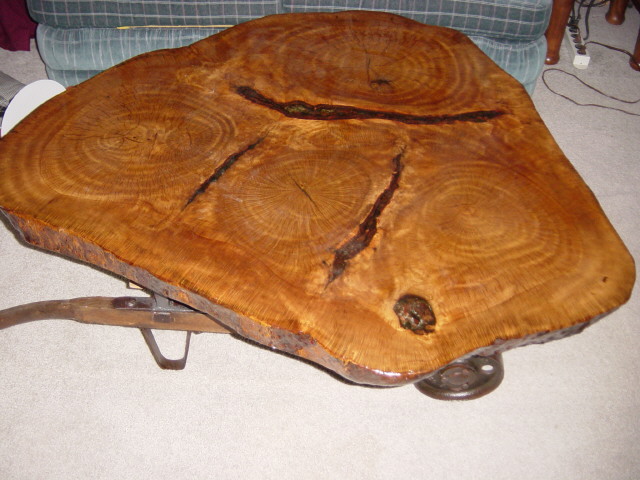
Click here for higher quality, full size image
From the original questioner:
That is one pretty table. How much does it weigh? Did it stay flat or did it bow as it dried? Is that the same "live oak" that we have around here that is heavy as stone and hard as a rock (when it dries)? I have posted a picture of a piece I did with this oak and although it’s hard it does just a bunch of little cracks as it dries.
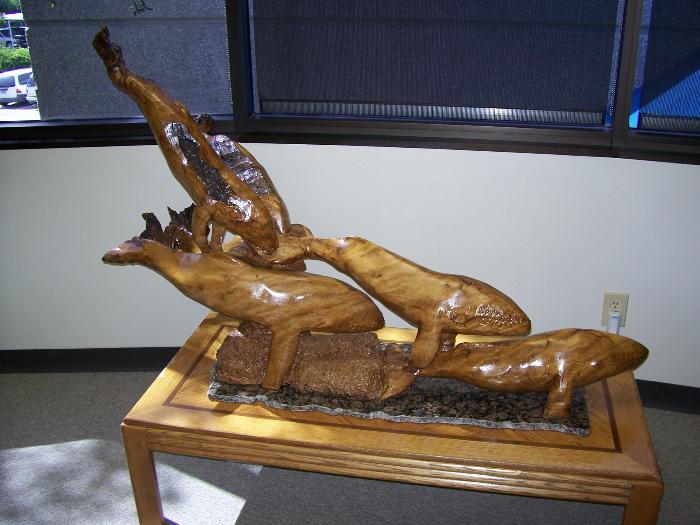
Click here for higher quality, full size image
From contributor W:
It weighed about two-three hundred pounds by my guess. It stayed nice and flat and it is Quercus Virginiana (live oak).
From the original questioner:
I realize in my pictures that you can’t see the tiny cracks. You can see the nice bands of light areas through the wood. Does yours have this? This is what they call live oak in Texas.
From contributor W:
Where in Texas? I am north of Austin.
From the original questioner:
I am in Katy. This tree came from Sargent (down on the coast by Freeport). Hurricane Carla knocked the tree down in 1961 but it lived a long time with just a little of the roots still in the ground.
From Gene Wengert, forum technical advisor:
We have tremendous problems drying oak thicker than 2". Live oak is even harder to dry without cracking than the other oaks. Your best bet is to cut it thinner, dry it and then put it back together in the same way it was sawn (minus the sawdust and planer or sander dust needed to get it smooth after drying). How about adding some walnut to the top and then having some character which will let you dry it thin?
From contributor F:
Why 6"? Even for a bar top 6" is very thick. Three inches you could do, if it is not live oak. Keep the airflow to nothing and cover the top. I did three and four inch white oak that was stored between a brick wall and shed with the top covered. I received excellent results.
From the original questioner:
I was thinking a rustic oak bar top would be about 6" thick. I am cutting it out of the log with a chainsaw so that’s about as much precision as I can handle. The legs will be the same connected to the top with a crude mortise/tenon joint. The next question is how to cut the log to get the "best"(beauty and stability) plank out of it.
