Home » Knowledge Base » Knowledge Base Article What's New  |  Site Map 


Today's
Sponsors:


Extrema Machinery

FastCap

Finish Systems

FlexiCAM

FORDAQ

Forest City Tool

FormWood Industries

Freeborn Tool Company

FS Cruing

FS Tool Outlet.com

Fuhr International

Fuji Spray

Furniture D Cube

G&M Woodcopy Lathes

Gabbiani Machine

Gary M. Katz

Global Hardwood Flooring

Glue Machinery Corporation

Goby Walnut Products

Granite Road

Great Lakes Kiln Drying Association

Great Northern Lumber

Greco Manufacturing

GreCon

GUHDO

Hanson and Leja Lumber Company

Hardware Resources

Hardwood Council

Hardwood Store of N.C. Inc.

Hasko Machines

Heidelberg Flooring

Hendrick

Her-Saf

CNCROUTERSTORE.com

CNT Motion Systems

Colonial Saw

Construction Programs and Results

Construction Recruiters

COOLwoodworkingstuff.com

Copemaster

Cordes Machine

Country Saw & Knife, Inc.

Courmatt International Inc.

CP Adhesives

CSH Custom Service Hardware Inc.

CTD Machines

Custom Woodworking Business

Cutlist Plus

D.S. Brown Machinery

Dancer Lumber

Delle Vedove USA, Inc.

Delmac Machinery Group

Delmhorst Instrument Co.

Delta

Denray Machine

DeVilbiss

Diehl Machines

Dispoz-A-Blade

Diversi-Tech

DMC

DODDS

Don Hall & Associates

Donald Dean and Sons

Downdrafttable.org

Durable Wood Products

E.W. Tooling Inc.

Eagle America

Eagle Machinery and Repair Co.

EasyCoper Tool Company

ECabinet Systems

Edge-It Edgebanding

Electrophysics

Elias Woodwork & Manufacturing

Elkom North America

Endeavor Hardwoods

EnRoute WOOD

ETemplate Digital Measuring

Eterna Lighting

ETK International

Eurosoft, Inc.

EX-FACTORY

Excel Dowel and Wood Products Inc.

ExpressSander.com


WOODWEB DISCLAIMS any and all RESPONSIBILITY and LIABILITY for the accuracy and application of the information below. Readers agree to evaluate the significance and limitations of the information provided, and accept full responsibility for the application of this information. Read More ...

Would you like to add information to this article?
Interested in writing or submitting an article?
Have a question about this article?


Fabricating Solid Wood Panel Entry Doors       Should the center panel be glued up, or built of tongue and groove pieces that allow movement? Pros share ideas and techniques. November 19, 2005

Question
I have some doors to build, interior, 1 3/4" x 3' 0 x 8'. They are a single panel door, rail and stile on outside with 3 plank panel. My question is, should I make each panel a tongue and groove so they can float separate of each other or glue them up as 1 panel and cut a v-groove between them? They are rustic white oak, stave core construction. Also, has anyone ever used a 1/2 plywood core panel and glued 3/8"-1/2" planks to the core? Would this work or would the planks try to move too much? Would the planks would be about 9" wide then?

Forum Responses
(Architectural Woodworking Forum)
From contributor K:
This is a recipe for disaster. If you are using solid wood, you must allow for movement.


From contributor G:
Do not glue the planks to the plywood. If you glue up the panel and v-groove it, it will move as one wide panel. If you tongue and groove three separate panels they will each move only 1/3 as much as a solid panel. I would use three separate panels.


From contributor D:
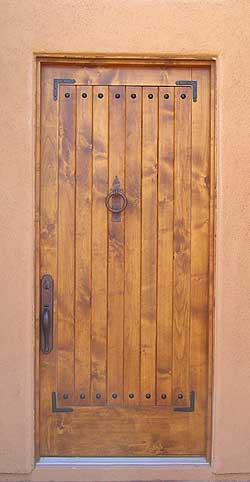
The door below is a 42"x 96" door I made for a customer. It’s basically a cope and stick with a floating panel. I glued up my planks (4" wide each) and then ran my v-groove down each side where the 4" panels came together. You have to be careful not to make your panel too thin, because after you groove it there won't be much glue joint left to hold it all together.


Click here for full size image


From contributor Y:
I would glue up the panels just as you would for flat panels and then v-groove them after sanding. This prevents a lot of glue squeeze out issues that you would have to deal with if you pre v-groove them - as long as you provide room for expansion at the sides and ends it will work great. I use a shop built jig for a router to travel in to do the grooving.


From contributor V:
To contributor D: I was just wondering why the door knocker was off center, rather than v-grooving the panel to have a full plank centered.


From contributor D:
The door knocker was an after thought for the customer. She found it when shopping in Mexico, the door was already done and in the finishing room. This was my first attempt at a v-groove panel door and the customer wanted 4" planks. Since it’s a 42" wide door that’s the way it came out. I have since reconfigured the number of planks in the field. We didn't want to mount the door knocker in the groove in fear of splitting the panel.


From contributor H:
The company I work for has used both methods with success. I wouldn't use plywood, I'd use MDF for the cores but only on interior doors. If you have a press large enough to laminate the planks to the cores, you shouldn't have any problems. It boils down to labor costs/customer expectations.


The comments below were added after this Forum discussion was archived as a Knowledge Base article (add your comment).

Comment from contributor S:
The problem is a result of non-organized labor. Tile and wood should always go before trim unless it’s a floating wood floor, that’s the only exception. Jamb saws are made for remodeling, not production construction. Beyond that Union contracts state tile setters need not carry saws other then a wet saw.

The way Union organized labor is set up, roughing comes first, then plumbing, electrical and carpentry. Drywall, first paint, flooring, trim, plumbing, and final paint come after that. There is no way to guarantee a tight fit of tile under a door jamb. The substrate may not be level, have thin set cures and change height.

This also makes me wonder about what people know about mud or claim to know about mud. Real mud is a combination of Portland sand and water. The floor is shot with laser lines for mudbed height and then screeted and dragged raising floor height. This leaves you the option of hardballing (leaving it to dry and set another day) or fresh set (tiled and grouted the same day while working on planks and left to cure over 48 hours).

This in itself tells you tile goes first. You couldn’t mud a floor around doors, cabinets, etc and some mud beds are 6" in height depending on the conditions. To tile a floor up to cabinets is absurd. You have to cut tight to the toe kicks and grout up to it as well. The grout cracks as a result of the change in temperature of the wooden toe kick. What happens when the home owner wants new cabinets? Now you need a new floor as well.

When a tile floor is installed you tile wall to wall within less than 3/4" of walls and plates, this way the base, shoe, and doors cover all tile leaving no exposed rough edges. If you were to have tile base as opposed to wooden base and shoe would you tile the base first before the floor? Not a chance.


Have you reviewed the related Knowledge Base areas below?
  • KnowledgeBase: Knowledge Base

  • KnowledgeBase: Architectural Millwork

  • KnowledgeBase: Architectural Millwork: Doors and Windows


    Would you like to add information to this article? ... Click Here

    If you have a question regarding a Knowledge Base article, your best chance at uncovering an answer is to search the entire Knowledge Base for related articles or to post your question at the appropriate WOODWEB Forum. Before posting your message, be sure to
    review our Forum Guidelines.

    Questions entered in the Knowledge Base Article comment form will not generate responses! A list of WOODWEB Forums can be found at WOODWEB's Site Map.

    When you post your question at the Forum, be sure to include references to the Knowledge Base article that inspired your question. The more information you provide with your question, the better your chances are of receiving responses.

    Return to beginning of article.


    Refer a Friend || Read This Important Information || Site Map || Privacy Policy

    Letters, questions or comments? E-Mail us and let us know what you think. Be sure to review our Frequently Asked Questions page.

    Contact us to discuss advertising or to report problems with this site.

    To report a problem, send an e-mail to our Webmaster

    Copyright © 1996-2008 - WOODWEB ® Inc.
    All rights reserved. No part of this publication may be reproduced in any manner without permission of the Editor.
    Review WOODWEB's Copyright Policy.

    The editors, writers, and staff at WOODWEB try to promote safe practices. What is safe for one woodworker under certain conditions may not be safe for others in different circumstances. Readers should undertake the use of materials and methods discussed at WOODWEB after considerate evaluation, and at their own risk.

    WOODWEB, Inc.
    RR4 Box 265A
    Montrose, PA 18801

    Contact WOODWEB