Today's
Sponsors:


Italpresse

J & G Machinery

J and B Hardwood Co.

J&P Machines

J. Gibson McIlvain Company

JMHsoftware.com

Joos USA Inc.

JusDust.com

KCD Software

Kentucky Pacific Lumber

Kerber Farms and Mill

Keystone Wood Specialties

Keytrix Data Systems

Kleiberit Adhesives USA, Inc.

Kreg Tool Company

Kremlin

Lacy Cypress Inc.

Laguna Tools

Leadermac USA

Leitz Tooling Systems

Lewis Lumber Products

Lignomat

Limtech Industries, Inc.

Logosol

Lumber Resources

Lumber Smith

M.L. Campbell

MACHINEKING.com

MARTIN Woodworking Machines Corp.

Mastercam - CNC Software

Maxima Software

Maya Positioning Equipment

Mereen-Johnson Machine Company

Merritt Woodwork

Microvellum

Middle Valley Lumber

Mikron Woodworking Machinery

Mill Outlet

Millwork Inc.

MLS Machinery

Monarch Machinery

Monarch Metal Z Clip and Panel Clip

Moulder Techniques

Mountainside Wood Products

MultiCam Southeast

Multicam, Inc.

Nail Gun Depot

New England Drawer

New England Kiln Drying Association

NEWCNC.com

Nyle Dry Kiln Systems

O'Shea Lumber Company

Old Mississippi Brick and Heart Pine Company

Oliver Machinery Co.

Omnitech Systems

ICA North America

Impact Search and Placement

Industrial Air Solutions

Integra Precision Grinding and Manufacturing

IpeDepot.com

irsauctions.com


Finger Joints: A Few Whys and Wherefores

      The Wood Doctor provides his prescription for effective finger joints in solid stock. 1998.

by Professor Gene Wengert

Editors note: The following article is an excerpt from the book "The Wood Doctor's Rx," by Gene Wengert, retired Professor and Extension Specialist in Wood Processing, Department of Forestry, University of Wisconsin-Madison.

With a wood resource that has less than high quality, many firms are looking at new species that are less expensive and at lower grades that can still fill the bill. They are considering also finger jointing: that is, the end-to-end gluing of short pieces that have several tapered "fingers" into long pieces.

The end grain of wood is so porous that good end-grain gluing can only be achieved by having mostly exposed side or edge grain. Properly made joints can easily exceed 85% of the strength of clear wood.

The benefits of finger joints in furniture and cabinet manufacturing are: 1) clear lumber from low grade stock, 2) less short length or waste material, and 3) increased yield of usable long parts. On the other hand, finger jointing does require investment in equipment, adhesives, and labor, and the reduced waste can eliminate an energy source, although as energy, wood is worth only $25/MBF. Furthermore, the joint itself may be considered by some to be unattractive and drastically inferior to solid wood. (But it's not!)

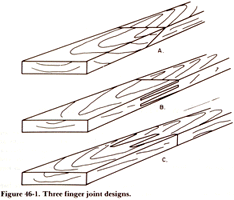
Finger joints have been in use in production for more than 50 years, yet it is only with the decline in resource quality that interest in them for furniture has increased. The joints can be made with only one finger (then it is called a scarf joint - Figure 46-1A), vertical (Figure 46-1C), or any in-between orientation.
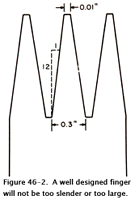
The finger joint design is usually based on a desire to achieve high strength. Best strength performance seems to be achieved with a slope of 1 to 12, with a thin tip of 0.01 in. (but not so sharp or not so thin as it may break in handling), and a base or root width (sometimes called the pitch) of 0.3 in. (Figure 46-2). These three factors combine to yield sufficient area on the fingers for a good, strong joint without weakening the wood fingers themselves. Naturally the wood species and the basic strength of the wood itself around the joint are important, too.
The steps in making a joint are:
1. Plane at least one edge of the lumber smooth so it can serve as a reference surface,
2. Square the ends of the lumber (including cutting to the correct length in some machines),
3. Form the fingers with cutting tools, by dies (often hot dies) that are forced into wood, or by a combination of these two (accuracy of +0.003 in. is required for high strength).
4. Spread the glue with a contoured brush or with a nozzle-a frequent trouble spot if the glue spread is not uniform and continuous,
5. Apply pressure (too much pressure will cause splitting at the roots).
6. Rapidly cure the adhesive with radio frequency or heated platens.

For a strong joint, the machining tolerances, wood moisture contents, and glue spread rates must be well controlled. Adhesives used for interior, nonstructural joints are melamine-urea, urea, and PVA. For structural joints such as laminated beams, phenol-resorcinol, resorcinol, and melamine adhesives are used.

Certainly it is obvious that the cost of finger jointing will vary from one operation to another. Important cost items include equipment costs, operating costs (mostly labor), direct costs (primarily adhesive and power), and raw material costs (usually the value of the wood is as residue).

Professor Gene Wengert is Extension Specialist in Wood Processing at the Department of Forestry, University of Wisconsin-Madison



Would you like to add information to this article?
Interested in writing or submitting an article?
Have a question about this article?


Have you reviewed the related Knowledge Base areas below?
  • KnowledgeBase: Adhesives, Gluing and Laminating: Glues and Bonding Agents

  • KnowledgeBase: Architectural Millwork: Moldings

  • KnowledgeBase: Solid Wood Machining: General

  • KnowledgeBase: Woodworking Miscellaneous: Woodworking

  • KnowledgeBase: Knowledge Base


    Would you like to add information to this article? ... Click Here

    If you have a question regarding a Knowledge Base article, your best chance at uncovering an answer is to search the entire Knowledge Base for related articles or to post your question at the appropriate WOODWEB Forum. Before posting your message, be sure to
    review our Forum Guidelines.

    Questions entered in the Knowledge Base Article comment form will not generate responses! A list of WOODWEB Forums can be found at WOODWEB's Site Map.

    When you post your question at the Forum, be sure to include references to the Knowledge Base article that inspired your question. The more information you provide with your question, the better your chances are of receiving responses.

    Return to beginning of article.


    Refer a Friend || Read This Important Information || Site Map || Privacy Policy || Site User Agreement

    Letters, questions or comments? E-Mail us and let us know what you think. Be sure to review our Frequently Asked Questions page.

    Contact us to discuss advertising or to report problems with this site.

    To report a problem, send an e-mail to our Webmaster

    Copyright © 1996-2012 - WOODWEB ® Inc.
    All rights reserved. No part of this publication may be reproduced in any manner without permission of the Editor.
    Review WOODWEB's Copyright Policy.

    The editors, writers, and staff at WOODWEB try to promote safe practices. What is safe for one woodworker under certain conditions may not be safe for others in different circumstances. Readers should undertake the use of materials and methods discussed at WOODWEB after considerate evaluation, and at their own risk.

    WOODWEB, Inc.
    335 Bedell Road
    Montrose, PA 18801

    Contact WOODWEB


  •   Home » Knowledge Base » Knowledge Base Article