Frame and Panel Table Top Construction
Tips and techniques for making picture-frame table tops that accomodate movement. August 21, 2006
Question
I am about to build a table that calls for a picture framed top. Basically, what they want is two panels framed (mitered corners) with a border and a center divider. My concern is getting this to line up right and making sure it does not move after I build it.
Forum Responses
(Furniture Making Forum)
From contributor L:
I did a table that is a picture frame around a piece of marble. I don't have a divider but it's just another piece of wood; it'll make it more stable. I have to make a perfect 45º jig for my table saw because my mitre box won't cut it straight enough. I think this is a good way to go anyway. Then I used two biscuits in each joint, one over the other separated by 1/4". My top was 1 1/2"; this with a 3/4" recess for the marble. I put a bevel with a vertical flat to terminate it. Came out nice. I don't think I will have any problems with it. Make sure you get a fair amount of glue squeeze out to assure you that you don't have a dry joint.
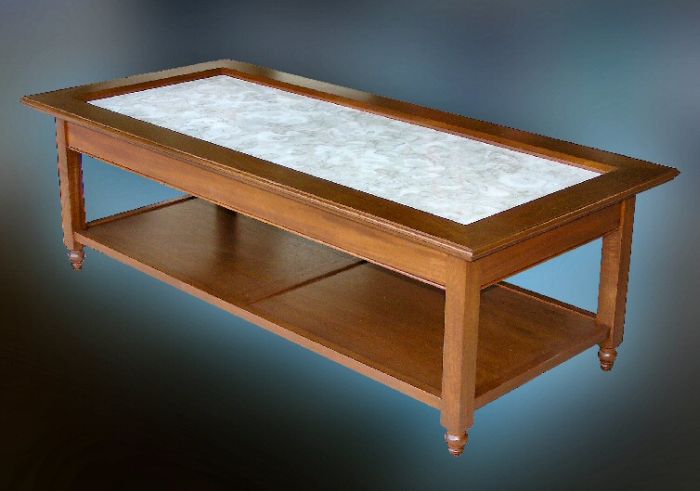
Click here for full size image
From contributor F:
Shouldn't be any stability problems with frame and panel construction. Frame and panel construction was created to solve the problem of the instability of wide solid wood panels.
You will need to engineer it to allow the panels to float and move within the frame. I worked for a maker once who had a coffee table in his line with a mitered framed top that I made quite a few of. I joined the mitered corners with anything from blind cross grain splines to biscuits. I used the biscuits in a line on the frame thicknesses center. I put in as many as I thought prudent for the frame's width of stock and held them back from the corners half an inch.
From the original questioner:
How would you machine the panels to float in the framework?
From contributor F:
Well, to an extent, it depends on the panel type - are they solid wood or composite? There are a multitude of methods. The panel can be tongued and the frame grooved with a suitable gap all around to allow for movement. It could also be done with a rabbit in the frame that a mating rabbit on the underside of the outer edge of the panel rests upon. A hidden loose spline in the lower edge of the rabbit locks the panel within its frame. Could be done with a spline alone as well, but the spline would need to be made cross grain for strength.
From the original questioner:
The panels are solid. I am making the table out of reclaimed antique cypress. I think I am going to try the tongue and groove method you suggest.
From contributor F:
Sounds like a good way to go. You can pin the panels in the center only from the underside to keep them steady. Be sure and leave ample room for the panel to grow across the grain.
From contributor A:
I use a product called Space Balls, which are 1/8 rubber balls that go into the groove on the frame in the space between the tongue and the groove. The balls get slightly compressed on assembly so the panel is tight. When the solid wood panel swells, the balls compress; when the panel shrinks, the balls expand. A good system that might work in this application.
