Fresh-Cut Pine for Rafters
In theory, green softwood should perform acceptably for barn rafters. In practice, on the other hand ... well, life is full of surprises. November 28, 2006
Question
I am short 2 x 6 x 16 rafters for a barn. Is it okay to cut green boards and use them without drying? Sure hate to buy some, since I have my own mill and plenty of pine.
Forum Responses
(Sawing and Drying Forum)
From contributor W:
Not unless you want a sag in your roof. Green lumber is very prone to deflection.
From Professor Gene Wengert, forum technical advisor:
Why not frame the roof and then in a few nice warm days, the wood will be quite dry and ready to go.
From Professor Gene Wengert, forum technical advisor:
I should mention that a fastener driven into dry wood that is kept dry has much more holding power than a fastener driven into wet wood that then dries. Another reason that drier wood is preferred is that it weighs less. And another is that any warp will occur before it is installed. On the other hand, dry wood is harder to nail, especially a wood like Southern pine. If you use wet wood, it will dry in place over a few weeks, even if you cover the framing immediately. But it will dry in just a few warm, sunny days if you leave the framing exposed. I suspect that many barns have been made with undried framing prior to 1950s.
From the original questioner:
I will cut the boards and wait a couple of weeks before using them.
From Professor Gene Wengert, forum technical advisor:
It is probably obvious, but while you are waiting the pieces should be stacked for drying
From contributor P:
I would not hesitate to install a couple pine rafters green. While the holding power of the nails may not be as great, I have built entire houses and other buildings out of green w. pine and they are still standing. You could always install some additional gusseting or metal to hold the rafters to the plates if you want to be safe. Just make sure you wait 6-8 weeks before any sheet rocking.
From contributor B:
No problem using green rafters. Do like the Dr. says and let them stay out in the sun and breeze a few days and they have their strength. Here is a building I cut out for a client this spring under construction. The rafters are 20 ft, cut out of hickory, poplar and some red oak. A week or two up in the sun and they were pretty hard. They sheathed it with sycamore, then metal. Also, an overhang was added in the front for looks. Building was 120 feet long for machine storage. Stayed straight!
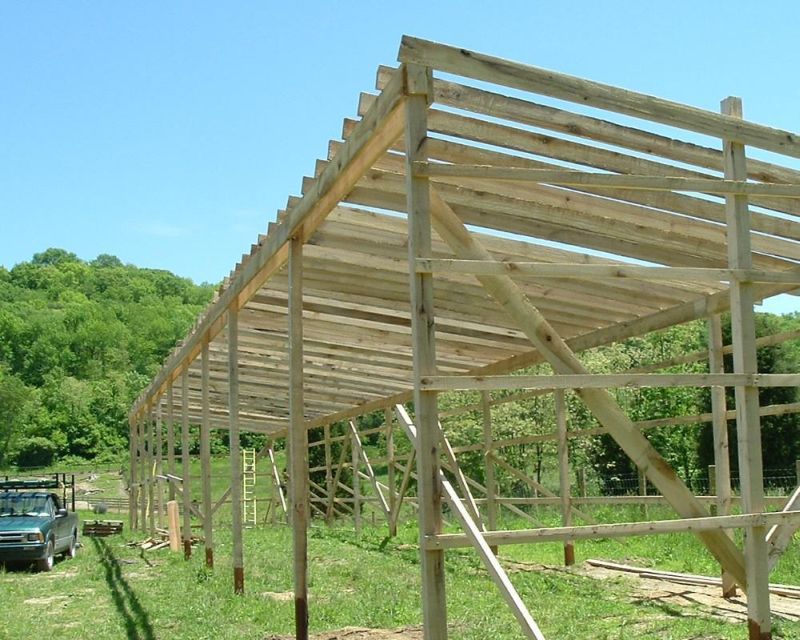
Click here for higher quality, full size image
From contributor T:
"I should mention that a fastener driven into dry wood that is kept dry has much more holding power than a fastener driven into wet wood that then dries."
It would seem that as the wood dries and shrinks, it would hold or grasp the fastener better??
From contributor J:
The problem is that the wood shrinks and the hole gets bigger. Try drilling a hole in green wood and measure it, then check it later when it has had time to dry.
From Professor Gene Wengert, forum technical advisor:
Actually, a hole gets smaller when the wood dries and shrinks. What is happening is that the wood around the hole is shrinking and that makes the hole get smaller. Of course, in the longitudinal direction, the size is constant. The problem with a nail is that the wood around the nail shrinks and holds the nail tightly, but then if there is any moisture regain, the hole widens more than if the nail had been inserted into dry wood.
From contributor P:
If the holding power of the nails is decreased by 30%, then use 30% more nails. Nail 'em up green… It's only a barn, for cripes sakes.
From contributor H:
Okay, I decided to try out this green rafter thing. I usually let my framing lumber air dry at least two weeks before use. I cut thirty 2"X6"X16' pine rafters for a single pitch machinery shed in the morning and nailed them up in the afternoon. I am in the Sierra Mts. and it has been kind of warm this last week in the 90's with a gentle breeze. Well, four days later they have taken off in every direction that it is possible for wood to go! Including a few distortions I did not know wood could do. I think that I will submit a picture to Ripley's Believe it or Not. It is impossible to lay any sheathing on those things as there is not any three that are in line or level.
Did I miss something here or is it just better to let the wood settle down and lose a little moisture before hanging it out in the air and sun without controlling the distortion potential by stacking and stickering for a few days first?
From contributor P:
Must be Ponderosa pine or something. Eastern white pine would never behave as uncivilized as that!
From contributor R:
Personally, I wouldn't have expected a 2x6 spanning that far and sitting in the sun, to stay straight, at least not around here. I would have at least nailed bracing at mid span or, depending on what the roof is going to be, put it on as I go. That's a long span for a 2x6; hope you don't have a lot of snow there.
