Today's
Sponsors:


Mereen-Johnson Machine Company

Merritt Woodwork

MFG in Honduras

Micro Fence

Microvellum

Middle Valley Lumber

Mikron Woodworking Machinery

Mill Outlet

Minimax

Mirror Reflections

MLS Machinery USA, Inc.

MLS Machinery

Modern Woodworking Magazine

Moldingknives.com

Monarch Machinery

Morbidelli

Moulder Services

Moulder Techniques

Mountainside Wood Products

Multicam, Inc.

NAP Gladu

Nebraska Tool

NEMI

New England Kiln Drying Association

NexGen

Hoffmann Machine Company

Holz Her U.S. Inc.

Howard S. Twichell Co.

Hvalsoe Sawmill Ltd.

ICA North America

Icy Straits Lumber

IDM

Impact Search and Placement

Indiana Hardwoods

Industrial Air Solutions

Integra Precision Grinding and Manufacturing

InTrading

Invicta Woodworking Machines

IpeDepot.com

irsauctions.com

Italpresse

J & G Machinery

J and J Barn Wood

J&P Machines

J. Gibson McIlvain Company

Jiffytops

JIT Hardware Supplies, Inc.

JMHsoftware.com

John G. Weber Co.

Joos USA Inc.

KCD Software

Kerber Farms and Mill

Keystone Wood Specialties

Keytrix Data Systems

Kiln-direct.com

Kleiberit Adhesives USA, Inc.

Kreg Tool Company

Kremlin

Lacy Cypress Inc.

Langelier Lumber Ltd.

Leadermac USA

Lewis Lumber Products

Lignomat

Logosol

Lumber Resources

Lumber Smith

M.L. Campbell

MACHINEKING.com

Macoser, Inc.

Mahros

Maine Timber Works

Maine Woods Company

Mann and Parker Lumber Co.

Martin Lumber

MARTIN Woodworking Machines Corp.

Mastercam - CNC Software

Matthews Mill

Maya Positioning Equipment


Furniture from Air-Dried Red Oak       If "air drying" is understood to include drying to equilibrium in a conditioned indoor space, then the result can be useable wood. May 27, 2008

Question
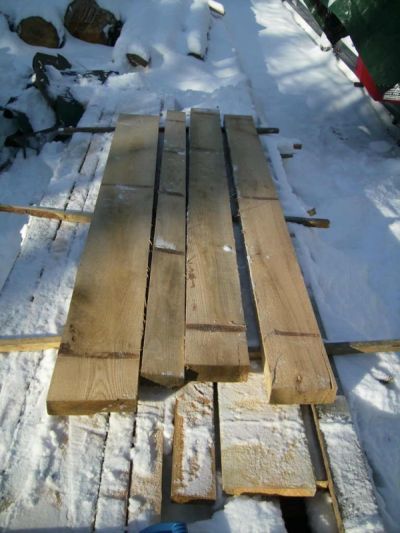
I have some 2" red oak planks that have been air-drying for about 1 year. The attached picture show 4 of these planks. One of my lumber customers wants to use some of this oak to construct some furniture (tables). Is it possible to build furniture from this oak without kiln drying? If so, what is the minimum time the lumber would have to dry indoors to be usable? I have now moved all the planks into my basement in a stickered pile to thaw them out.
Forum Response
(Sawing and Drying Forum)
From contributor A:
The moisture will be about 12 % MC, so it is too wet for indoor furniture. It will likely shrink about 1.5% MC as it dries and may also warp. You also could have powderpost beetles, so you need to heat the wood to kill them. They will not show up now, but will show up when the wood is warm for a few weeks or more. I would not suggest that this wood be used without kiln drying.


From contributor B:
2" thick might not even be down to 12% yet, it depends where it was stacked. If he is making rustic furniture where nothing has to be perfect 12% would be OK keeping in mind the wider boards might bend a little. I've built lots of furniture where it's only been up to 120 degrees and never had a bug come out yet.


From contributor B:
I've been building furniture with air dried wood for over 15 years now, and have never had a problem. I've always started by letting the wood stay outside until it's down below 20%. Then, it gets restacked inside my woodshed, where it stays until it's down to around 12%, which is about as low as it's going to get around my neck of the woods. I keep around 200 to 300 bf of each of the species I use most frequently (cherry, maple, poplar, and walnut) inside the shop, and I always make sure I have enough stock inside for 2 to 3 months before using it, so it reaches equilibrium with the shop. The MC gets down to around 8%, and I've never (knock on wood) had an issue.

If your customer needs to work the wood immediately, then those boards aren't ready. However, if he can wait a little while, and put them inside, they should be ready inside 6 months. American craftsmen have been building furniture out of air dried lumber for over 400 years. If you know what conditions are required, it's not a problem at all. And, the beautiful colors of walnut and cherry are much more brilliant when not introduced into a kiln environment.


From Professor Gene Wengert, technical advisor, Sawing and Drying Forum:

Although contributor C indicates that the wood is air dried, it is actually further dried at room temperatures, which is also the way lumber was dried by people 200 years ago. Today, we also air dry and then dry it in a kiln in a few weeks rather than wait for it to air dry at room temperature.

The phrase "air dried" has the connotation of 20% MC (+ or -), so it would not be fair to state that furniture was built with air-dried wood. If we redefine the phrase to mean that wood that has been air-dried will always be called air-dried, then even the kiln-dried wood used for the past century could be called air-dried wood.


From contributor D:
You've made a good point Doctor. Air drying, verses going through the extra steps of finishing the job in an indoor controlled environment, are two different things. Good results can be achieved by taking those extra steps. So saying air-dried, when it was dried in an outdoor stack, is not the same as saying air-dried when it was further dried indoors. Of course you have many times pointed out the benefits of additionally kiln drying to kill the bugs and set the pitch. It makes me wonder how our ancestors managed to make furniture that didn't always succumb to powderpost beetles.


From contributor B:
Doc, I'm sorry for the confusion in terminology. I guess, in a way, I'm using the dry conditions in my shop, which are kept that way with dehumidifiers in the summer months, as "the kiln" to finish off the wood. The only difference being that I'm not getting it done in 5 to 10 days.

I began working with my own sawn lumber as an experiment, because I was having difficulty finding consistent quality kiln dried lumber in the Chicagoland area. There are many, many suppliers around here, but you might (or might not!!) be surprised at how many times I'd resaw a 12/4 slab for bookmatched doors, only to find out I have some real expensive firewood. I now always make sure I stay ahead of my wood consumption rate by continually milling logs of the hardwood I use the most. That way, I rarely find myself needing to pay a visit to the hardwood store, unless it's something I don't use a lot.
Thanks for all your information at this site, also. I don't post frequently here, but I've been a daily lurker for several years now, and have learned quite a bit about sawing and drying lumber. When the economy improves, I will be expanding my business to sawing and drying quality lumber and slabs, with the furniture maker in mind.


Would you like to add information to this article?
Interested in writing or submitting an article?
Have a question about this article?


Have you reviewed the related Knowledge Base areas below?
  • KnowledgeBase: Knowledge Base

  • KnowledgeBase: Primary Processing

  • KnowledgeBase: Primary Processing: Air Drying Lumber


    Would you like to add information to this article? ... Click Here

    If you have a question regarding a Knowledge Base article, your best chance at uncovering an answer is to search the entire Knowledge Base for related articles or to post your question at the appropriate WOODWEB Forum. Before posting your message, be sure to
    review our Forum Guidelines.

    Questions entered in the Knowledge Base Article comment form will not generate responses! A list of WOODWEB Forums can be found at WOODWEB's Site Map.

    When you post your question at the Forum, be sure to include references to the Knowledge Base article that inspired your question. The more information you provide with your question, the better your chances are of receiving responses.

    Return to beginning of article.


    Refer a Friend || Read This Important Information || Site Map || Privacy Policy || Site User Agreement

    Letters, questions or comments? E-Mail us and let us know what you think. Be sure to review our Frequently Asked Questions page.

    Contact us to discuss advertising or to report problems with this site.

    To report a problem, send an e-mail to our Webmaster

    Copyright © 1996-2009 - WOODWEB ® Inc.
    All rights reserved. No part of this publication may be reproduced in any manner without permission of the Editor.
    Review WOODWEB's Copyright Policy.

    The editors, writers, and staff at WOODWEB try to promote safe practices. What is safe for one woodworker under certain conditions may not be safe for others in different circumstances. Readers should undertake the use of materials and methods discussed at WOODWEB after considerate evaluation, and at their own risk.

    WOODWEB, Inc.
    RR4 Box 265A
    Montrose, PA 18801

    Contact WOODWEB


  •   Home » Knowledge Base » Knowledge Base Article