Today's
Sponsors:


Rex Lumber Company

Riethmiller Lumber

Ritter Manufacturing Inc.

Roberts WebForge, Inc.

Rockler Woodworking and Hardware

Roger Shaw and Associates

Rose Machinery

RouterCAD

RT Machine Co.

Safety Speed Cut

Sand-Rite Manufacturing

Sandman Products

Sawmill and Woodlot Magazine

SCM Group USA

Sears Trostel Lumber Co.

ShopBot

SII Dry Kilns

Silvaris

Simantech

Sinker Treasures

SIS Machinery

SNX Technologies

Solid Setup

South State Machinery

Southeast Tool, Inc.

Sovereign Machine, Inc.

Specialtytools.com

Speed Sander

Sprayguncaptain.com

Steve H. Wall Lumber Co.

Stiles Machinery

Stiles Shop Solutions

Super Source Tooling Inc.

Supergrit Abrasives

Oliver Machinery Co.

Omnitech Systems

Oneida Air Systems

Onsrud Cutter

Opti-Sand

Optisol for Project Scheduling

Orange Aluminum

Original Saw Company

Osborne Wood Products

Paragon Enterprises

Patrick Lumber Company

Penn Sylvan International

People Logic Software Corp.

Peterson Portable Sawmills

Pinske Edge

Pioneer Lumber Company

Planit Solutions

Porter-Cable

Preservation Solutions

Prime Estimating and Software Services, LLC

Primo Woodworking Machinery

Pro.Woodworker.com

Professional Machinery Group

PSL Optimization Software

Quality VAKuum Products, Inc.

Quickscrews International Corporation

QuickScribe

QuickWood, Inc.

QuikDrawers

R&R Drummond, Inc.

R.A.W.

RazorGage


Gold Showing Through Black

      Tips on achieving an artistic finish: A gold undercoat showing through a sanded-back black topcoat. February 13, 2006

Question
We have a job that involves something we're not proficient at. The project involves a china hutch with 6-lite glass doors that the customer wants finished in black with gold showing through - or burnished, if thats the right term. For our paint grade jobs we typically use ML Campbell opaque base tinted products. I'm having a problem getting a gold that looks good. Also, what techniques do you use to cut through the top black layer so that the gold shows through elegantly?

Forum Responses
(Finishing Forum)
From contributor A:
Give this a try, on a sample. Clear coat the glass, and allow to dry. Use a gold glaze - you can brush out the glaze, or dab and mottle the glaze as in faux marble. Allow it to dry, and then clear coat and allow to dry. Then apply your black coat, allow to dry, and clear coat. It's a reversed process that is very attractive, and you can add many artistic options.


From contributor B:
I would use the following process:

1. Vinyl Sealer - sand.
2. Opaque color Gold (pigmented vinyl or lacquer)- 2 coats. Sand.
3. Opaque color Black, to cover.
4. Rub-through with low abrasive sand pad or light solvent, to desired look.
5. Clear topcoat.


From contributor C:
Apply a sealer coat, then apply the gold - as much as it takes to completely cover - then seal the gold (clear). Then apply black - not too heavy. Let it dry, then sand back to the gold where you want it to show. Go black again - it should be covered thoroughly where you didn't sand through. The sanded through areas should still be fairly visible so you can sand again, then apply final clear coat. This technique minimizes the amount of sanding you have to do to remove the black, which in turn minimizes the amount of gold you'll accidentally sand through. It's probably best to have one person do the sanding through. Individual techniques usually don't match, and you don't want one side to look too different from the other. It's a pretty forgiving process - if you don't like something, add more black or gold, and start over.


From contributor A:
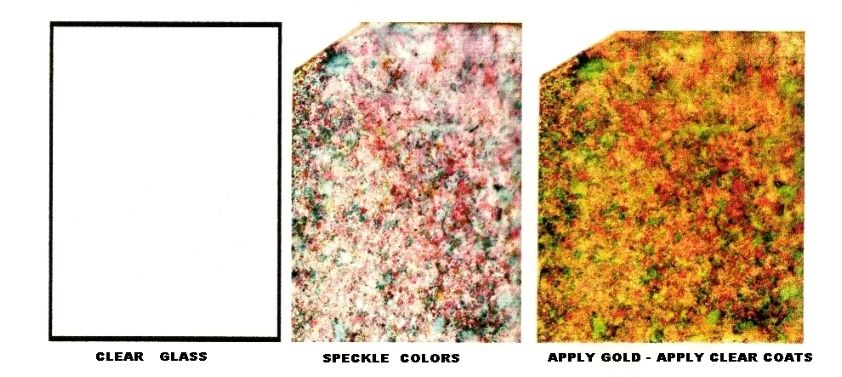
This was done on clear glass. I use a water clear acrylic as my coating, and the colored speckling can be done with either colored pigments or with dyes. The gold is acrylic, followed with acrylic clear coats to protect the finish. There are many decorative finishes that be be done with these same products. The glass top increases the beauty of the finishes. It's smooth and glossy.


Click here for full size image


From contributor D:
This sounds like a classic rub through. The gold is an important and overlooked feature. There are a lot of cheap looking gold paints that just don't give the luster and sheen of gold. I use Ronan almost exclusively. It can give you the tone you want, with various shades to choose from. It has a high metallic content and wears exceptionally well. The only drawback is its relatively high price, but considering the cost of the job, it is really a small cost. It can be found at one of your high end paint or specialty paint stores that carry faux stuff, or ordered online.

If you insist on keeping it cheap (normally customers who want gold on cabinetry do not want cheap), I would use a couple products for base coating larger faux work, Muralo and Ralph Lauren. Both are pretty decent, and can be found at Home Depot. I'd stay far away from gold paint found at your local paint store. Also, the gold paint is a fast drying latex, so I'd double coat it, and you’re done. This will give you higher build so less chance of sanding through it. Seal it also.

When sanding down the black it’s important to use a very fine sandpaper or abrasive pad. This will give you the smooth flow into the gold from the black, and will give a much smoother surface to boot. That will be the difference between an artful flow between colors, and a hack with a 100 grit sanding block.

Finally, since you didn't mention the customer wanting any other type of distress, I'm guessing it’s another one of those structured distressed pieces that are popular now. If that is the case, keep your rub-through narrowed lines following the lines of the piece, edges of boxes, etc. Do not make the rub-through wide unless the customer asks for it. Sand very lightly along the top of the profiles and detail. Tips should show here and there but not every tip and not every profile. I usually complete the look with some aging glaze over the gold and in the detail to give an added dimension.


Would you like to add information to this article?
Interested in writing or submitting an article?
Have a question about this article?


Have you reviewed the related Knowledge Base areas below?
  • KnowledgeBase: Knowledge Base

  • KnowledgeBase: Finishing

  • KnowledgeBase: Finishing: General Wood Finishing


    Would you like to add information to this article? ... Click Here

    If you have a question regarding a Knowledge Base article, your best chance at uncovering an answer is to search the entire Knowledge Base for related articles or to post your question at the appropriate WOODWEB Forum. Before posting your message, be sure to
    review our Forum Guidelines.

    Questions entered in the Knowledge Base Article comment form will not generate responses! A list of WOODWEB Forums can be found at WOODWEB's Site Map.

    When you post your question at the Forum, be sure to include references to the Knowledge Base article that inspired your question. The more information you provide with your question, the better your chances are of receiving responses.

    Return to beginning of article.


    Refer a Friend || Read This Important Information || Site Map || Privacy Policy || Site User Agreement

    Letters, questions or comments? E-Mail us and let us know what you think. Be sure to review our Frequently Asked Questions page.

    Contact us to discuss advertising or to report problems with this site.

    To report a problem, send an e-mail to our Webmaster

    Copyright © 1996-2012 - WOODWEB ® Inc.
    All rights reserved. No part of this publication may be reproduced in any manner without permission of the Editor.
    Review WOODWEB's Copyright Policy.

    The editors, writers, and staff at WOODWEB try to promote safe practices. What is safe for one woodworker under certain conditions may not be safe for others in different circumstances. Readers should undertake the use of materials and methods discussed at WOODWEB after considerate evaluation, and at their own risk.

    WOODWEB, Inc.
    335 Bedell Road
    Montrose, PA 18801

    Contact WOODWEB


  •   Home » Knowledge Base » Knowledge Base Article