Hard Maple for Baseball Bats
Info about sawing, drying, and grading maple bat billets. October 2, 2005
Question
I'm about to mill some hard maple. I'd like to turn a few baseball bats out of it. The logs are green.
1) Do I cut 3x3 or 4x4 billets out of it, or other?
2) Do I need to kiln dry them, or is air dried good enough?
3) How long can I expect to air dry them before turning?
Forum Responses
(Sawing and Drying Forum)
From contributor B:
1. 3x3s are typically okay. Look at your desired bat size.
2. Kiln drying is typically required.
3. Air drying such thick stock will take months. You will have a very hard time air drying below 15% MC. Some folks dowel their blanks prior to drying.
Be very careful with straightness of grain. Weak, prone-to-breakage bats will be produced from otherwise clear wood in which the grain does not run straight. Do you carry appropriate liability insurance?
From contributor M:
I always thought white ash was the wood of choice for bats. Adirondack Sluggers were always ash. Now most are aluminum. Maple may be too dense and heavy to meet weight requirements if these are to be used where league rules apply.
From contributor D:
We just sold a second kiln to a company that dries HM bat billets. That will bring their capacity up to 17,100 billets per month so, if you know what you're doing, hard maple baseball bats are big business.
From contributor I:
Ball bats have to be right around 12% MC to make a good bat. The grain must be straight. The piece must be knot and check free. Hard maple works very well for ball bats. Ash is still preferred. Red oak is too brittle. It breaks to easily. Some tell me that vacuum dried ash and HM is harder? I don't know if there is any truth to that or not. It is better to dry as a square and then turn the bat. Drying as a round can get tricky - egg shaped wood.
From contributor I:
Red oak, when dried and oil treated the right way, can make a great bat. It will out-hit ash by about 50 feet. I don't know much about baseball, but I hear that Babe Ruth used a red oak bat.
Also, when I say "vacuum drying," I'm referring to hot water plate vac drying. There is something about RFV vac drying that will make the center of a RO square very brittle.
From contributor D:
This is how HM billets look when they are being loaded into a vac kiln.
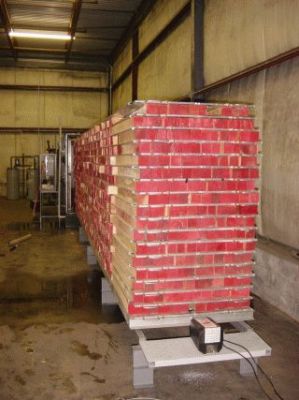
We suspect that wood dried in our kilns is less brittle because we never use excess heat. The wood is in the range of 15 to 25% before its temperature starts to climb above 100F. Penn State suggested a test. They will provide the wood, they will air-dry and conventionally dry part while we vacuum dry the rest. They will do the analysis. Then we will know.
From contributor I:
What's the red on the end of the squares? I see a lot of vac dry operations painting the end of their squares. What's the reason for this?
From contributor D:
As soon as the squares are cut, they get end seal to prevent end checks. Since most wood is cut to length before it goes into a vac kiln, you can't have any end checks. If the wood is going to a lathe, not even tiny ones that have closed.
From contributor I:
Maple will check quick if it is cool and dry outside. If it's warm and humid, one doesn't have to worry as much about end checks, but about stain. I used to end seal some species of hardwood before vac drying because the end seal forces water out through the sides of the wood instead of out of the ends. This helps create more even drying in a vac kiln.
From contributor D:
Actually, we recommend wax emulsion and it doesn't have much if any affect under vacuum. Therefore, it doesn't force any water out the sides.
The comments below were added after this Forum discussion was archived as a Knowledge Base article (add your comment).
Comment from contributor W:
For the best ball bat squares I would recommend bucking the logs to about 42-48" long. The goal is 100% sapwood squares 3-1/4" x 40" long and end seal. Ash is far better than maple and only needs to be Kiln Dried to 9-10%. I have used both higher and lower moisture however. The key is making sure to use even and stable drying regardless of the method. Maple, while slightly harder in the barrel is too stiff in the handle to make a good safe bat. I would stick with northern white ash from PA and NY, north of Route 80. Some of the best ash comes from along the NY-PA border. If you like a really heavy strong bat like the Babe used, then hickory might be what you want as it was his choice at one time in his career.
Comment from contributor O:
I had a bat made of hickory for my son in 1999. He used it in a wood bat summer league and then for batting practice in college for 4 years. He also used it in a wood bat summer league for 4 years and it still refused to be broken. It’s still in use after another 4 years in an adult wood bat league as well. The pattern was S44, 33" and it's not heavy. The balance is perfect and the ball jumps off the bat. I’m not sure why hickory is not used commercially, as it works great for handles.