by Dr. Eugene Wengert
A kiln schedule is a set of temperatures and humidities that are used during kiln operation. The kiln humidity can be expressed as an EMC, relative humidity, or wet-bulb temperature. The velocity through the load is assumed to be between 275 and 350 fpm, except for the white woods (including maple, ash, basswood, hackberry) where higher velocities (up to 600 fpm) are desired and acceptable. Changes in kiln temperatures and humidities are based on the MC of the lumber being dried, which in turn is determined from properly prepared kiln samples.
Choosing a Kiln Schedule
The kiln schedule information in the tables below has been assembled from many different sources, including drying texts and industrial contacts. (A major source was Dry Kiln Schedules for Commercial Woods which is available from the Forest Products Society in Madison, WI.) This listing incorporates current market requirements for the various species, as well as the current quality of the lumber resource itself. (In the original Dry Kiln Operator’s Manual written in the early 1950s, some species were not used in high quality products. As a result, the kiln schedules were too severe. Also, today, we are often kiln drying No.2 Common lumber which requires a milder schedule than upper grades; in the 1950s, seldom was this lower grade lumber kiln dried.) The common lumber name is used throughout.
The schedules are all moisture content based, using the moisture content of the wettest half of the kiln samples. The schedule designations use the popular U.S. Forest Products Laboratory designations. (See the following sections for a discussion of how to develop a schedule from these designations.) A small "m" after the designation indicates that the wet-bulb temperatures should be adjusted to avoid temperatures below 90 F. See the above mentioned publication for details.
Formulating a Kiln Schedule
A free BASIC program to convert the designations into actual temperatures and humidities is available from the author. The schedules can also be formulated manually as follows.
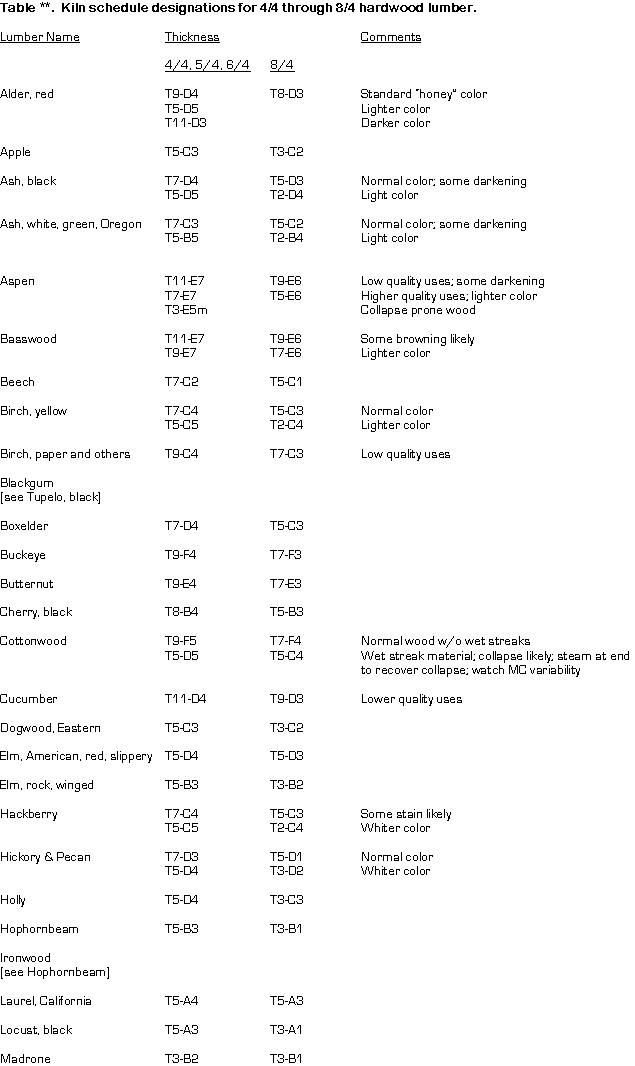
1. Determine the correct designation, such as T3-D2 for 4/4 red oak.
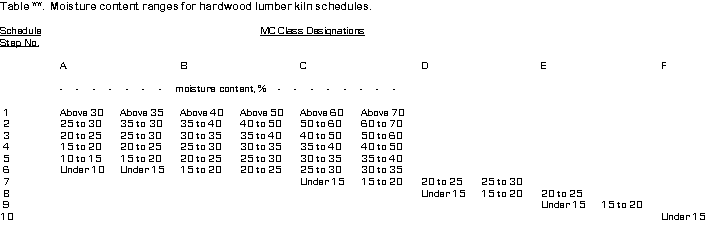
2. Go to the second letter designation (the MC Class Designation) and find the corresponding MC ranges in the table below. (Note: This letter designation is related to the green MC of the species. The MC ranges are chosen so that the loss of the first one-third of moisture, and the highest risk of checking and staining, will occur in the first step listed.)

Click here to view full size image
3. Using a piece of paper with 6 columns, write down the Schedule Step numbers in the first column on the left. Then, write down the appropriate MC ranges (determined in #2 above) in the second column.
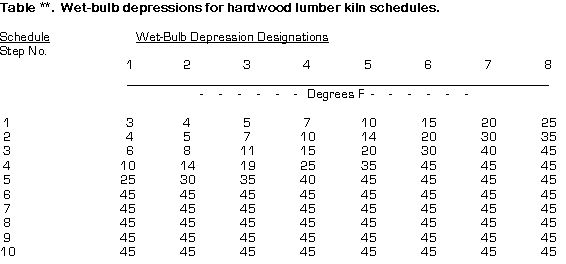
4. Go to the second number designation (the wet-bulb depression designation) and find the corresponding depressions in the table below.
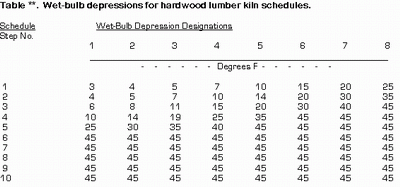
Click here to view full size image
5. In the fourth column, write down the wet-bulb depressions (determined in #4 above), one for each Schedule Step, starting at the top (Schedule Step 1). There may be more depression values than required; ignore the extra depression values in this table.
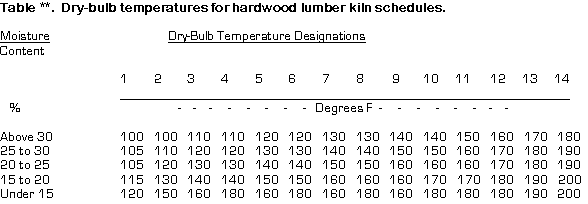
6. Go to the first number designation (the temperature designation) and find the corresponding temperatures in the table below.
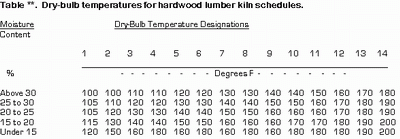
Click here to view full size image
7. In the third column, write down the appropriate dry-bulb temperatures. BE CAREFUL--The first temperature value must be repeated for every MC class (column #2) that is above 30% MC. The second temperature value is written for the 25 to 30% MC class; the third for the 20 to 25% MC class; and so on.
8. Subtract the wet-bulb depression from the dry-bulb temperatures for each schedule step and enter the value in the fifth column.
9. If required, look-up and write down the RH (sixth column) and EMC (seventh column) for each schedule step.
10. Determine the equalization settings and conditioning settings, as required. This procedure is discussed in a following section.
Using a Kiln Schedule
Always use adequate samples representing both the wettest and driest lumber in the dryer. MC values in the kiln schedules are based on the wettest half of the kiln samples. Always avoid conditions that add moisture back to the lumber, especially during start-up. Low temperatures can be used for an extra safety margin on greener lumber. A maximum 45 F depression often produces better lumber.
Dehumidification Kilns
For DH kilns, use the same RH, but lower the temperature to the typical operating temperature for the compressor; raise temperature to steam values when convenient and possible.
Equalizing and Conditioning
Equalizing and conditioning are required for almost all hardwood lumber. For equalizing, use an EMC 2% below the target MC at a dry-bulb of 170 F. For conditioning, use an EMC 4% above the target MC at a dry-bulb of 180 F.
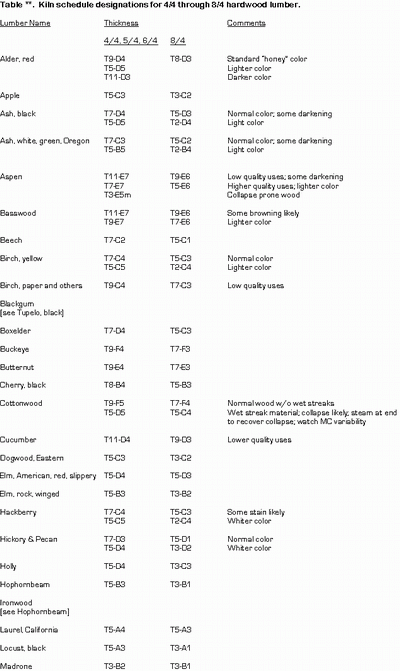
Click here to view full size image

Click here to view full size image
Professor Gene Wengert is Extension Specialist in Wood Processing at the Department of Forestry, University of Wisconsin-Madison