Today's
Sponsors:


Endeavor Hardwoods

Erecta-Rack

ETK International

EX-FACTORY

Excel Dowel and Wood Products Inc.

Extrema Machinery

FastCap

Felder USA

Festool

Finish Systems

Firth Maple Products

Flap-Wheels.com

FormWood Industries

Freeborn Tool Company

Freedom Machine Tool

Fuhr International

Fuji Spray

Gary M. Katz

Goby Walnut Products

Graco, Inc.

Great Lakes Kiln Drying Association

GreCon

Green Valley Wood Products

GUHDO

Hanson and Leja Lumber Company

Hardwood Council

Hardwood Store of N.C. Inc.

Heartwoods, LLC

Hendrick

Her-Saf

Hermance Machine Company

Hi-Knoll Cedar, John Langstroth Consulting

Historical Plus Wood

Centre for Advanced Wood Processing

Charles G.G. Schmidt Co.

Chicago Dowel Company, Inc.

Classic Designs by Matthew Burak | tablelegs.com

Clear Lake Lumber

Clear Vue Cyclones

CNC Parts Dept.

CNCROUTERSTORE.com

Colonial Saw

Construction Programs and Results

Cook's Saw Mfg.

Coulee Region Hardwoods

Country Saw & Knife, Inc.

CP Adhesives

CSH Custom Service Hardware Inc.

Cutlist Plus

Cutting Edge CNC

Delta Power Equipment Corporation

Denray Machine

Digital Wood Carver

Dispoz-A-Blade

Don Hall & Associates

Donald Dean and Sons

Eagle Bay Cabinet Doors and Drawers

Eagle Machinery and Repair Co.

Eagle Mouldings

ECabinet Systems

Edge-It Edgebanding

Electrophysics

Elias Woodwork & Manufacturing


Ideas for Cabinet Feet

      Cabinetmakers discuss style ideas for feet on a kitchen sink cabinet. November 30, 2009

Question
I'm trying to come up with some ideas for furniture feet on sink bases. I am trying to avoid short grain to long grain scenarios because the short grain piece often seems to attract moisture and swell relative to adjacent elements. Can anybody suggest anything better than these?
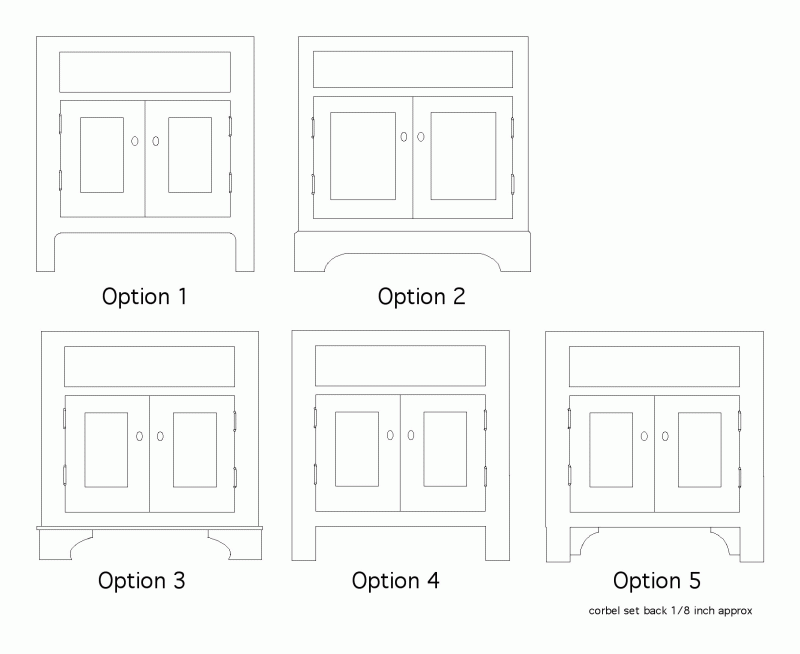

Click here for higher quality, full size image

Forum Responses
(Cabinetmaking Forum)
From contributor F:
What exactly do you mean by "the short grain to long grain scenario"?


From contributor R:
How about bun feet?


From contributor M:
If you're worried about cross-grain swelling against a more stable length-grain piece, avoid the wider-piece face frame scenario. But against that consideration you must remember that even a 3" or 3 1/2" face frame member won't swell that much even in a very moist climate.

I can't see much difference between your "option 1" and "option 4" choices, but if it were me, I would go with options 2, 3, or 5, since the arched base really adds design punch to this simply-constructed piece. Don't worry about the wide base pieces swelling - just attach them in a way that they can swell or shrink freely. They are against the floor, and won't open up a crack which will be noticeable from a typical line of sight.
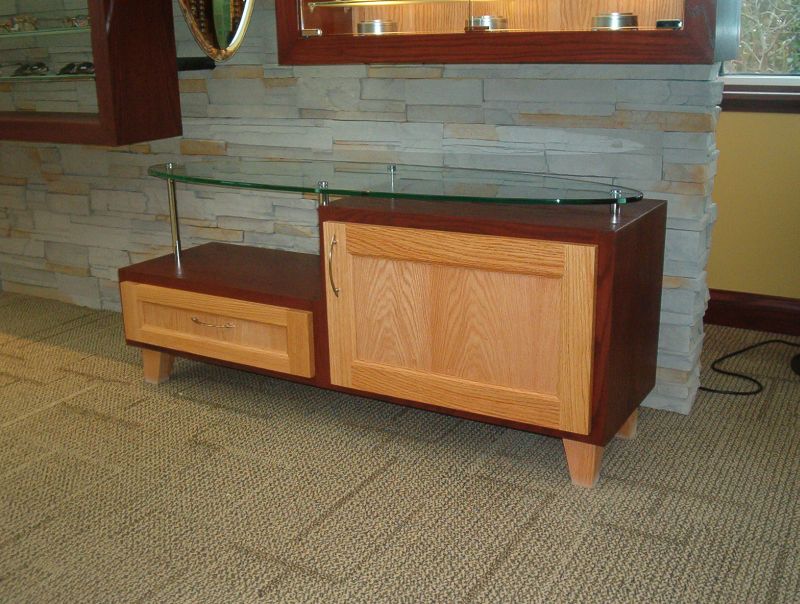


From contributor G:
These feet are easy.


Click here for higher quality, full size image


From contributor J:
We base it on the architectural style of the kitchen - traditional, contemporary, shaker, etc.


From contributor F:
On furniture, there is often a sub bottom frame and panel. The foot design is mitered and glued to the outside edge of the frame and panel long grain to long grain and the thickness of the foot part falls outside of the carcass at the front and sides.

The carcass sits atop the frame and panel and is equal in dimension to the frame minus the thickness of the foot. A trim molding such as an ogee is then mitered and applied to the top of the foot and against the carcass front and sides. Another nice design element would be ogee bracket feet. These would take more time than the typical scroll sawn designs.


From the original questioner:
This is the short grain that I am trying to avoid.

As others have noted, the choice of furniture foot need to be appropriate to the style of work. For the most part my work has a classic/contemporary bent to it, bordering on Shaker or Craftsman style. The majority of it is kitchen cabinetry.

Context adds a couple of other variables. The furniture feet typically land on an out of level floor and have to transition to other elements in the room that are not symmetrically placed. They also have to land on a budget. This budget has to also include getting a buy-in from the homeowner/designer, getting the crew to figure out how to make it, explaining it to the contractor who is really not the guy who's going to install it and then mopping it up because the painter smokes pot and loses one of them.

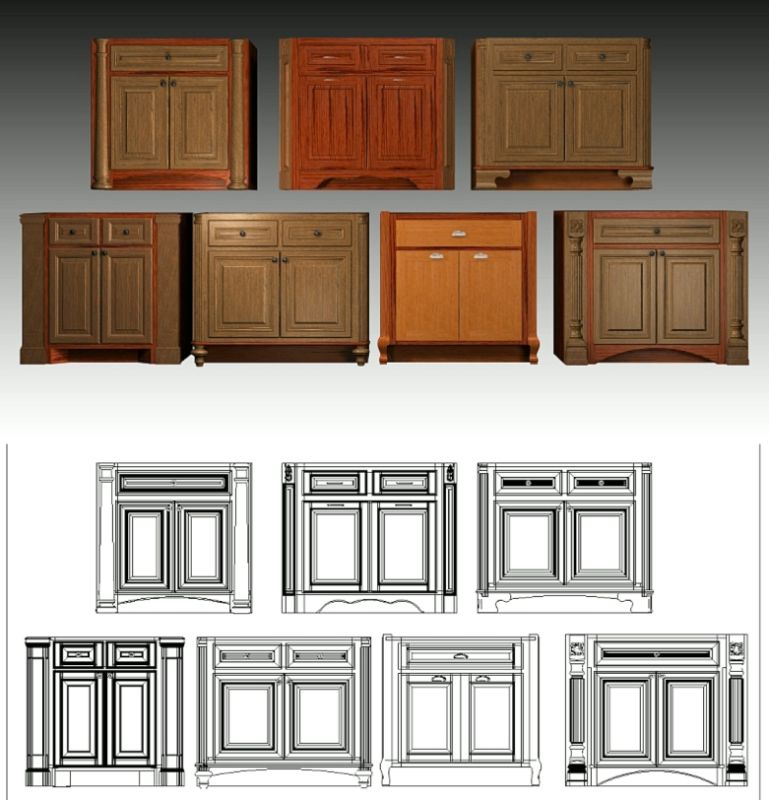
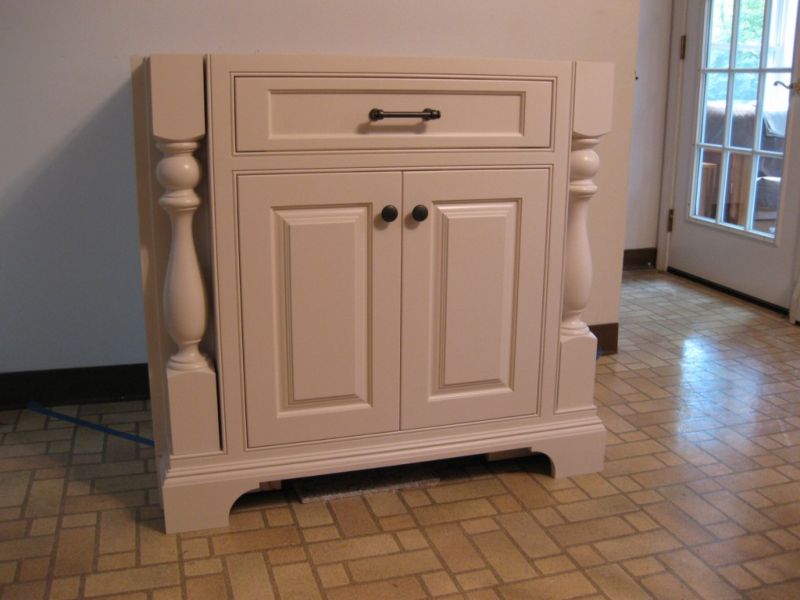
Click here for higher quality, full size image


From contributor K:
Here are some decorations I have done for bumped out sink bases in the past.


Click here for higher quality, full size image


From the original questioner:
Contributor K, that's some nice work. You also have some very interesting pieces on your website. I like how you transition the baseboards on some of those rustic vanities.


From contributor P:
Here's the sink base for my own kitchen. I'm building the cabinets between projects.


Click here for higher quality, full size image


Would you like to add information to this article?
Interested in writing or submitting an article?
Have a question about this article?


Have you reviewed the related Knowledge Base areas below?
  • KnowledgeBase: Knowledge Base

  • KnowledgeBase: Cabinetmaking

  • KnowledgeBase: Cabinetmaking: Cabinet Design


    Would you like to add information to this article? ... Click Here

    If you have a question regarding a Knowledge Base article, your best chance at uncovering an answer is to search the entire Knowledge Base for related articles or to post your question at the appropriate WOODWEB Forum. Before posting your message, be sure to
    review our Forum Guidelines.

    Questions entered in the Knowledge Base Article comment form will not generate responses! A list of WOODWEB Forums can be found at WOODWEB's Site Map.

    When you post your question at the Forum, be sure to include references to the Knowledge Base article that inspired your question. The more information you provide with your question, the better your chances are of receiving responses.

    Return to beginning of article.


    Refer a Friend || Read This Important Information || Site Map || Privacy Policy || Site User Agreement

    Letters, questions or comments? E-Mail us and let us know what you think. Be sure to review our Frequently Asked Questions page.

    Contact us to discuss advertising or to report problems with this site.

    To report a problem, send an e-mail to our Webmaster

    Copyright © 1996-2012 - WOODWEB ® Inc.
    All rights reserved. No part of this publication may be reproduced in any manner without permission of the Editor.
    Review WOODWEB's Copyright Policy.

    The editors, writers, and staff at WOODWEB try to promote safe practices. What is safe for one woodworker under certain conditions may not be safe for others in different circumstances. Readers should undertake the use of materials and methods discussed at WOODWEB after considerate evaluation, and at their own risk.

    WOODWEB, Inc.
    335 Bedell Road
    Montrose, PA 18801

    Contact WOODWEB


  •   Home » Knowledge Base » Knowledge Base Article
