Today's
Sponsors:


BetterVacuumcups.com

Biesse America

Biewer Lumber

Binks

Black Bros. Co.

Blackhawk Machinery

Briquetting Solutions by Sunomi LLC

Brown Wood Products Co.

Business Management Solutions

Byrd Tool

C.R. Onsrud

Cab Parts

Cabinet Door Service Co.

Cabinet Pro

CabinetCRUNCHER Cutlist & 3D Cabinet Design Software

Cabinetmakers Association

CADCABINETS.COM

CADCode

Cag Lumber

Cantek America

Carolina Woodworking Consultants

Carter Products

Carving Technologies

Castle

Catskill Timber Industries

Charles G.G. Schmidt Co.

Chicago Dowel Company, Inc.

Clear Lake Lumber

CNC Parts Dept.

1-800-Cabinets.com

2Sand.com

3M Corporation

A O M Spray Equipment

Abrasive Resource

Accu-Router, Inc.

AceCo Precision Wood Tooling

Activa

Air Handling Systems

Alan McIlvain Company

Algoma Lumber Co.

All Star Adhesives

Alliance Millsoft

Allied Machinery Inc.

AllRout

Amana Tool

Ameitech South

American Fabric Filter Co.

American Institute of Building Design

American National Woodworking Knife

American Rotary Converters

Andreou Machinery

ANEST IWATA USA, Inc.

Antique Beams and Boards

Antique Building Materials

Anver Corporation

Apollo Sprayers Inc.

Arbor Processing Inc.

Architectural Elements

ArtCam

ATEMAG

Atlantic Machinery Corp.

Auton Motorized Systems

AWFS

B.H. Davis Company

Bailey's Inc.

Baker Products

Banks Hardwoods

Barn Detail

Barn Door Lumber

BC Wood Specialties Group

BeamsRUS

Beaver Tools

Benz Incorporated

Best Cabinets


Inset-door cabinets       A cabinetmaker goes from frameless to face frame and seeks advice. September 19, 2001

Q.
We are a 32MM Euro shop and are looking to stretch a bit. I need some advice on frame cabinets with inset doors. What are standard rail and stile widths? What are the common attachment methods between frame and carcass? What overhang is standard? Are the top and bottom rails flush with the top of the carcass? Which part of the stile is flush with the carcass (or is any)?

Forum Responses
I don't believe there are any "standards" to speak of. That said, I'll try to offer some possibilities.

Stiles are often 1.5”, rails 1.5” as well. Mulls between doors are often 3” so that the reveal between pairs of doors is always the same. But there are no rules. Wall cabinet bottom rails might be much wider to accommodate under-cabinet lighting. Some shops pull the cabinets down from the ceiling to allow for wide crowns, some build a wide top rail and install as usual to eliminate any changes to doors and cabinet side length.

Inset doors with beads add another set of possibilities. You may find that some rail/stile widths are awkward looking once a bead is applied to the door opening. The gist is that there is no standard. Your aesthetic and shop methods will ultimately determine your decisions.

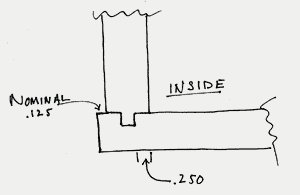
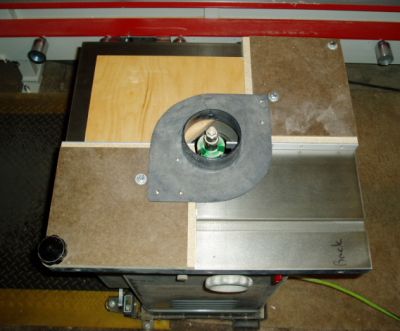
There are many ways to attach frames to boxes: butt, rabbet, dado, tongue and groove, biscuit. The most common is likely the dado. We used a t&g joint that worked well for us. The tongue was .25 x .25” and was set up .250” from the inside surface of the cabinet side. The tongue was machined on a dedicated shaper, face up so that the clearance between inside and tongue was consistent. The mating groove was machined on another dedicated machine running a .25” router bit .375” from the outside edge of the frame. That gave us a nominal .125” reveal - outside edge of frame to cabinet side face. If the cabinet side varied in thickness slightly (plywood varies) the reveal allowed for that.

Our frames were machined, sanded and sent out for finishing. Boxes were made from prefinished .75” veneer core birch and assembled after the frames were finished.

In our system, the top and bottom rails were flush with the sides and the stile was never flush except in some angled cabinets with exposed sides.

There are likely as many different (good) answers to your questions as there are cabinetmakers. The above worked well for us.


The biggest difference between face frame and frameless are the reveals when you actually construct the cabinet. With a frameless case the tops and bottoms are flush. But with a face frame or beaded inset (the bead doesn't matter, it's just a detail on the actual face), you need to recess the floor of the wall and base cabinets to lie flush or 1/16 to 1/8 lower than the lower rail on the face. Your recess will be determined simply by how wide you intend to make your rails and stiles, although sometimes the stile and rail widths are different.

I would suggest 1 1/2 all around, simply because Conestoga and many other manufacturers use this dimension as a standard.

I assume since you have gained your expertise in frameless cabinetry, you don't have the machinery and equipment needed to properly and profitably build faces. If I am correct, you will find it's much simpler to just buy faces in your dimensions than buy material and machinery to make them. The goal is to offer a face frame cabinet, so if you buy your doors, it makes perfect sense to buy your faces as well. The lead time is the same and there's no need to stock 3 or 4 different species of wood for an occasional face frame since your forte will continue to rest on your 32mm expertise.


We designed a hybrid cabinet that combines 32 mm technology and good old English face frames and inch measurements. We do flush inset all the time and use an M-42 boring machine from Laguna tools for all our holes. We set up samples of all applications on full size panels with hardware attached for the guys to reference to. We build our cabinets with fluted stiles and sometimes bead mold set into the openings.

Would you like to add information to this article?
Interested in writing or submitting an article?
Have a question about this article?


Have you reviewed the related Knowledge Base areas below?
  • KnowledgeBase: Cabinetmaking

  • KnowledgeBase: Cabinetmaking: Commercial Cabinetry

  • KnowledgeBase: Cabinetmaking: Custom Cabinet Construction

  • KnowledgeBase: Cabinetmaking: General

  • KnowledgeBase: Cabinetmaking: Installation

  • KnowledgeBase: Knowledge Base

  • KnowledgeBase: Panel Processing

  • KnowledgeBase: Panel Processing: General


    Would you like to add information to this article? ... Click Here

    If you have a question regarding a Knowledge Base article, your best chance at uncovering an answer is to search the entire Knowledge Base for related articles or to post your question at the appropriate WOODWEB Forum. Before posting your message, be sure to
    review our Forum Guidelines.

    Questions entered in the Knowledge Base Article comment form will not generate responses! A list of WOODWEB Forums can be found at WOODWEB's Site Map.

    When you post your question at the Forum, be sure to include references to the Knowledge Base article that inspired your question. The more information you provide with your question, the better your chances are of receiving responses.

    Return to beginning of article.


    Refer a Friend || Read This Important Information || Site Map || Privacy Policy || Site User Agreement

    Letters, questions or comments? E-Mail us and let us know what you think. Be sure to review our Frequently Asked Questions page.

    Contact us to discuss advertising or to report problems with this site.

    To report a problem, send an e-mail to our Webmaster

    Copyright © 1996-2009 - WOODWEB ® Inc.
    All rights reserved. No part of this publication may be reproduced in any manner without permission of the Editor.
    Review WOODWEB's Copyright Policy.

    The editors, writers, and staff at WOODWEB try to promote safe practices. What is safe for one woodworker under certain conditions may not be safe for others in different circumstances. Readers should undertake the use of materials and methods discussed at WOODWEB after considerate evaluation, and at their own risk.

    WOODWEB, Inc.
    RR4 Box 265A
    Montrose, PA 18801

    Contact WOODWEB


  •   Home » Knowledge Base » Knowledge Base Article