Integrated fillers in cabinets
Using fillers, integrated or loose. April 3, 2002
Question
For Euro style cabinets, what are the pros and cons of fillers integrated into the box or separate? I have them loose for now because they're easier to cut and scribe.
Forum Responses
From contributor T:
I don't even like the thought of integrated fillers. It's always seemed easier to scribe and fit loose fillers versus pulling the whole box out. Even flush face fillers should be loose, in my opinion. How about wall to wall framed boxes that need to be scribed in both sides? I have always assembled my face frames with one end lightly glued, ie "doweled or biscuit" enough to get through sanding and finishing, but when time to install, it can be popped loose, leaving room to slide the cabinet in and scribe the opposite stile. You push the box up tight to that side, install the case and then scribe in your loose stile. Back cut the stile and then you can rotate it into position. Of course, put some glue in the joint to keep it from shifting. This has always given me a very nice built-in look.
From contributor B:
The questioner is talking about face frame cabinets, I think. We do a lot of Euro style cabinets and always send the fillers loose to the job. I usually make several different widths so there is not as much to plane off and we don't work so hard. I have a system that works well for us, using a 1/2" thick shaped piece to hold the scribe strip in place. It also works well to hold fillers in corners where the cabinets make a turn. We allow minimum 1" for scribe strips because if the wall is out of plumb 1/4" or more we have something to work with. Plus the visual effect is better when the scribe strip goes from 3/4" to 1" than it would be if it went from 1/4" to 1/2" in the same condition.
From contributor T:
I was referring to Euro when talking about fillers, but I got off track. I might add that in the case of a flush face filler, I prefer that the filler is loose or at least removable from any cleating or fasteners attached to the back of the filler that is used to mount it to the casework. This just makes it easier to lay on a table saw and freehand to your scribe line. I then clean it up with my belt sander.
I send them loose. Mount the box and then cut a scribe and tack it in place.
From the original questioner:
We use them loose, but I have had to install some that did not send them loose. Do you guys place fillers on the bottoms of your uppers? Also, do you set back your fillers 1/8" or so or leave them flush?
We are in the middle of the debate in the shop. Looks better back but can create some other problems when you have floor to ceiling cabinets to line up.
From contributor C:
You mention installing fillers on the bottom of the upper cabinets. This has me confused - could you explain what you mean?
From contributor T:
I prefer flush with the box unless it's a flush face with a door edge detail. I also use a wood taped edge on my boxes and shelves stained to match the finish of the doors and fillers. Regarding the fillers on the bottom of the box, I generally put a finished 1/4" bottom skin underneath and run it to the wall. The face edge of the ply is concealed by an applied 1 1/2" X 3/4" light valance or face frame. We mostly get granite tops that reflect the image from underneath. If it's more on a budget job, I don't worry about it.
From the original questioner:
Contributor T has hit the nail on the head for the areas I mentioned. Our shop is held to a high standard even on the regular jobs. We place a filler between the bottom of the upper cabinet and wall. Even caulk it as well.
From contributor C:
I think I understand part of this discussion about the need for fillers for the underside of the uppers… Below is a sketch of what I think the original questioner is talking about.
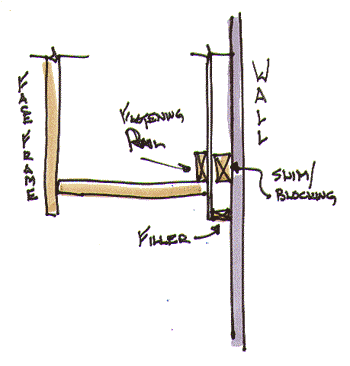
I'm not clear on what contributor T means when he says "I generally put a finished 1/4" bottom skin underneath and run it to the wall. The face edge of the ply is concealed by an applied 1 1/2" X 3/4" light valance or face frame." Can you elaborate?
From contributor B:
It seems that the questioner is talking about a filler (scribe strip) between the cabinet bottom and the end wall. Contributor T seems to be talking about adding a piece of 1/4" to the bottom between the finished end and the wall to take the place of the scribe strip. We do this when, as he says, we have a light rail and the finished end in projecting below the cabinet bottom. We use white melamine for this - the sales point is it reflects light well, but reality is also you don't have to finish this piece and white caulk cleans up the gaps easily, plus I can use up those narrow rips of melamine. The other thing is that the cabinets can be made with the bottom the same dimension as the top - easier in the shop with the top and bottom being the same material and dimension.
From contributor T:
Actually, I skin the entire cabinet bottom and run the skin beyond the wall end of the cabinet box all the way to the wall. I might add that my unfinished end partitions do not hang below the cabinet bottom. The bottoms are continuous except at the finished ends, where they hang down 1 1/2" to match the light valance. The filler at the wall end also hangs down 1 1/2". The 1 1/2" X 3/4" light valance sets back 1/8" from the face of the box and runs continuous from the finished end to the filler. The edge of the bottom skin is concealed by the light valance. I use a finished wood bottom because my customers prefer to see the reflection of wood rather than the reflection of laminate coming from their polished granite tops as they gaze down at them. In the event that the tops were Corian or laminate, where you don't have the mirrored reflection, white melamine may suffice. If you had no light valance it would change the scenario a bit and you would just be filling in that 1"+ space between the box and the wall.