Intentional Spalting
Can you treat logs with fungus and humidity to create spalting on purpose? Some say "yes," but it's more art than science. June 23, 2005
Question
I like spalting, and I was wondering if I could encourage it, perhaps by adding sugar water? Does anyone have any suggestions?
Forum Responses
(Sawing and Drying Forum)
From Gene Wengert, forum technical advisor:
The fungus that causes spalting does not feed on sugar. Even if it did, how would you get the sugar deep into the wood?
From contributor K:
If you are a new turner or wanting to supply this, the most common practice is to stand some short cross-sections directly on the ground under a nice shade tree, and wait. Coat the top end and sample it every now and then.
If you are talking about logs, I think you would be better off looking for trees that already have it in it, rather than taking a good log and allowing it to rot. There is no guarantee that you will have a nice spalted log, and more than likely you will just have a rotten worthless log.
From contributor S:
I've fooled around with spalting soft maple and sycamore. I leave it on the ground and forgo the wax. Pile some decomposing leaves and dirt around the ends of the log, and let nature have at it for a year. It worked well on the soft maple. The sycamore didn't go very deep.
From contributor B:
To contributor S: Have you ever tried to inoculate the wood by covering a log with saw dust recovered from sawing a spalted log? That's another thing on my long list of things to do, and I was wondering if anyone else had tried it before.
From contributor S:
To contributor B: I haven't tried it yet, but I did save some chainsaw chips from the maple I did with that in mind.
From contributor Y:
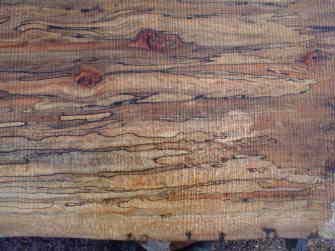
If this is what you are after, then it is more art then science. I don’t know about sugar-water, but I do flirt with Mother Nature and spalt logs all the time. I busted these up just a week or so ago.
From contributor A:
My experience with spalting (at least for soft maple and yellow birch) is to first cut the log at the end of the spring/early summer when the sap is maximized. Then let the logs stand in tall grass in the shade most of day with a high degree of humidity (closer to a woody area). Don’t forget to
roll the logs now and then.
From contributor T:
I am a wood turner and have been achieving pretty good results at controlled spaulting for the past three years. My system is to place pieces of hard maple into plastic lined pallet boxes. The boxes I use are designed to hold 1 ton of machine harvested grapes. I leave some air space around the blanks, and place a few shavings on the top. I place a plastic lid on the box and let nature take its course over the spring and summer. By the fall, the blanks have some good spalting, and are ready for turning. This system has worked well for me in northwestern PA
From contributor K:
To contributor T: Are you saying that six months is all it takes in a container? Do you leave any air space around the lid, or does it seal tight? Do you leave it in the chamber after the first six months? I was also wondering if there was any decay already in the wood when you put it in there, and how long before it was too punky to use?
From contributor C:
Is it necessary to kill the spalting?
From contributor K:
To contributor C: Keep it dry. Decay has to have moisture content somewhere above 20%.
From contributor C:
To contributor K: I live on a barrier island and the humidity never drops below 40%. Is there another way to kill it?
From contributor T:
I am a new turner, but a seasoned landscape contractor. If you are going to try spores for spaulting, use them on the same species you found them in. Many fungi are host specific. They will hang out dormant in the soil for 30 years until the right tree comes along.
From contributor T:
I came across this about producing spalted wood:
To view the file, left click the link below. To download the file, right click and choose “save target as”.
The document is in Acrobat PDF format. Download latest Acrobat Reader if required.
Producing Spalted Wood
From contributor S:
To contributor C: Spalting is stopped by drying the wood. Humidity levels are not the same as wood moisture levels, so you should be able to air dry spalting lumber enough to stop the decay. Spalt it in log form, and cut and dry.
