Joining Flex Molding to Straight Runs
Fitting curved flexible molding to straight molding can be tricky. September 24, 2009
Question
I bought curved dentil crown molding made of flexible polyurethane or some similar rubber. The molding is pre-formed to a 12" radius. The curved molding is just fine, but the cabinet also has a straight section which the molding needs to run along and I can't figure how to unbend a section of this molding.
My only idea is to heat the molding in an oven, then mount on form until it cools. Any other ideas? Would hot water allow enough flex to rebend the molding?
Forum Responses
(Cabinet and Millwork Installation Forum)
From contributor D:
Can't you get the same molding in straight pieces?
From Gary Katz, forum technical advisor:
Ditto. We never run flex on the straight runs... It's always wiggly.
From the original questioner:
The problem is that when I butted the curved piece with the straight piece, they didn't line up exactly, so there is a tiny jog in the joint. The customer wants this fixed (and it should be fixed). I do have some straight stock left and could try again, this time butting the joint in the shop instead of in the field. This would only require a bit more molding. Also the vendor said that molding is a two part
polyurethane resin that can't be re-formed after it sets up. So how do you do it?
From contributor P:
Sorry to disappoint you, but you can not straighten out a piece of pre-formed flex to use on a straight section. That's one of the hazards of having to use this crap. As you have found out, it seldom matches the straight trim. Close, but no cigar. If it isn't close enough to shape or sand to match, then you may need to order some straight trim from the same supplier that furnished the flex.
From Gary Katz, forum technical advisor:
We bring the curved trim around past the radius a little bit, then join to the straight trim. Liquid Nails or PL is a good way to help secure the curved trim. 2P10 works well at helping to secure the joint between the two so that the fit is the best you can get - you have to kind of hold the joint in place to get the best fit. Then sand and even sometimes carve to fit. That's the nature of flex. In big crown we don't use 2p10 on the joint -
Titebond is more reliable, or even PL. Flex isn't high-quality material. It's meant for speed and economy. If you put a little extra time into it, and plan your joints, you can usually make the stuff look pretty good.
From the original questioner:
And one final question: What's the best way to cut this curved crown to an inside 90 degree corner? My first effort, I used a modified jig like one used to hold crown, and then raised it up above the level of the back fence of the chop saw, then cut. Worked, but it was rather squirrelly and didn't seem entirely safe. Is there a better way? What about cutting by hand?
From contributor S:
Cutting flex molding is best done on the flat. As always, cut it a bit long and fine tune it as needed. Also make a simple jig like the one shown. It will speed up your installation process and because it holds the crown at the proper spring angle, there is no need to put any marks on the walls or ceiling.
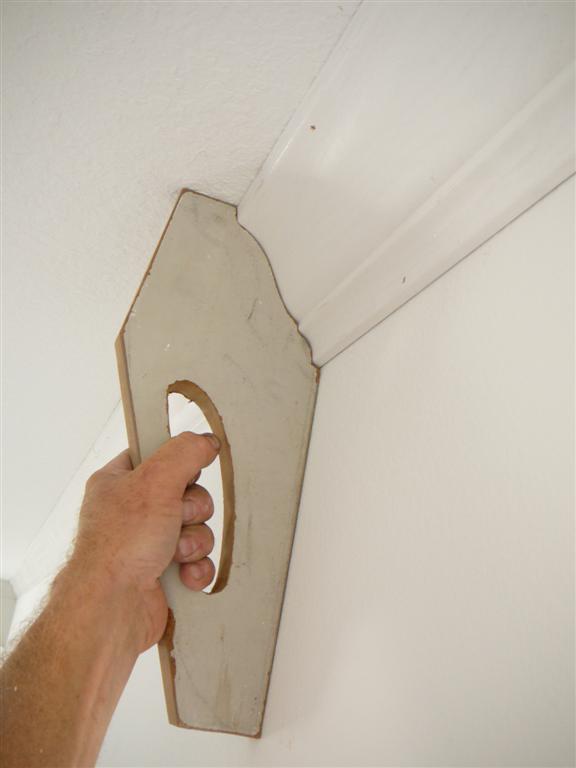
Click here for higher quality, full size image
From contributor B:
That jig's probably a little overkill for dentil mold, but I'm just guessing. ;)
From contributor S:
Now that I re-read the original post, I see that he is talking about dentil, and on a cabinet no less. Oh well, maybe next time, but I sure do love my spring jig.
