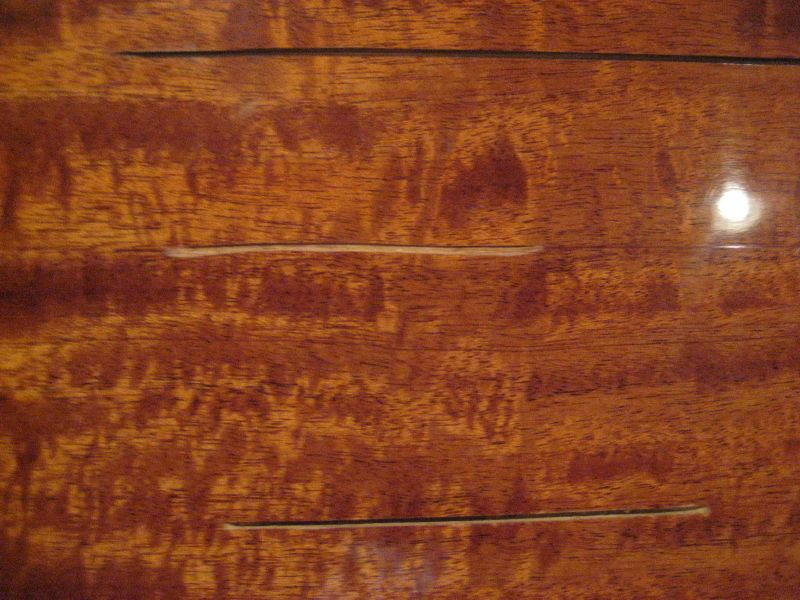
Question
I need suggestions on how to reduce lacquer checking in my crotch mahogany veneer table tops. I manufacture high-end tables using exotic veneers. I use a high solids nitrocellulose sealer and lacquer. I start by spraying lacquer with NGR stain added on the raw surface. Then grain fill with a petro-based filler, then dry one day. I apply 1-2 coats of sealer, then apply 3-4 coats of lacquer (approximately 45+ minutes between coats). Then dry for 3-5 days. Then sand, rub and polish to get a 75-90 sheen. Finish is 3.5 to 6 mils.
Periodically, checking develops weeks or months later as moisture content of veneer/core changes. The process of making the raw table top (2-ply veneer on MDF with 2-ply backing) is relatively climate-controlled. The help I am looking for is in the finishing area, not the manufacturing area. I understand there are two ways to reduce the chance of checking: 1) Apply a substance to the raw veneer top which fills the pores and locks the veneer into place, thus not allowing it to move during moisture/temperature changes, and 2) using a flexible sealer and/or top coat lacquer that will flex with the veneer as it expands and/or contracts. What is the best process and/or chemicals/additives that will help me reduce my checking problem?
Forum Responses
(Finishing Forum)
From contributor J:
I deal with this problem on a very regular basis. There is a company in Canada that has all of its products make in Italy. By the time the product, usually table tops, gets here, it has been through many different climate changes. Especially here in NYC - once it enters an 80 degree apartment, it seems to crack right away. They call me in to fix it all the time, as I am the only company that for some reason has figured this one out. I strip it down and reapply the finish using 2 part polyurethane sealer for the bottom coat. It has a high build and fills all the grain. I use the one from Milesi. I have never had a problem with checking again. They finally asked me what I was doing, and when I told them my secret, I never heard from them again. Oh well.
Also, are you positive that it's checking? It might also be shrinkage. Lacquer will continue to shrink for a month after you spray it. If you are doing high gloss, this is a big problem because what looks great today won't look great in a month. My suggestion is to try a two-component polyurethane. You can spray that up to 8 mils without worrying about finish failure. The shrinkage with a good 2kpu is very minimal in comparison to nitrocellulose lacquer. Also, the stuff rubs like a champ. You don't really need to worry about getting it hot with the buffing wheel as you would lacquer.
Some questions to consider before you blame the finish for the failure...
To start with, what is the moisture content of the veneer and substrate? Properly prepared veneer should simply not shrink that much. If the veneer and substrate are not within normal moisture levels, you are asking the finish to compensate for inadequately prepared materials.
What kind of glue are you using to apply the veneer to the substrate? If it is a contact cement or an aliphatic resin, this could be the cause of the creep in the veneer. Try a glue that has a rigid glue line like a 2 part product such as Unibond 800 or a Resorcinol.
Finally, do you coat the underside of the table? Moisture could be entering here and causing the assembly to move.
Comment from contributor A:
In my daily practical application, crotch mahogany/Khaya/Notra mahogany checking happens first. It then causes the problem of finish coat checking. Although I use 2K PU, the finish still checks and cracks later. I see that you use 2 ply veneer on MDF.
If you apply crotch mahogany veneer/45 degree movingue veneer on MDF, the veneer moving due to moisture is reduced. It is better if you use the mahogany veneer/ +45 degree movingue/-45 degree movingue. Applying an adhesive to the raw veneer top which fills the pores and locks the veneer into place is not always a good solution. This can cause a dead look finish because you use NGR stain as color base. Also, in some climate changes, it can lead to serious cracks. If applying epoxy glue, I am afraid it is unavailable because some finishes require the non-yellowing look.
After hot press, the laminated veneer panels should not be pre-sanded to remove the excessive cured glue. They should be conditioned at least thirty minutes – one hour depending on thickness of the panels. This is to avoid breaking the glue bone between veneers and MDF, especially for the ureformal dehyde glue system. The hidden defects of UF glue can reduce the stability of mahogany veneer in checking.
The total dry thickness of finish should be in 3 - 5 mils. If over 5 mils, the finish is in high risk of checking, especially finishes on sensitive moisture crotch mahogany veneer substrate.