Home » Knowledge Base » Knowledge Base Article What's New  |  Site Map 


Today's
Sponsors:


Scientific Dust Collectors

SCM Group USA, Inc.

SCM Group

SCM

SDN Contracting

Seagrave Coatings Corporation

Sears Trostel Lumber Co.

Shade Dri

Shomaker Lumber Company

ShopBot

SII Dry Kilns

Silvaris

Simantech

SIS Machinery

Nebraska Tool

NEMI

New England Kiln Drying Association

Newman Whitney

Norment and Lambert

North Pacific Lumber

Northtech Machinery

NPO BARS

Nydree Flooring

Nyle Dry Kiln Systems

O'Shea Lumber Company

Old Mississippi Brick and Heart Pine Company

OMGA, Inc.

Omnitech Systems

Onsrud Cutter

Opti-Sand

Original Saw Company

Osolnik Machinery & Supplies

Patton Cabinet Doors

Paul Saws and Systems

People Logic Software Corp.

Pinske Edge

Pioneer Lumber Company

Planit Solutions Inc.

plastiMACH

Plogic Solutions Ltd.

Pond Cove Paint

Porter-Cable

Precision Drive Systems

Precision Saw Sharpeners

Premium Specialty Hardwoods

Pricecutter.com

Prime Estimating and Software Services, LLC

Pro.Woodworker.com

Pro100

Professional Hardware & Supply Co.

Quality VAKuum Products, Inc.

Quick Machinery Company

Quickscrews International Corporation

QuickScribe

QuickWood

QuikDrawers

Quis Machinery

R&R Drummond, Inc.

R.A.W.

R.D. Billhofer Company

Rangate

Rawles-Aden Lumber Corp.

RazorGage

Reliance Building Products

Restoration Specialists

Rex Lumber Company

Riethmiller Lumber

Ritter Manufacturing Inc.

Rockler Woodworking and Hardware

Roger Shaw and Associates

Rose Machinery

Routech

Royce Ayr Cutting Tools

RT Machine Co.

Safety Speed Cut

Sand-Rite Manufacturing

Sandman Products

Saw Trax Mfg.

Sawmill and Woodlot Magazine

Schmalz, Inc.

Schultz Forming Products


WOODWEB DISCLAIMS any and all RESPONSIBILITY and LIABILITY for the accuracy and application of the information below. Readers agree to evaluate the significance and limitations of the information provided, and accept full responsibility for the application of this information. Read More ...

Would you like to add information to this article?
Interested in writing or submitting an article?
Have a question about this article?


Machining Small Radius Molding       The problem: holding a small, curved piece of brittle wood fixed while machining a small moulding profile into it. Here, pros offer various solutions. December 20, 2005

Question
I'm a professional millworker who specializes in radius work. I’ve made many complicated pieces of trim, but this time I've hit the wall. I have to make a small radius overlay moulding, 3/4 x 1 1/4, profiled on 3 sides with a 3/8 x 7/8 rabbet on the back side. There is no room for fasteners to hold it to a template. The radius is about 22", and the piece is 30" long. The piece is made of Jatoba, and is very hard and brittle. I spent most of a day with various templates trying to hold it from the backside, with the rabbet registering the part to the template and a screw at each end to hold the blank. That was dangerous though.

Has anyone had much luck using hot glue to hold such small parts to templates for profiling? Laminating the billet to be machined is an option as there is too much cross-grain at the ends of each piece, and it’s very explosive. Any advice would be greatly appreciated.

Forum Responses
(Architectural Woodworking Forum)
From contributor F:
I recently made some faux bamboo moulding and one lathe turned blank yields two pieces of moulding so instead of turning one piece blanks and then sawing them in half, I made "half blanks" and used some good quality double sided tape in between the two halves. If you put clamp pressure on two sided tape it develops a strong reversible bond. Two side tape plus your end screws might work.


From contributor D:
Almost any molding has a flat surface on one of the four sides. We make this flat side fat - bigger - so we have a handle to support the cutting pressure and to hold onto (hands, templates, clamps, etc).

We do curve parts all the time where the outside or inside is left wide, while profiling goes onto the opposite edge, and/or top or bottom. With little curve moldings - 11/16 x 11/16, we make the part double thick or thicker - 2-1/2 x 11/16, profile, then saw apart on the band saw or even the table saw.

Often, a part is made in two or three pieces to complete the arch to avoid that attention getting end grain. A one piece 180 will have a lot of cross grain movement, and will likely split if nailed- even with pre-drilling. Even if we could get a 180 degree arch, 6" radius, in one piece of wide stock, we'd still break it into two pieces at 90 degrees plus for shaping/safety.
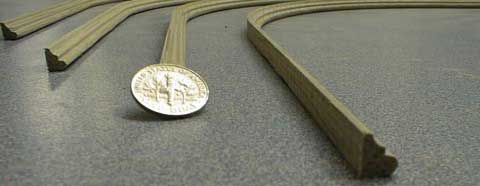


From contributor H:
Contributor D is right. Segmented construction is often required. The widest board we'll work with is about 8", and we prefer to stay at 2" to 3" wider then the final moulding. Jointing tiny mouldings can be difficult, but some method can usually be devised.


Click here for full size image


From contributor G:
Similar to Contributor F’s method you might try gluing the Jatoba to the template with paper between the two pieces. It usually splits apart easily when it’s done.


From contributor F:
Contributor G is correct that my "clamped double sided tape" method is a substitute for the "paper joint" method. I decided to try the two sided tape because the thought of scraping of mucho lineal feet of paper and glue was not very appealing.


From contributor H:
When we need to do these as suggested with extra thickness, rather then glue or tape on extra material we just run them out of thicker wood. Then they can be sent through the Timesaver with 60 grit to remove the excess thickness after profiling.


From contributor B:
Here's something I've done a few times - maybe you can get stock that's more "user friendly" by doing the moulding in two (or more) pieces. Also, like Contributor D suggested - leave them big if need be and cut to size last.


From contributor J:
To contributor H: Is that a dime on that moulding?


From contributor H:
Yes, it's a dime. The mouldings were cut with custom router bits on the CNC. It was segmented construction if I remember correctly.


From the original questioner:
I ended up using double sided tape, seating it well with a rubber mallet right before running it.


Have you reviewed the related Knowledge Base areas below?
  • KnowledgeBase: Knowledge Base

  • KnowledgeBase: Architectural Millwork

  • KnowledgeBase: Architectural Millwork: Custom Millwork

  • KnowledgeBase: Architectural Millwork: Moldings

  • KnowledgeBase: Solid Wood Machining

  • KnowledgeBase: Solid Wood Machining: General


    Would you like to add information to this article? ... Click Here

    If you have a question regarding a Knowledge Base article, your best chance at uncovering an answer is to search the entire Knowledge Base for related articles or to post your question at the appropriate WOODWEB Forum. Before posting your message, be sure to
    review our Forum Guidelines.

    Questions entered in the Knowledge Base Article comment form will not generate responses! A list of WOODWEB Forums can be found at WOODWEB's Site Map.

    When you post your question at the Forum, be sure to include references to the Knowledge Base article that inspired your question. The more information you provide with your question, the better your chances are of receiving responses.

    Return to beginning of article.


    Refer a Friend || Read This Important Information || Site Map || Privacy Policy

    Letters, questions or comments? E-Mail us and let us know what you think. Be sure to review our Frequently Asked Questions page.

    Contact us to discuss advertising or to report problems with this site.

    To report a problem, send an e-mail to our Webmaster

    Copyright © 1996-2008 - WOODWEB ® Inc.
    All rights reserved. No part of this publication may be reproduced in any manner without permission of the Editor.
    Review WOODWEB's Copyright Policy.

    The editors, writers, and staff at WOODWEB try to promote safe practices. What is safe for one woodworker under certain conditions may not be safe for others in different circumstances. Readers should undertake the use of materials and methods discussed at WOODWEB after considerate evaluation, and at their own risk.

    WOODWEB, Inc.
    RR4 Box 265A
    Montrose, PA 18801

    Contact WOODWEB