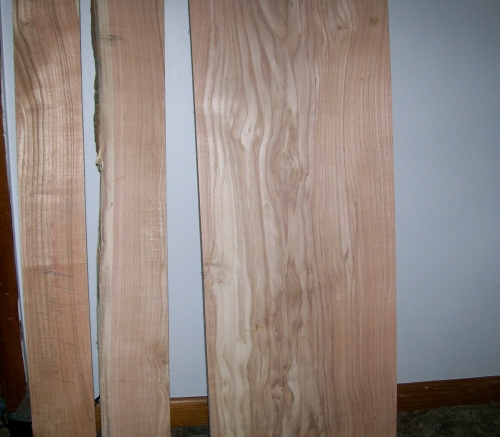
Question
I recently came across some good size 18-24" Mesquite trees and have taken a couple of orders for mantles. I cut one with my Lucas mill, and after leaving the scraps laying outside for three or four days I notice little or no cupping, warping, or bowing. My questions are actually many, and I wouldn't mind hearing from as many people as possible who have experience cutting Mesquite. Will my mantles, if sawn green, move much afterwards? The cut faces are a good 14-15 inches, and I left the front round with the bark on. Does leaving an uncut face help minimize movement? Would it be beneficial to cut the trees and let the logs age a while before sawing?
Forum Responses
(Sawing and Drying Forum)
From contributor A:
You’re in luck with Mesquite as it is more than likely one of the most stable woods. I have a friend in TX who has cut a lot of it and uses it in his woodworking business. Its stabililty is based on very slow growth in adverse conditions. You should notice some voids within the logs. This is normal and not considered as a defect by woodworkers. It can be tough on your blades as it can have lots of trapped sand. The size logs you have are very large compared to my friend’s. He currently has 4 or 5 hundred logs. Most range from 6 to 9 in. Also, you can wait forever to mill them. He has milled logs that were several years old with no problems. He builds fine furniture with it only air dried for a short time.
Watch out for Powder Post Beetles and other bugs. They love mesquite, especially the sapwood and a few layers in. Use a kiln to at least kill the bugs, and if you don't have a kiln, make one that will at least take you to about 140 degrees for a few hours at the center of the lumber. By the way, letting the logs age just gives the bugs longer to eat them.
Here are a few things I have learned - firsthand and from reading. Because the fibers that make up Mesquite are very short, the shrinkage is the same in both dimensions for nearly all boards. Of the hundreds of pieces I've handled I only remember one bowed board. And checking will be minimal. Good and bad. No movement to speak of but a lot of separation along growth rings (shake) and some just downright cracking in any direction. We really don't have much experience with thick pieces like mantles as we have only cut one so far. I would imagine that if a piece were going to crack it would be more likely in it. I know our pecan mantles sure do over pecan boards.
Whenever you cut a live Mesquite the wood releases a chemical that is like a dinner bell to borers, so mill the wood right away. We have cut a big Mesquite that had been standing dead for over twenty years and the wood was fine other than a little color degrade. We now have a pile of smaller stuff that was cut live several months ago and on a calm day you can hear the borers working from ten feet away. Air drying or kiln drying the wood will get it dry enough that the big borers (locust borer) won't tackle it but not so for powder post. Get rid of the sapwood and don't make anything with the sapwood left on. That bright yellow sapwood would sure be pretty as a contrast to the red heartwood but I have yet to hear about a sure prevention for powder post in it. You can kiln dry a board with sapwood, let it sit in the open for a couple months and it will take up enough moisture from the air that the critters will be back. I have had that happen several times.
If you can't mill logs right away it's not a tremendous loss as the bugs don't go very far into the wood and any damage can be cut out. And some people like the "rustic" borer holes, but having a borer emerge in their living room might get them upset. The small stuff I mentioned will be cut and either kiln dried or frozen to kill any borers and cut into picture frames. People love it for their western prints. Just use something to keep the logs off the ground as we have cut some Mesquite that was down for a year on ground that could get wet and it was mostly unusable.
You will see a lot of bark pockets and voids along with the cracks. Going along with the rustic character most people either leave them as is or fill with epoxy and don't try to cover them up. If shake is an appearance problem then you can use wood flour cement which is mixed with mesquite sawdust and worked into the cracks and then sanded off and if it's done right is barely noticeable. I have a friend who makes Mesquite flooring that uses it and it will cover up to about an eighth inch void.