Today's
Sponsors:


Firth Maple Products

Flap-Wheels.com

FormWood Industries

Freeborn Tool Company

Freedom Machine Tool

Fuji Spray

Furniture Medic

Gary M. Katz

Gemini Coatings

Giben

Goby Walnut Products

Graco, Inc.

Great Lakes Kiln Drying Association

GreCon

Green Valley Wood Products

GUHDO

Hanson and Leja Lumber Company

Hardwood Council

Hardwood Store of N.C. Inc.

Haste Engineering

Heartwoods, LLC

Her-Saf

Hermance Machine Company

Hi-Knoll Cedar, John Langstroth Consulting

Historical Plus Wood

Centre for Advanced Wood Processing

Charles G.G. Schmidt Co.

Chicago Dowel Company, Inc.

Classic Designs by Matthew Burak | tablelegs.com

Clear Lake Lumber

Clear Vue Cyclones

CNCROUTERSTORE.com

Colonial Saw

Construction Programs and Results

Cook's Saw Mfg.

Coulee Region Hardwoods

Country Saw & Knife

CP Adhesives

CSH Custom Service Hardware Inc.

CustomCabinetSoftware.com

Cutlist Plus

Denray Machine

Diaz Manufacturing Company

Dispoz-A-Blade

Doucet Machineries Inc.

DustCollectionBags.com

Eagle Bay Cabinet Doors and Drawers

Eagle Machinery and Repair Co.

ECabinet Systems

Edge-It Edgebanding

Electrophysics

Elias Woodwork & Manufacturing

Endeavor Hardwoods

Erecta-Rack

ETK International

EuroButt II

EX-FACTORY

Excel Dowel and Wood Products Inc.

FastCap

Felder USA

Festool

Finish Systems


Mobile Machinery and Power Cords

      Shop owners exchange ideas for putting tools on wheels and feeding power from overhead. August 8, 2005

Question
We have recently improved our shop with a space saving idea. For a bunch of wonderful reasons, our chop saw needs to be moveable from day to day. The problem we were having was that there was no great spot from which to feed the electrical cord. What was acceptable in some circumstances was a hindrance in others.

We would find ourselves having to compete with this cord when moving people or carts through this district. The solution, as you see, was very simple. We affixed a mast to the chop saw and now feed the electricity from the ceiling. A simple loop hangs down and allows about a 20 foot radius when quickly moving the chop saw in and out and around the zone. It's amazing to see the amount of free floor space when you don't have to dodge a cord.

What I would like is some help with the castors. I have some fairly expensive castors on another cart that theoretically lock when a lever is engaged. The problem is that sometimes fine sawdust gets between the lock and the wheel and the cart still moves.

I would like to find something similar to a library stool. I would like the castor to engage when necessary and completely disappear when necessary. I remember seeing some a hydraulic tool here recently, but I hope to find something a little simpler. Does anyone have any ideas?

Below is a drawing of the setup we have right now.
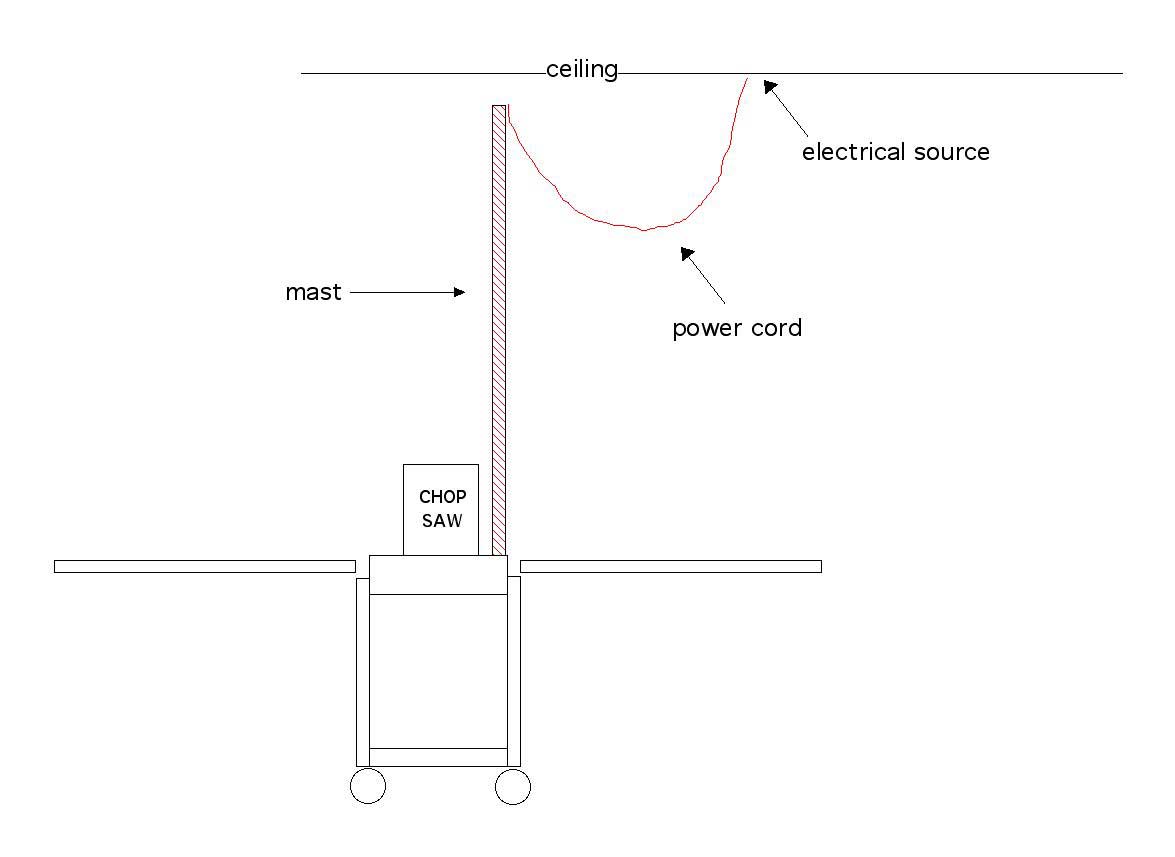


Click here for full size image

Forum Responses
(Cabinetmaking Forum)
From contributor F:
Is your cart so heavy that you could not put a couple of 2x 4s under the cart so the casters just clear the floor? I wouldn’t cost anything.


From contributor J:
I believe this is the hydraulic tool to solve your problem below.

http://www.rossdesign.net/Hydrauliccasters.asp


From contributor T:
Have you thought about installing a thick rubber or brush wiper above each wheel?


From contributor S:
We came to the same solution with the power cords in our shop. We zip-tied our power cords to shower curtain hangers and strung them up with heavy duty picture hanging wire. We have 4' dangling of power cord off the end, and that gives us plenty of play.

We also have our chop saws (and planers, jointers, table routers, etc.) on rolling carts and had the same problem with movement. We attached small push-type toggle clamps vertically to the fronts and/or sides of the carts along the bottom edge (aimed at the floor) so that when they are engaged they push the cart up off the floor 1/4" or so. It holds all our carts steady, not perfectly, but close enough.

I know I haven't explained this well enough, so here's a link with both large and small push-type toggle clamps from Rockler. Once you see the picture, you'll get what I mean.

http://www.rockler.com/ecom7/product_details.cfm?offerings_id=2150


From contributor J:
I would suggest that you put your casters on one end on the side so they are just clear of the floor. On the other side, put two handles to lift that end. When the end is lifted so the casters hit the floor, just wheel the saw to the new spot, then lower the side to lift the casters off of the floor and you’re done.


Would you like to add information to this article?
Interested in writing or submitting an article?
Have a question about this article?


Have you reviewed the related Knowledge Base areas below?
  • KnowledgeBase: Knowledge Base

  • KnowledgeBase: Cabinetmaking

  • KnowledgeBase: Cabinetmaking: General


    Would you like to add information to this article? ... Click Here

    If you have a question regarding a Knowledge Base article, your best chance at uncovering an answer is to search the entire Knowledge Base for related articles or to post your question at the appropriate WOODWEB Forum. Before posting your message, be sure to
    review our Forum Guidelines.

    Questions entered in the Knowledge Base Article comment form will not generate responses! A list of WOODWEB Forums can be found at WOODWEB's Site Map.

    When you post your question at the Forum, be sure to include references to the Knowledge Base article that inspired your question. The more information you provide with your question, the better your chances are of receiving responses.

    Return to beginning of article.


    Refer a Friend || Read This Important Information || Site Map || Privacy Policy || Site User Agreement

    Letters, questions or comments? E-Mail us and let us know what you think. Be sure to review our Frequently Asked Questions page.

    Contact us to discuss advertising or to report problems with this site.

    To report a problem, send an e-mail to our Webmaster

    Copyright © 1996-2013 - WOODWEB ® Inc.
    All rights reserved. No part of this publication may be reproduced in any manner without permission of the Editor.
    Review WOODWEB's Copyright Policy.

    The editors, writers, and staff at WOODWEB try to promote safe practices. What is safe for one woodworker under certain conditions may not be safe for others in different circumstances. Readers should undertake the use of materials and methods discussed at WOODWEB after considerate evaluation, and at their own risk.

    WOODWEB, Inc.
    335 Bedell Road
    Montrose, PA 18801

    Contact WOODWEB


  • WOODWEB - the leading resource for professional woodworkers


      Home » Knowledge Base » Knowledge Base Article
